

 プレビュー
プレビュー
 シェアする
シェアする シェアする
シェアする
 詳細を見る
詳細を見る

 ダウンロード
 似ている作品
 X線調査
X線調査 スライドショー
Twenty four Lines


 詳細を見る
詳細を見る
手描き油彩複製画
当社のアーティストが、お客様のご希望のサイズと額縁に合わせて、キャンバスに手描きで制作する油彩画です。 ( プリント版に切り替え 画像に切り替え)




































作品のオリジナル比率に合わせた、当店の規定サイズからお選びください。

特定のフレームやスペースに合わせて、ご希望のサイズをご入力いただけます。選択されたサイズが元の画像の比率と異なる場合、アートワークをトリミングするか、手描きで要素を追加して絵画を拡張いたします。デジタルモックアップ を制作し、制作開始前にご確認(承認)をいただきます。
画面上のプレビューは、実際のトリミングや拡張を正確に反映しているものではありません。最終的な構図は、モックアップによってのみ正確にご確認いただけます。
カスタムサイズもご利用いただけますが、元の比率を維持するためには、あらかじめ用意されたリストからサイズを選択することをお勧めいたします。
ご注文後、OriginalUniqueArt.com チームより詳細な指示をお送りするとともに、仕上がりイメージ(モックアップ)をご提供いたします。


 ガラスオプションは、110cm未満のサイズでのみご利用いただけます。

Twenty four Lines
複製技法
複製画のサイズ
-


合計金額
$ 300
アーティストの略歴
The Poetry of Motion: The Life and Legacy of George Rickey
George Rickey stands as a singular figure in American sculpture, recognized for his groundbreaking approach to kinetic art—a fusion of geometric abstraction and mechanical movement that captivated audiences throughout the mid-century. Born in South Bend, Indiana, in 1907, Rickey’s formative years were marked by an early fascination with simple mechanisms, specifically the conical latches found in historic buildings, which instilled a lifelong preoccupation with paradoxical design principles. This intuitive understanding would become a cornerstone of his artistic vision, informing countless sculptures that defy conventional notions of static form and inviting viewers to contemplate dynamism within seemingly austere structures. His childhood was deeply influenced by the industrial atmosphere of Glasgow, Scotland, where his father, an engineer for the Singer Sewing Machine Company, fostered a spirit of innovation. Growing up near the River Clyde and learning to sail around the outer islands provided Rickey with a firsthand education in the fluid, unpredictable rhythms of nature—a sensory foundation that would later manifest in his wind-driven masterpieces.From Canvas to Kinetic Engineering
The trajectory of Rickey’s career was far from linear, evolving from the static world of painting into the complex realm of mechanical engineering. After studying at Trinity College Dublin and Balliol College Oxford, he ventured into Paris in 1926, immersing himself in the avant-garde energy of the Académie L'Hote and Académie Moderne. These years exposed him to the principles of Constructivism, yet his early professional output was rooted in much more traditional mediums; during the 1930s and early 40s, he worked as a painter and muralist, even completing commissions through the WPA. It was not until his service in the Army Air Corps during World War II that a dormant aptitude for mechanics resurfaced, fundamentally altering his artistic trajectory. He began to move away from the fixed image toward an exploration of movement itself, seeking to capture what he called the "waving of branches and the trembling of stems." Unlike many of his contemporaries who relied on motorized components, Rickey sought a more organic connection to the environment, engineering his stainless steel forms to react to the most delicate alterations in wind currents.The Architecture of Air and Steel
Rickey’s mature work is characterized by a profound elegance, where heavy, industrial materials like stainless steel are transformed into lyrical, weightless entities. He often referred to his creations as "useless machines," a playful nod to their lack of utilitarian function, yet they served a vital purpose in redefining the relationship between sculpture and space. His sculptures, such as the celebrated Peristyle series, utilized the principle of the pendulum to create a dialogue between gravity and air. In these works, metal blades were precisely calibrated to "talk" to one another through motion, moving in a slow, deliberate, yet entirely unpredictable dance that ensured they would never collide. This mastery of balance allowed his large-scale installations to reshape landscapes, turning public squares and museum gardens into active stages where light, shadow, and wind perform in constant flux.A Lasting Impression on Modernism
The historical significance of George Rickey lies in his ability to bridge the gap between the rigid geometry of abstraction and the ephemeral beauty of the natural world. While he shared much common ground with legends like Alexander Calder, Rickey carved out a unique niche by eschewing the motorized for the atmospheric, focusing less on the physical shape of the object and more on the patterns of its movement. His dedication to "movement as means" earned him international acclaim and prestigious honors, including the Lifetime Achievement Award from the International Sculpture Center in 1999. Today, his legacy persists in major museum collections across North America, Europe, and Asia, where his gleaming, burnished surfaces continue to catch the light and invite a sense of wonder. Through his work, the viewer is reminded that art is not merely something to be observed in stillness, but a living, breathing participant in the ever-changing environment.
George Rickey
1907 - 2002 , United States of America
基本情報
- Artistic Movement Or Style: Kinetic Sculpture
- Artists Or Movements Influenced By This Artist: ['Wind Sculpture']
- Artists Who Influenced This Artist: ['Constructivism']
- Date Of Birth: June 6, 1907
- Date Of Death: July 17, 2002
- Full Name: George Warren Rickey
- Nationality: American
- Notable Artworks:
- The Departure
- Twenty four Lines
- Place Of Birth: South Bend, United States
関連記事

現代インテリアデザインにおける黒、白、グレー抽象の魔力:装飾と空間の深化
ホテルデザインに最適な黒、白、グレーの抽象画選びをサポート。色彩心理学に基づいた空間演出から、OriginalUniqueArt.comのカスタムアートまで、専門家が洗練されたインテリアを実現します。

Abstract Harmony: Achieving Interior Cohesion Through Textural Resonance Between Art, Furniture, and Material Palettes
Discover how to create harmonious interiors with expert art curation tips! Learn to balance abstract art, furniture & textures for a cohesive, emotionally resonant space. Elevate your home's aesthetic today.

断片化された視点、統一された空間:モダンヴィラデザインにおけるキュビズムにインスパイアされたアートの統合—美的革新と法的考察
モダンヴィラデザインにおけるキュビズムアートの統合を専門家が解説。美的革新と法的側面から、高級住宅のアート選定、投資価値、著作権対策まで網羅。OriginalUniqueArt.comで理想の空間を実現。

The Enduring Allure of Marble in Art History: From Classical Sculpture to Modern Abstraction
Explore the captivating history of marble sculpture from ancient Greece to modern art. Discover renowned artists like Canova & Michelangelo, carving techniques, and investment insights at OriginalUniqueArt.
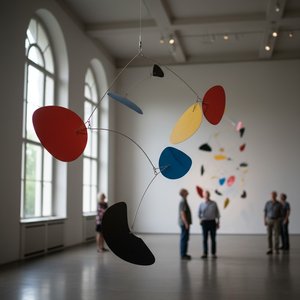
Alexander Calder: Kinetic Sculpture, Mobile Art & the Poetics of Chance
Explore the revolutionary world of Alexander Calder's kinetic sculptures & mobiles. Discover insights for collectors, acquisition advice, and the enduring legacy of this modern master. Expert analysis & art valuation.

