プリント版に切り替え
 続きを読む
続きを読む







































 いずれかの辺が105 cm(約41インチ)を超えるアートワークまたは複製画の場合、フレームは分解されたキットの状態でお届けいたします。この方法は、輸送中の破損を防ぎ、安全に配送するために採用しております。


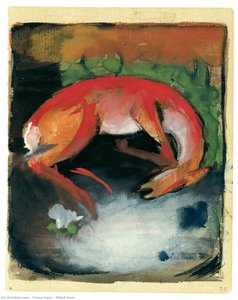
A Moment of Serenity: Unpacking Franz Marc's "The Monkey"
Franz Marc’s 1912 painting, “The Monkey,” isn’t merely a depiction of an animal; it’s a profound meditation on innocence, nature, and the very essence of being. Created during a pivotal period in his career as a leading figure of German Expressionism, this work transcends simple representation to become a vibrant embodiment of Marc's deeply held spiritual beliefs. The painting immediately captivates with its bold palette – a riot of reds, yellows, and blues that seem to pulse with an inner life. Marc masterfully employs loose, expressive brushstrokes, creating a dynamic surface that feels both energetic and profoundly calm. It’s a deliberate contrast: the monkey, positioned centrally within a swirling backdrop, exudes a sense of serene contemplation, while the surrounding environment vibrates with restless movement.

(Image: Franz Marc, “The Monkey,” 1912)
Expressionist Roots and the Language of Color
To fully appreciate "The Monkey," it’s essential to understand Marc's place within the Expressionist movement. Emerging alongside artists like Wassily Kandinsky, Marc sought to move beyond purely representational art, aiming instead to convey inner emotions and subjective experiences. He believed that color held a spiritual significance, capable of communicating profound truths about the world and humanity’s relationship with it. Marc's use of color isn’t arbitrary; each hue is carefully chosen to evoke specific feelings – the warm reds suggesting vitality and passion, while the blues and greens hint at tranquility and connection to nature. This deliberate manipulation of color aligns perfectly with Expressionist principles, prioritizing emotional impact over photographic realism.
Symbolism: The Monkey as a Vessel for Meaning
The monkey itself is laden with symbolic weight. Within Marc’s oeuvre, animals frequently served as metaphors for human qualities and spiritual concepts. Here, the monkey embodies innocence, curiosity, and a primal connection to the natural world. Some scholars interpret the scattered figures in the background – resembling birds or other creatures – as representing the interconnectedness of all living beings within an ecosystem. The painting can be seen as a visual representation of Marc’s belief that humans are fundamentally part of nature, not separate from it. Furthermore, the monkey's posture—sitting calmly amidst the energetic backdrop—suggests a state of detached awareness, perhaps reflecting Marc’s own spiritual quest for understanding.
A Timeless Legacy: Reproduction and Beyond
“The Monkey” continues to resonate with viewers today, offering a glimpse into the artistic vision of a truly unique artist. Franz Marc's work stands as a testament to the power of art to evoke emotion, stimulate contemplation, and explore profound philosophical questions. OriginalUniqueArt.com offers meticulously crafted, hand-painted reproductions that faithfully capture the vibrancy and spirit of this iconic painting. Owning a reproduction allows you to bring this captivating artwork into your home or office, transforming any space into a sanctuary for artistic inspiration. Explore the details and secure your own high-quality reproduction of “The Monkey” at OriginalUniqueArt.com – a journey into color, spirit, and the enduring legacy of Franz Marc.
よくあるご質問
「The Monkey」の作者と制作年はいつですか?
フランツ・マルクによる「The Monkey」は、1912年に制作されました。
「The Monkey」の油彩複製画を注文することはできますか?
フランツ・マルク作「The Monkey」の手描き複製画は、こちらの手描き油彩複製画ページからご注文いただけます:リネンキャンバスに手描きされた油彩複製画(受注制作)
「The Monkey」は、Expressionismを代表する有名な作品でしょうか?
フランツ・マルク作「The Monkey」は、Recognizedに分類され、Expressionismの様式に属しています。





 設置イメージを確認
 送る
送る シェア
シェア
 詳細情報
詳細情報 ガイドを表示

 画像をダウンロード
 似ている作品
 X線調査
X線調査 スライドショー
 Q&A
Q&A 統計情報
統計情報