プリント版に切り替え
 続きを読む
続きを読む







































 いずれかの辺が105 cm(約41インチ)を超えるアートワークまたは複製画の場合、フレームは分解されたキットの状態でお届けいたします。この方法は、輸送中の破損を防ぎ、安全に配送するために採用しております。


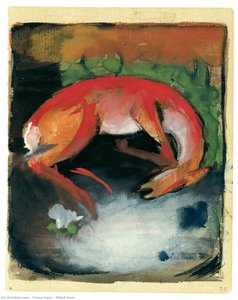
A Moment of Tranquility Captured in Color: Exploring Franz Marc’s “Sleeping Deer”
Franz Marc’s “Sleeping Deer,” painted in 1913, stands as a cornerstone of German Expressionism—a movement that sought to convey inner emotions and spiritual truths through bold artistic expression. More than just a depiction of an animal resting peacefully, this artwork embodies Marc's profound belief that art could serve as a conduit for accessing the sacred, reflecting his formative engagement with theology alongside his burgeoning fascination with the natural world.
The Style of Cubism – A Revolutionary Approach
- Cubist Influence: Marc’s stylistic choices align closely with the principles of Cubism, pioneered by Pablo Picasso and Georges Braque. Unlike traditional representational art that strives for accurate depiction, Cubism fragments objects into geometric planes, presenting multiple perspectives simultaneously.
- Simplified Forms: Observe how Marc reduces the deer's form to simplified shapes—primarily rectangular and triangular—emphasizing its essence rather than meticulous detail. This deliberate distortion contributes to the artwork’s expressive power.
Technique and Color Palette – Expressions of Emotion
Marc employed a tempera technique, known for its luminosity and durability. The vibrant hues he utilized—primarily reds, yellows, and blues—were not merely decorative; they functioned as symbolic representations of inner states. Red signifies passion and vitality, yellow embodies optimism and enlightenment, while blue evokes serenity and contemplation. These colors intertwine to create a harmonious yet dynamic visual experience.
Historical Context – The Blaue Reiter Circle and Spiritual Quest
“Sleeping Deer” emerged from the influential Blaue Reiter (“Blue Rider”) circle—a group of artists who championed abstraction as a means of conveying spiritual ideas. Marc, along with Wassily Kandinsky and Alexej von Jawlensky, believed that art could transcend materialism and connect directly to the divine. This conviction fueled their experimentation with color and form, aiming for an emotional resonance that surpassed mere visual representation.
Symbolism – Deer as Embodiment of Innocence and Spiritual Harmony
The deer itself holds significant symbolic weight within Marc’s oeuvre. Often interpreted as representing innocence, purity, and spiritual harmony—themes central to Christian iconography—the animal embodies Marc's desire to depict the sublime beauty of nature imbued with divine presence. Its posture—resting calmly on its paws—further reinforces this notion of tranquility and repose.
Emotional Impact – A Window into Inner Reflection
"Sleeping Deer" invites viewers into a meditative state, prompting contemplation on themes of peace, vulnerability, and the interconnectedness of life. Marc’s masterful use of color and form transcends mere visual observation, tapping into deeper emotional currents—a testament to his enduring legacy as one of Expressionism's most visionary artists.
よくあるご質問
「Sleeping Deer」は、何年に、どの様式(ムーブメント)で制作されたものですか?
フランツ・マルク作「Sleeping Deer」は1912年に制作されたもので、German Expressionismに属します。
フランツ・マルク作「Sleeping Deer」 の色彩的な特徴は何ですか?
フランツ・マルク作「Sleeping Deer」はEarthyのパレットを使用しており、Rosy Brown (#cdb286)が基調となっています。
フランツ・マルク作「Sleeping Deer」の解説ページはありますか?
フランツ・マルク作「Sleeping Deer」のガイドページでは、印刷して活用できる2枚構成のファクトシートを提供しています。これには、作品とその詳細情報をまとめたデータテーブル、アーティストの生涯における時代背景を示す年代チャート、同アーティストによる他の作品、測定されたカラーパレット、そしてそのままコピーして使用できる4つの形式の引用文献情報が含まれています。
More about this painting
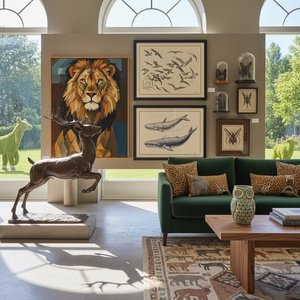
 設置イメージを確認
 送る
送る シェア
シェア
 詳細情報
詳細情報 ガイドを表示

 画像をダウンロード
 似ている作品
 X線調査
X線調査 スライドショー
 Q&A
Q&A 統計情報
統計情報