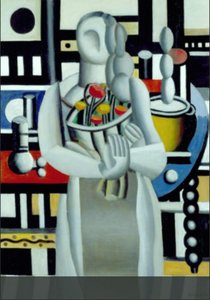
油彩画を購入
 Stalingradの詳細







































 いずれかの辺が105 cm(約41インチ)を超えるアートワークまたは複製画の場合、フレームは分解されたキットの状態でお届けいたします。この方法は、輸送中の破損を防ぎ、安全に配送するために採用しております。


The Creation of Stalingrad by Fernand Léger
In 1924, Fernand Léger turned his gaze toward the heavy, rhythmic pulse of industrial labor. His painting, Stalingrad, emerged from this fascination with the intersection of man and machine. The canvas captures a moment of intense industrial collaboration, where the human form and the mechanical tool become inseparable. It is a scene of construction and movement, a study of how steel and muscle work in tandem to reshape a landscape.
The work is rooted in the language of Cubism, utilizing fragmented planes to organize the chaos of the machine age. At the same time, it carries the simplified, direct clarity often associated with Naïve Art. This duality allows the subject matter to remain grounded. The heavy machinery and the workers are not mere decorations; they are the structural bones of the composition. Fernand Léger sought to translate the energy of the modern era into a visual reality of intersecting lines and solid forms.
Steel pistons and heavy cranes define the space. The work exists in the tension between the organic and the manufactured. It is a quiet record of strength.
Artistic Movements and Stylistic Influences
The canvas is anchored in the fractured logic of Cubism. It follows the path cleared by the pioneers of the movement, breaking the world into a sequence of overlapping planes and geometric shards. This is not a soft dissolution of form, but a structural dismantling. The artist’s own hand developed a specific variation of this language, often called Tubism, which emphasizes cylindrical, tubular shapes. These rounded, mechanical volumes replace the organic curves of the natural world with the hard, rhythmic precision of the machine age.
There is a heavy, industrial pulse within these shapes. The work looks toward the future, acting as a forerunner to the Pop Art movement that would emerge decades later. By treating modern, mechanical subjects with such directness, the artist bridges the gap between fine art and the objects of a consumer society. The painting captures a moment where the human figure and the machine become inseparable parts of a single, moving mechanism. Steel and shadow define the new reality.
Q&A
Stalingradは手描きですか、それともプリントですか?
手描きによる制作:熟練した画家が、リネンキャンバスに油彩でStalingradを模写します。
Stalingradのサイズはどれを選べばよいですか?
原画のサイズは32 x 50 cmです。 サイズは29.9 x 33.4 cm (¥39580)から217.2 x 242.6 cm (¥311096)まで展開しております。こちらのページ内の表に、主な工程とそれぞれの価格を記載しています。
配送にはどのくらいの時間がかかりますか?
配送には4〜5週間を要し、世界中どこでも速達便にて無料でお届けいたします。また、本ページではお急ぎの方向けの特急制作オプションもご用意しております。商品は、理由を問わず100日以内であれば全額返金での返品が可能です。
フェルナン・レジェはStalingradの制作にどのような画材(メディア)を使用しましたか?
Oil On Canvas
 設置イメージを表示

 シェアする
 シェアする
 詳細を見る
 解説シート


 ダウンロード
 似ている作品
 X線調査
 スライドショーを表示
 Q&A

 統計情報