手描き複製画を注文する
 詳細を表示







































 いずれかの辺が105 cm(約41インチ)を超えるアートワークまたは複製画の場合、フレームは分解されたキットの状態でお届けいたします。この方法は、輸送中の破損を防ぎ、安全に配送するために採用しております。


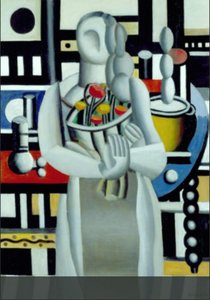
A Mechanical Vision: Decoding Fernand Léger’s ‘Composition’
Created in 1924, this striking work by French artist Fernand Léger is a powerful example of his distinctive “Tubism” – a unique offshoot of Cubism. The artwork presents a tightly cropped and detailed depiction of complex machinery, rendered with meticulous precision in sepia tones. It’s an image that immediately draws the eye, inviting contemplation on themes of industry, modernity, and the beauty found within mechanical structures.Style & Technique: The Essence of Tubism
Léger's style is instantly recognizable for its emphasis on cylindrical forms and geometric shapes – hence the term “Tubism.” ‘Composition’ exemplifies this approach perfectly. Notice how circles, rectangles, and angled planes interlock to create a sense of depth and complexity. The artist masterfully employs hatching and cross-hatching techniques to build form and texture, giving the impression of solidity and weight despite the two-dimensional surface. This isn't simply a drawing; it’s an exploration of volume and space achieved through line work alone. The monochromatic palette further emphasizes the focus on structure and form, reminiscent of technical illustrations or blueprints.Historical Context: Post-War Modernity
Fernand Léger’s artistic development was profoundly impacted by his experiences during World War I. Witnessing the power and precision of machinery in wartime led him to embrace industrial motifs as subjects for his art. ‘Composition’ reflects this shift, moving away from traditional representational painting towards a celebration of the modern, machine age. The 1920s were a period of rapid technological advancement and social change, and Léger's work captures the spirit of optimism and dynamism that characterized this era. He was part of the Puteaux Group (Section d’Or), exploring new ways to represent reality in a post-Cubist world.Symbolism & Interpretation: Beyond the Gears
While seemingly abstract, ‘Composition’ is rich with symbolic potential. The intricate machinery can be interpreted as representing the interconnectedness of modern life, the power of industry, or even the human body itself – reduced to its essential mechanical components. The absence of any human figures encourages viewers to focus on the machine as an entity in its own right. It prompts questions about humanity’s relationship with technology and the impact of industrialization on society.Emotional Impact & Aesthetic Appeal
Despite its subject matter, ‘Composition’ isn't cold or sterile. The meticulous detail and dynamic arrangement of forms create a visually engaging experience. The artwork evokes a sense of awe at human ingenuity and the elegance of engineering. Its neutral color palette makes it incredibly versatile for interior design – complementing both modern and traditional spaces. A reproduction of this piece would serve as a striking focal point in a study, living room, or office, sparking conversation and inspiring contemplation.Key Features
- Artist: Fernand Léger
- Date: 1924
- Medium: Graphite or Charcoal on Paper
- Dimensions: 25 x 23 cm
- Style: Tubism, Cubism, Technical Illustration
Q&A
Compositionは手描きですか、それともプリントですか?
手描きによる制作:熟練した画家が、リネンキャンバスに油彩でCompositionを模写します。
Compositionのサイズはどれを選べばよいですか?
原画のサイズは25 x 23 cmです。 サイズは30.3 x 33.0 cm (¥31506)から229.8 x 249.9 cm (¥326249)まで展開しております。こちらのページ内の表に、主な工程とそれぞれの価格を記載しています。
配送にはどのくらいの時間がかかりますか?
配送には4〜5週間を要し、世界中どこでも速達便にて無料でお届けいたします。また、本ページではお急ぎの方向けの特急制作オプションもご用意しております。商品は、理由を問わず100日以内であれば全額返金での返品が可能です。
フェルナン・レジェはCompositionの制作にどのような画材(メディア)を使用しましたか?
Acrylic On Canvas
 設置イメージを表示

 シェアする
 シェアする
 詳細を見る
 ガイドを表示


 ダウンロード
 似ている作品
 X線調査
 スライドショーを表示
 Q&A

 統計情報