- ホーム

- キャンバスプリント用
- エゴン・シエレ
- agony 1912
 手描き複製画を注文する
 シェアする
シェアする シェアする
シェアする
 詳細を見る
詳細を見る

 ダウンロード
 似ている作品
 X線調査
X線調査 スライドショー
agony 1912

 詳細を見る
詳細を見る




P118B $10

P118H $10

P118W $10

P438Z $10

P508JH $12

P508YH $12

P805H $10

P805Z $10

P919BZ $10

P919G $10

P919XJ $10

P959ZH $10

P968JZ $12

W106C $8

W218G $10

W218JH $8

W218Y $10

W307PJ $10

W316G $10

W316PJ $8

W316Y $10

W398PJ $8

W4111J $10

W500HY $15

W500JH $15

W692G $12

W849H $8

W940BG $15

W953PJ $8




作品のオリジナル比率に合わせた、当店の規定サイズからお選びください。

特定のフレームやスペースに合わせて、ご自身でサイズを指定することも可能です。選択されたサイズが元の画像の比率と一致しない場合、作品をトリミングするか、鏡面反射または単色での塗りつぶしによって画像を拡張いたします。制作を開始する前に、ご確認用のデジタルモックアップをお送りいたします。
画面上のプレビューには、実際のトリミングや拡張は反映されませんのでご注意ください。最終的な構図を正確に確認できるのは、モックアップのみとなります。
カスタムサイズも承っておりますが、元の比率を維持するためには、あらかじめ用意されたリストからサイズを選択することをお勧めいたします。


 ガラスオプションは、110cm未満のサイズでのみご利用いただけます。

agony 1912
ジークレー/アートプリント
複製画のサイズ
-


合計金額
-
作品詳細説明
A Descent Into Darkness: Exploring Egon Schiele’s ‘Agony’
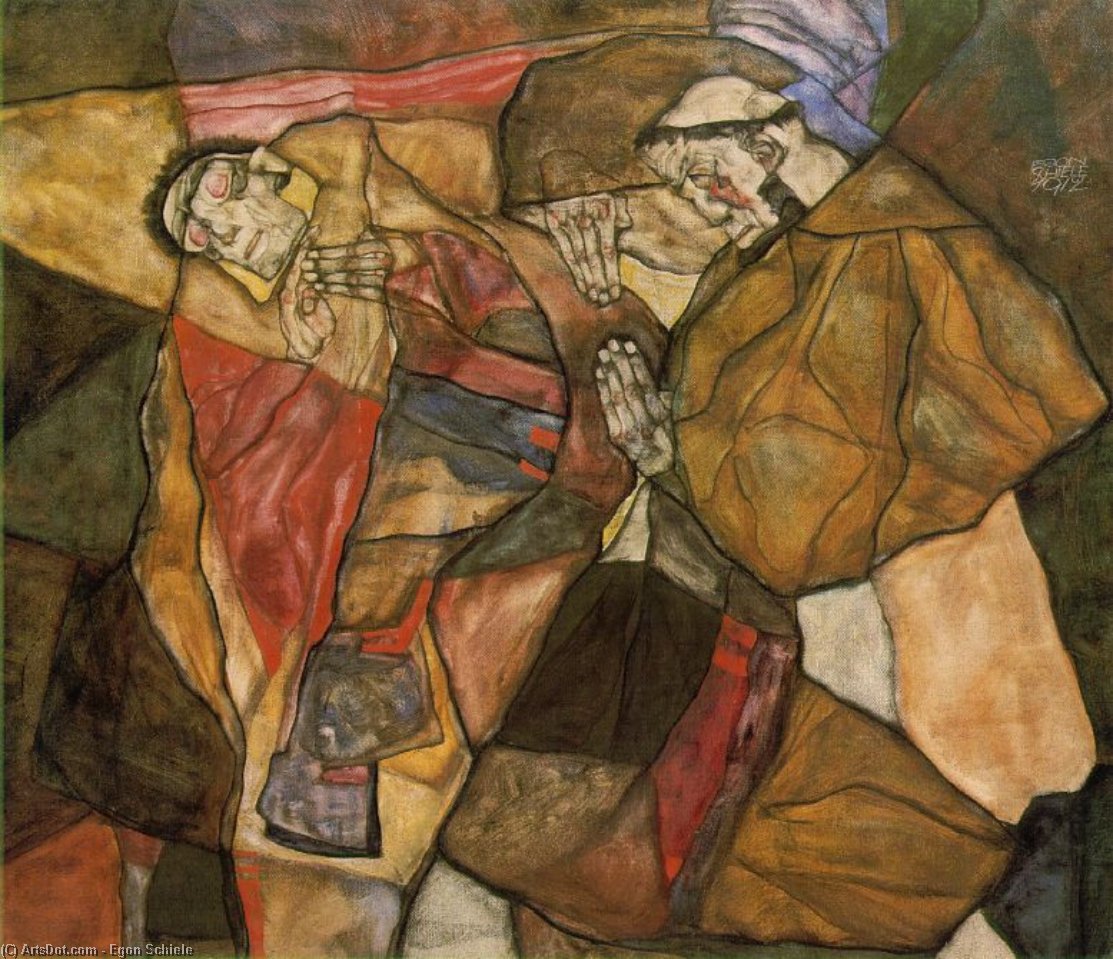
‘Agony,’ painted in 1912 by Austrian Expressionist artist Egon Schiele, isn't merely a depiction of figures; it’s an unflinching confrontation with primal fear and psychological torment. Created during the turbulent period following World War I, this haunting monochrome canvas embodies the core tenets of Expressionism – prioritizing emotional intensity over objective representation—a movement born from disillusionment and grappling with the anxieties of modernity. Schiele's work immediately distinguishes itself through its unsettling gaze, reflecting a preoccupation with themes of vulnerability, suffering, and the inescapable awareness of mortality that permeated Viennese art circles at the time.The Expressionist Vision: Beyond Surface Appearance
Expressionism sought to liberate art from academic conventions, rejecting idealized beauty in favor of raw emotion. Artists like Schiele deliberately distorted forms—the figures are rendered with angular lines and unsettling proportions—to convey inner turmoil rather than capturing a realistic likeness. Bold contrasts of black and white heighten the dramatic effect, emphasizing the oppressive atmosphere and amplifying the psychological drama unfolding before the viewer’s eyes. The influence of artists such as Edvard Munch and Oskar Kokoschka is palpable, demonstrating Schiele's engagement with broader artistic dialogues concerning emotional honesty and confronting uncomfortable truths.A Portrait of Vulnerability: Composition and Symbolism
The painting’s composition is deliberately unsettling. Two men dominate the canvas, one kneeling in apparent submission while the other stands above him with forceful hands gripping his head. This posture speaks volumes about power dynamics and control—a recurring motif in Schiele's oeuvre—but crucially underscores the vulnerability of the kneeling figure. The inclusion of a book nearby adds another layer of complexity; it represents knowledge and contemplation, juxtaposed against the overwhelming force of emotion and physical dominance. Some scholars interpret the scene as representing the struggle between intellect and instinct, highlighting the artist’s fascination with confronting existential anxieties.Technical Mastery: Schiele's Unique Approach
Schiele employed a meticulous technique characterized by thick impasto—heavy application of paint—creating palpable textural surfaces that contribute to the painting’s visceral impact. The careful layering of pigment ensures that every brushstroke retains its expressive quality, mirroring the artist’s intention to capture not just what he saw but how he *felt*. This dedication to craftsmanship elevates ‘Agony’ beyond mere visual representation; it becomes a conduit for conveying profound psychological states—a testament to Schiele's artistic prowess and his unwavering commitment to exploring the darkest recesses of human experience.Legacy and Resonance: Experiencing ‘Agony’ Today
‘Agony’ continues to captivate audiences today, serving as an enduring emblem of Expressionist art’s ability to provoke contemplation and elicit emotional responses. Its stark aesthetic and psychologically charged imagery resonate powerfully with viewers grappling with themes of trauma, repression, and the confrontation with mortality—issues that remain relevant in contemporary culture. A high-quality reproduction from OriginalUniqueArt.com allows you to immerse yourself in Schiele's vision without compromising on artistic integrity, preserving the painting’s unsettling beauty and conveying its profound emotional depth. Explore more about Egon Schiele’s work and other Expressionist artists at https://OriginalUniqueArt.com/ADC/Art.nsf/O/6WHKF6/$File/Egon_Schiele-agony_1912.jpgアーティストの略歴
Egon Schiele: Austrian Expressionist Painter
Egon Schiele’s artistic journey began in Tulln an der Donau, Austria, amidst a backdrop of familial hardship—the premature death of his father from syphilis and the subsequent loss of his sister Elvira—experiences that profoundly shaped his worldview and fueled his relentless pursuit of expressive truth. Born in 1890, Schiele’s childhood was marked by illness and instability, yet he cultivated an unwavering independence and a fascination with trains—a motif that would subtly permeate his later canvases—demonstrating an innate talent for drawing from a young age. Recognizing this potential, his uncle Leopold Czihaczek championed his artistic aspirations, guiding him toward the Akademie der bildenden Künste in Vienna where he encountered Gustav Klimt, whose influence solidified Schiele’s stylistic trajectory. Despite facing considerable resistance from Viennese academic circles—particularly Professor Griepenkerl—Schiele persevered, establishing the Neues Wiener Kunstgruppe alongside fellow artists who challenged prevailing artistic conventions. His early works—often unsettling portraits and self-portraits—captured the anxieties and vulnerabilities of the human psyche with startling honesty, utilizing elongated figures and expressive lines to convey psychological tension. Schiele’s exploration of sexuality was particularly provocative for its time, reflecting the broader cultural shifts occurring in Vienna during the Fin de siècle era. His artistic development gained momentum through mentorship from Klimt and engagement with the Viennese Secession—a movement that championed avant-garde experimentation and rejected bourgeois morality—resulting in iconic paintings like *The Kiss* and *Death and the Maiden*. Schiele’s distinctive style—characterized by distorted forms, raw emotion, and a preoccupation with mortality—established him as one of Austria's foremost Expressionist painters. He continued to refine his technique throughout his brief career, producing masterpieces that resonate powerfully with audiences today. Schiele’s legacy extends beyond his artistic achievements; he embodies the spirit of rebellion against societal norms and unwavering commitment to artistic integrity. His paintings remain influential in contemporary art, inspiring artists to confront difficult themes and explore psychological depths—a testament to Schiele's enduring impact on the visual arts. He died tragically young during the Spanish flu pandemic in 1918, leaving behind a remarkable body of work that secures his place as one of Austria’s most celebrated artistic figures.- Key Themes: Mortality, sexuality, isolation, psychological turmoil.
- Influences: Gustav Klimt, Viennese Secession, personal trauma.
- Style Characteristics: Elongated figures, contorted poses, expressive lines, raw emotion.
- Notable Works: *Self-Portrait with Physalis*, *Couple Embracing*, *Field Landscape (Kreuzberg) near Krumau*
- Achievements: Schiele’s uncompromising artistic vision and masterful technique garnered international acclaim, securing his place as a pivotal figure in Austrian Expressionism.
- Historical Significance: His work challenged Viennese bourgeois sensibilities and paved the way for subsequent generations of artists to explore psychological themes with boldness and vulnerability.

エゴン・シエレ
1890 - 1918 , オーストリア
基本情報
- Artistic Movement Or Style: 表現主義
- Artists Who Influenced This Artist: ['グスタフ・クリムト']
- Date Of Birth: 1890年6月12日
- Date Of Death: 1918年10月31日
- Full Name: Egon Leo Adolf Ludwig Schiele
- Nationality: オーストリア
- Notable Artworks:
- フィザリスと自画像
- 抱擁する男女
- クロウズベルクの風景
- Place Of Birth: オーストリア・トゥルン
関連記事

The Vienna Secession: A Rebellion of Form & Spirit in Fin-de-Siècle Art
Discover the revolutionary Vienna Secession art movement! Explore Klimt, Olbrich & more. Learn about its history, characteristics & lasting influence on modern art. High-quality reproductions available.
Beyond Ephemerality: Hand-Painted Art Reproductions as a Paradigm of Sustainable Luxury in Contemporary Décor
Discover museum-quality hand-painted art reproductions crafted with sustainable practices & ethical sourcing. Elevate your décor with timeless beauty – expertly created and customized to your vision. Explore our collection today!
Pop Spirit: Infusing Luxury Villas with the Boldness of Modern Art – A Guide to Inspired Reproductions, Curatorial Strategies, and Aesthetic Harmony
Elevate your luxury villa with vibrant Pop Art! Discover expert curation tips, museum-quality reproductions & bespoke commissions at OriginalUniqueArt. Transform your space today.
Acrylic Canvas Masters: 10 Paintings That Redefined Modern Art |
Explore 10 legendary 'Acrylic On Canvas' masterpieces by artists like Rothko, Warhol & Frankenthaler. Discover the stories behind these iconic paintings and their impact on modern art. Find museum-quality reproductions at – elevate your home with timeless beauty.
OriginalUniqueArt.com F.A.Q.: 富裕層コレクターのためのオリジナルアートと手描きレプリカの相違点 – 品質、カスタマイズ、そしてコレクション構築
OriginalUniqueArt.comでは、オリジナルアートと手描きレプリカの違いを徹底解説。富裕層コレクター向けに、品質、カスタマイズ性、投資価値など、専門家が選ぶポイントをご紹介します。コレクション構築のサポートも充実。