 油彩画を購入
 Stop Clockのすべて







































 いずれかの辺が105 cm(約41インチ)を超えるアートワークまたは複製画の場合、フレームは分解されたキットの状態でお届けいたします。この方法は、輸送中の破損を防ぎ、安全に配送するために採用しております。


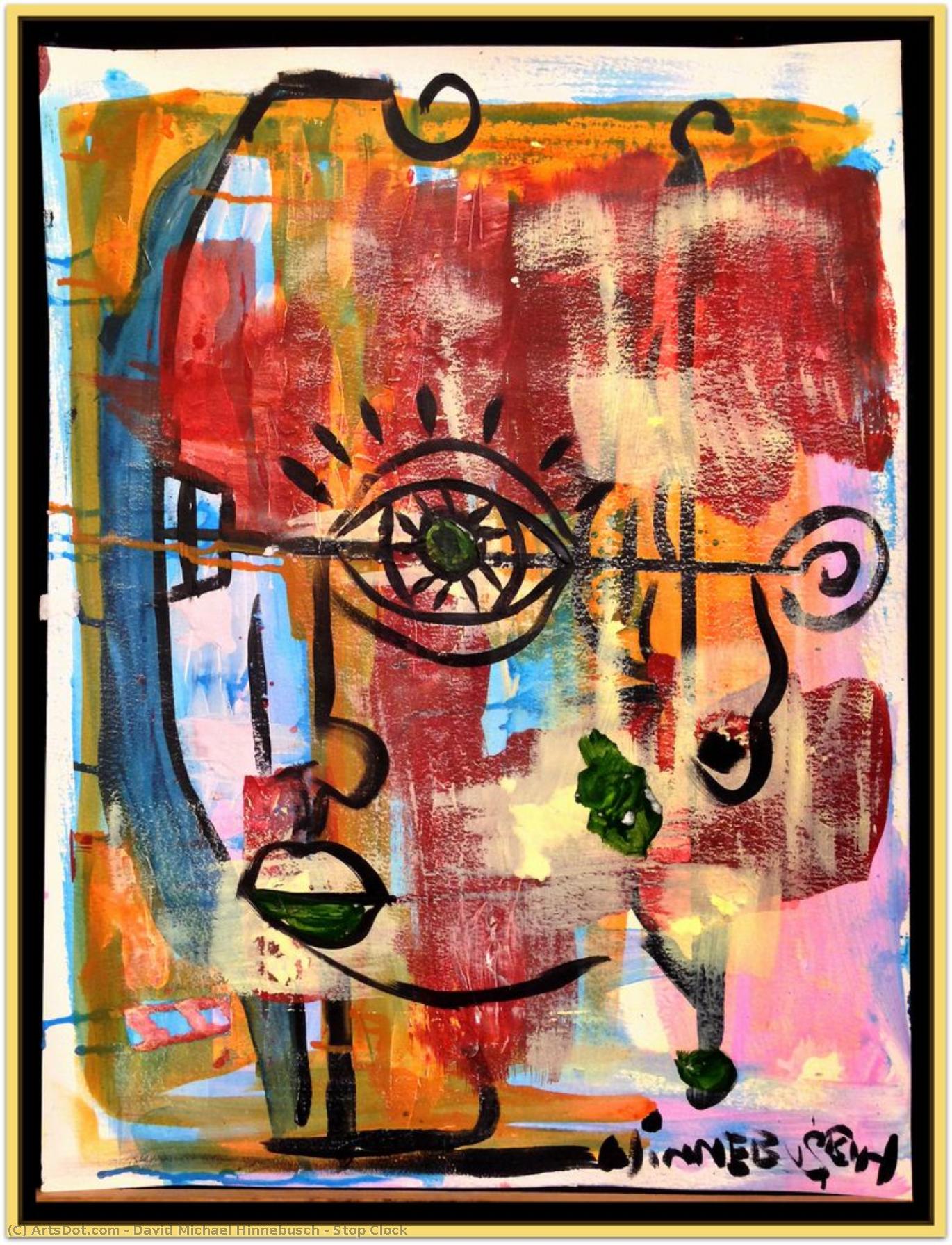
The Stylized Portrait of Stop Clock
In Stop Clock, David Michael Hinnebusch presents a stylized portrait of a human face that moves away from traditional likeness. Created in 2016, the work functions as an expressive interpretation of the human form rather than a literal representation. The subject is rendered through bold, black lines that define the eyes, nose, and mouth with a deliberate, slightly distorted simplicity. This approach allows the artist to prioritize the emotional weight of the gaze over anatomical precision.
The face is centrally positioned, drawing the viewer into a direct encounter with the subject. A single, prominent eye, represented by concentric circles, anchors the composition and suggests a sense of quiet observation. This focal point provides a moment of stillness amidst the energetic, layered colors that surround the figure. The portrait captures a specific tension between the recognizable features of a person and the abstract energy of the background.
David Michael Hinnebusch uses this abstraction to explore the internal landscape of the subject. The work avoids the comforts of realism, opting instead for a visual language that communicates intensity and awareness. By stripping the face down to its essential shapes, the artist invites a deeper engagement with the psychological presence of the figure. It is a quiet, forceful study of identity and perception.
Composition and Visual Elements
The portrait is centrally positioned within the frame, with the head occupying most of the vertical space. This placement creates an immediate sense of presence, pulling the viewer into a direct encounter with the subject. While the face itself maintains a degree of symmetry, the surrounding composition utilizes asymmetry to create a sense of movement. The background consists of layered washes and strokes of various hues, which swirl around the central figure in a way that feels both energetic and somewhat chaotic.
There is a striking economy in how the features are rendered. Thick, black lines define the eyes, nose, mouth, and eyebrows, eschewing fine detail for expressive, slightly distorted forms. The eye is particularly notable, represented by a large circle containing a smaller concentric circle within it. The nose is indicated by a simple vertical line, while the mouth is suggested by a single curved shape. These simplified elements allow the viewer to focus on the psychological weight of the gaze rather than anatomical precision.
Technique and Artistic Materials
In this work, the artist employs a tactile approach that emphasizes the physical presence of the medium. The surface is built through an energetic layering of washes and bold brushstrokes, suggesting a process of constant revision and movement. There is a clear evidence of a wet-on-wet technique, where colors are allowed to blend directly on the canvas, creating soft transitions amidst the more defined, gestural marks. This method lends the piece a sense of immediacy, as if the paint was applied with a certain urgency.
The texture is quite pronounced. You can see the evidence of the brush in the thick impasto and the way the paint sits upon the surface. This creates a three-dimensional quality that invites a closer look at the interplay between the colors. The materials appear to be acrylic paint applied to a canvas, or perhaps a similar suitable surface, which allows for such heavy, layered application without losing the clarity of the individual strokes. The result is a surface that feels lived-in and deeply textured.
Related Works by the Artist
To understand the trajectory of Hinnebusch’s recent output, one might look toward his 2017 pieces. Works such as I Will Buy Art Today and Vernon S Place offer a glimpse into the same period of intense creative activity that produced this piece. These works share a certain immediacy, reflecting the artist's continued engagement with the layered, gestural language that defines his practice.
The artist's exploration of form and emotion remains consistent across his various compositions. For instance, A Vision, created about 2017, and Ache, also from 2017, demonstrate his ability to navigate the space between the figurative and the abstract. In these works, the tension between structured imagery and spontaneous, expressive marks remains a central concern, much like the energy found within the layers of this portrait.
Q&A
Stop Clockは手描きですか、それともプリントですか?
手描きによる制作:熟練した画家が、リネンキャンバスに油彩でStop Clockを模写します。
Stop Clockのサイズはどれを選べばよいですか?
原画のサイズは61 x 46 cmです。 サイズは36.2 x 27.7 cm (¥34881)から240.8 x 184.2 cm (¥293064)まで展開しております。こちらのページ内の表に、主な工程とそれぞれの価格を記載しています。
配送にはどのくらいの時間がかかりますか?
配送には4〜5週間を要し、世界中どこへでも速達便にて無料でお届けいたします。また、本ページではお急ぎの方向けの特急制作オプションもご用意しております。商品は、理由を問わず100日以内であれば全額返金での返品が可能です。
デビッド・マイケル・ヒネブッシュはStop Clockの制作にどのような画材(メディア)を使用しましたか?
Acrylic On Canvas
 設置イメージを表示

 シェアする
 シェアする
 詳細を見る
 解説シート


 ダウンロード
 似ている作品
 X線調査
 スライドショーを表示
 Q&A

 統計情報


