

 プレビュー
プレビュー
 シェアする
シェアする シェアする
シェアする
 詳細を見る
詳細を見る

 ダウンロード
 似ている作品
 X線調査
X線調査 スライドショー
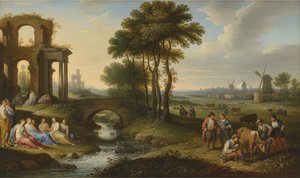
Untitled (843)

 詳細を見る
詳細を見る
ジークレー/アートプリント
迅速な制作と多彩な仕上げオプションを備えた、ミュージアムクオリティのジークレーまたはキャンバスプリント。 ( 手描きの絵画を購入 画像を購入)




































作品のオリジナル比率に合わせた、当店の規定サイズからお選びください。

特定のフレームやスペースに合わせて、ご自身でサイズを指定することも可能です。選択されたサイズが元の画像の比率と一致しない場合、作品をトリミングするか、鏡面反射または単色での塗りつぶしによって画像を拡張いたします。制作を開始する前に、ご確認用のデジタルモックアップをお送りいたします。
画面上のプレビューには、実際のトリミングや拡張は反映されませんのでご注意ください。最終的な構図を正確に確認できるのは、モックアップのみとなります。
カスタムサイズも承っておりますが、元の比率を維持するためには、あらかじめ用意されたリストからサイズを選択することをお勧めいたします。


 ガラスオプションは、110cm未満のサイズでのみご利用いただけます。

Untitled (843)
ジークレー/アートプリント
複製画のサイズ
-


合計金額
$ 80
アーティストの略歴
Cornelis Huysmans: A Flemish Landscape Master
- Born: Antwerp, Belgium (1648)
- Died: 1727
Early Life and Training
- Cornelis Huysmans was baptized on April 2, 1648, in Antwerp. His parents were Hendrik Huysmans and Catharina van der Meyden.
- His father's profession is described as either a master builder or a craftsman in the mint.
- Following his parent’s early death, he was sent to study under the landscape painter Gaspar de Witte.
- He later moved to Brussels to further his studies and may have worked as an assistant in the studio of Jacques d'Arthois.
- Around 1675, he collaborated with Adam Frans van der Meulen in Maastricht.
Career and Artistic Development
- In 1675, Huysmans became an independent master of the Guild of Saint Luke in Brussels.
- He spent time in London from approximately 1686 to 1688, creating landscapes for prominent members of society.
- Around 1688, he settled in Mechelen and married Maria Anna Scheppers.
- In 1690, he created a significant altarpiece, "The Road to Emmaus," for the Onze-Lieve-Vrouw-over-de-Dijle church in Mechelen.
- He returned to Antwerp in 1706 and was admitted as a master in the local guild of Saint Luke.
- Huysmans eventually returned to Mechelen, where he continued working until his death in 1727.
Artistic Style and Influences
- Huysmans is primarily known for his landscape paintings, though he also created religious and history works.
- His style is characterized by detailed observations of nature, particularly forests and trees.
- He was significantly influenced by Jacques d'Arthois, evident in the decorative compositions depicting forest edges with sandy banks.
- Huysmans incorporated a "pseudo-Italianate" aesthetic, featuring mountains and vegetation reminiscent of Italy.
- His use of dramatic light contrasts between roads and tree shadows created a striking visual effect.
- He often employed diagonal lines within his compositions to create depth and perspective.
Legacy and Historical Significance
- Cornelis Huysmans held a prominent position in Flemish landscape painting during the late 17th and early 18th centuries.
- His works demonstrate a transition from earlier, more detailed styles towards a more decorative and atmospheric approach to landscape art.
- He influenced younger artists, including his son Pieter Balthasar Huysmans and his brother Jan Baptiste Huysmans.
- Huysmans's paintings are represented in numerous museum collections worldwide, including the Louvre, the Hermitage Museum, and various museums in Belgium and elsewhere.
- His ability to capture both the realism of nature and a sense of idealized beauty contributed to his lasting reputation as a significant Flemish landscape painter.

Cornelis Huysmans
1648 - 1727 , Belgium
基本情報
- Artistic Movement Or Style: Pseudo-Italianate landscapes
- Artists Or Movements Influenced By This Artist:
- Pieter Balthasar Huysmans
- Jan Baptiste Huysmans
- Artists Who Influenced This Artist:
- Nicolas Poussin
- Jacques d'Arthois
- Date Of Birth: 1648
- Date Of Death: 1727
- Full Name: Cornelis Huysmans
- Nationality: Flemish
- Place Of Birth (City And Country): Antwerp, Belgium
関連記事
Cornelis van Poelenburch: Bridging Mannerism & the Dutch Baroque Landscape
Discover Cornelis van Poelenburch, a pivotal Dutch Baroque landscape painter bridging Mannerism & Italianate styles. Explore his life, key works, and lasting influence on 17th-century art with OriginalUniqueArt.

Drama in Nature: The Captivating Grandeur of Baroque Landscapes and the Art of Emotional Spectacle
Explore the breathtaking drama of Baroque landscapes. From Rubens's grand vistas to the mastery of chiaroscuro, discover how 17th-century artists transformed nature into a theatrical stage of emotion and light. A deep dive for true art enthusiasts.

Masterpieces of Light: A Definitive Guide to the Landscapes of the Dutch Golden Age
Discover the luminous mastery of Dutch Golden Age landscapes. Our expert guide explores the atmospheric realism of masters like Van Goyen and Cuyp. Elevate your space with museum-quality, hand-painted oil reproductions from OriginalUniqueArt.com. Art history, beautifully realized.

Golden Light & Dutch Skies: The Timeless Magic of Dutch Golden Age Landscapes
Discover the breathtaking beauty of Dutch Golden Age landscapes. Explore the mastery of light, chiaroscuro, and 17th-century realism through an expert art history lens, celebrating the enduring legacy of the Dutch Masters for discerning collectors and art lovers.

Dutch Baroque Masters: 10 Paintings That Shaped an Era | OriginalUniqueArt
Journey through the Golden Age with our guide to the Top 10 Dutch Baroque masterpieces! Explore iconic paintings by Rembrandt, Vermeer & Frans Hals. Find museum-quality art reproductions and elevate your home decor at OriginalUniqueArt.com.

