

 設置イメージを確認
 送る
送る シェア
シェア
 詳細情報
詳細情報 ガイドを表示

 画像をダウンロード
 似ている作品
 X線調査
X線調査 スライドショー
 統計情報
統計情報Crucifix
 Byzantine & Renaissance
 1280
1280 350.0 x 690.0 cm
 続きを読む
続きを読む
ジークレー/アートプリント
スピーディーな制作と多彩な仕上げオプションが魅力の、ミュージアムクオリティなジークレー・キャンバスプリント。 ( 手描きの複製画を注文する デジタル画像販売へ切り替え)




P118B ¥10

P118H ¥10

P118W ¥10

P438Z ¥10

P508JH ¥12

P508YH ¥12

P805H ¥10

P805Z ¥10

P919BZ ¥10

P919G ¥10

P919XJ ¥10

P959ZH ¥10

P968JZ ¥12

W106C ¥8

W218G ¥10

W218JH ¥8

W218Y ¥10

W307PJ ¥10

W316G ¥10

W316PJ ¥8

W316Y ¥10

W398PJ ¥8

W4111J ¥10

W500HY ¥15

W500JH ¥15

W692G ¥12

W849H ¥8

W940BG ¥15

W953PJ ¥8




作品のオリジナル比率に合わせた、当店の規定サイズからお選びください。

額縁や壁のスペースに合わせて、ご希望の幅と高さを入力してください。プリントはカットすることは可能ですが、元の画像より大きくすることはできないため、異なる比率のサイズを選択された場合は、画像の一部が欠けることになります。印刷を開始する前に、内容を確認していただくためのデジタルモックアップをお送りいたします。このページに表示されている画像は、実際のカット後の状態を示すものではありません。実際の仕上がりはモックアップにてご確認ください。


 ガラスオプションは、110cm未満のサイズでのみご利用いただけます。

Crucifix
ジークレー/アートプリント
複製画サイズ一覧
-


合計金額
¥ 12695
A Bridge Between Worlds: Cimabue’s ‘Crucifix’
Cimabue's “Crucifix,” painted around 1283 in Florence, stands as a pivotal work not merely for its artistic merit but for its profound role in marking the transition from the rigid formality of Byzantine art to the burgeoning naturalism that would define the Italian Renaissance. More than just a depiction of Christ’s suffering, this painting embodies a courageous shift—a subtle yet decisive challenge to established conventions, laying the groundwork for the revolutionary changes that were about to reshape Western art. Born Cenni di Pepo around 1240 in Florence, Cimabue wasn't simply a painter; he was an innovator who dared to experiment with form and expression, a figure whose legacy resonates powerfully even today.
The painting immediately draws the eye with its monumental scale – measuring over three by two meters – reflecting the Byzantine tradition of imposing religious imagery. Yet, Cimabue’s genius lies in his ability to infuse this grandeur with a nascent sense of humanity. The Christ figure, rendered in tempera and gold on wood, is undeniably rooted in the iconography of the East: he is depicted as *Christus patiens*, or deceased, flanked by the Virgin Mary and St. John the Evangelist, both figures enveloped in sorrowful contemplation. However, subtle innovations distinguish Cimabue’s work from its Byzantine predecessors. The Christ's pose, while still conveying a sense of stillness, possesses a greater physicality—a suggestion of weight and vulnerability that hints at the human drama unfolding before us.
The Language of Symbolism
Beyond the immediate depiction of the crucifixion, “Crucifix” is rich in symbolic meaning. The inscription "HIC EST IESUS NAZARENUS REX IUDEORUM" – “Here is Jesus Christ, King of the Jews” – anchors the scene within its religious context, asserting both his divinity and his earthly sacrifice. The carefully chosen details—the draped cloth, the outstretched limbs, the sorrowful faces of the witnesses—all contribute to a powerful narrative of suffering, redemption, and hope. The use of gold leaf, particularly in highlighting Christ’s figure, further elevates the scene, connecting it to the opulent traditions of Byzantine mosaics and illuminating the divine nature of the subject.
Technique and Innovation
Cimabue's mastery is evident in his skillful manipulation of tempera paint. He employs a technique known as *distemper*, mixing pigments with a binding medium, creating rich colors and subtle gradations of tone. The painting’s monumental scale demanded careful planning and execution; the panel itself was constructed from five timber boards, meticulously joined to create a stable support for the vibrant imagery. Notably, Cimabue moved away from the purely abstract representation favored in Byzantine art, introducing a greater degree of naturalism into his depiction of Christ's body—a subtle shift that would become increasingly pronounced in the work of his successors, particularly Giotto.
A Legacy Forged in Florence
“Crucifix”’s journey through history is inextricably linked to the artistic landscape of Florence. Originally intended for “Santa Croce II,” a significant church project, it eventually found its home within the Basilica di Santa Croce, where it has remained a treasured masterpiece. The painting's survival—despite being partially damaged during the devastating 1966 flood that ravaged Florence – is itself a testament to its enduring value and the dedication of those who have preserved it. Today, this powerful image continues to inspire awe and reflection, serving as a poignant reminder of faith, sacrifice, and the transformative power of art.
よくあるご質問
「Crucifix」における光と影のバランスは、どのように表現されていますか?
シマブエ作「Crucifix」 の記録された数値は、明度 brilliant、輝度 Bright Balance です。
シマブエ作「Crucifix」が醸し出す感情的なトーンはどのようなものでしょうか?
シマブエ作「Crucifix」に記録された情緒的なトーンはMelancholicです。これは、作品が表現している感情を要約したものです。
シマブエ作「Crucifix」の活用方法や、おすすめの設置スペースについて教えてください。
シマブエ作「Crucifix」 のおすすめの用途は (Statement)、飾る場所は (Living Room) です。
アーティストについて
Cimabue: Grandfather of the Italian Renaissance
Giovanni Cimabue, born Cenni di Pepo around 1240 in Florence, stands as a monumental figure—a bridge between the established artistic traditions of the Byzantine world and the burgeoning innovations that would define the Italian Renaissance. His life, though partially obscured by time and romanticized accounts – most notably those penned by Giorgio Vasari centuries later – marks an undeniable turning point in Western art history. Cimabue wasn’t simply a painter; he was a courageous innovator who dared to subtly challenge artistic conventions, laying the groundwork for the revolutionary changes that would soon sweep across Italy. Even his nickname, believed to mean “bull-headed,” hints at a strong will and perhaps a rebellious spirit—qualities demonstrably present in his willingness to experiment with form and expression. He represents a crucial moment where art began to shift from being solely devotional imagery towards something more humanistic and emotionally resonant.Early Influences and Artistic Development
Initially immersed in the Italo-Byzantine style prevalent throughout Florence, Cimabue’s early work adhered closely to established aesthetic principles: flattened figures adorned with shimmering gold leaf, symbolic rather than realistic depictions of space, and a profound focus on religious iconography. However, even within these constraints, a nascent desire for naturalism began to emerge. He wasn't content merely replicating existing forms; he sought to imbue his paintings with a greater sense of life and emotional depth. While the precise nature of his early training remains debated, it’s likely he honed his skills within Florentine workshops, absorbing the techniques and influences of the time while simultaneously developing his own unique artistic voice. The Byzantine style, characterized by its formality and spiritual focus, provided him with a solid foundation, but Cimabue began to subtly introduce elements that would foreshadow the coming Renaissance—a greater attention to volume, more expressive facial features, and a nascent understanding of spatial relationships. This wasn’t a sudden break from tradition, but rather a gradual evolution, a delicate balancing act between honoring the past and embracing new possibilities.Masterpieces and Artistic Innovations
Cimabue's legacy is cemented through a series of breathtaking works that showcase his evolving style. The *Maestà* (Louvre), originally created for the Church of San Francesco in Pisa, stands as one of his most celebrated masterpieces. This monumental altarpiece exemplifies his mastery of composition and use of color, while simultaneously hinting at the shift away from rigid Byzantine conventions. The figures, though still possessing a degree of formality, exhibit a newfound sense of volume and presence. The *Crucifixion* (San Domenico, Arezzo), dating around 1270, is particularly significant as an early demonstration of his departure from strict Byzantine norms. Here, the proportions are more realistic, and the emotional weight of the scene is palpable—a stark contrast to the often-distant depictions found in earlier religious art. Further evidence of Cimabue’s innovative spirit can be seen in works like the *Flagellation of Christ* (Frick Collection), generally attributed to his workshop. This complex composition reveals an evolving understanding of perspective and spatial relationships, showcasing a growing interest in creating more immersive and believable scenes. His contributions weren't limited to panel paintings; Cimabue also excelled as a mosaicist, contributing significantly to the decoration of the Baptistery of Florence—though these mosaics have unfortunately suffered from deterioration over time.A Pivotal Teacher: Giotto and Beyond
Perhaps Cimabue’s most enduring legacy lies in his role as the teacher of Giotto di Bondone. While historical accounts vary regarding the exact nature of their relationship, it is widely accepted that Giotto received crucial training under Cimabue's guidance. However, Giotto would ultimately surpass his master, revolutionizing Italian painting with an even more radical embrace of naturalism and emotional realism. It’s a testament to Cimabue’s skill as a teacher that he fostered such talent, even knowing it might eclipse his own achievements. The story, often recounted by Vasari, of Giotto playfully painting a fly on Cimabue's face speaks volumes about the dynamic between master and pupil—a playful rivalry that ultimately pushed both artists to greater heights. Cimabue’s influence extended beyond Giotto, impacting numerous other artists of the period. He challenged the artistic norms of his time, demonstrating that art could be more than just religious symbolism; it could also reflect human emotion and experience. His willingness to experiment with form, proportion, and expression paved the way for the innovations of the Renaissance, establishing him as a crucial transitional figure in the history of Western art.Enduring Significance
Cimabue passed away in 1302 in Pisa, leaving behind a body of work that continues to captivate and inspire. Despite his significant contributions, details surrounding his later life remain scarce. However, Cimabue’s artistic legacy resonates powerfully through the works of his students and the evolution of Italian art. He represents a crucial step in the development of Western painting, moving away from the stylized conventions of the Byzantine era towards a more humanistic and naturalistic approach. His paintings are not merely historical artifacts; they are windows into a pivotal moment in artistic history—a time when artists began to question established norms and explore new possibilities. He was a pioneer, a visionary who dared to challenge the status quo and lay the foundations for the artistic brilliance that would define the Renaissance. Cimabue’s work reminds us that even within tradition, there is always room for innovation, and that true artistry lies in the courage to push boundaries and explore new horizons.
シマブエ
1240 - 1302 , イタリア
アーティスト情報
- Artistic Movement Or Style: ビザンチン様式とルネサンス様式
- Artists Or Movements Influenced By This Artist: ['ジョットト・ディ・ボンドネ']
- Artists Who Influenced This Artist: ['ギウント・ピサノ」「コッポ・ディ・マルコバルド']
- Date Of Death: 1302年
- Full Name: Giovanni Cimabue
- Nationality: イタリア人
- Notable Artworks: ['マエストラ」「十字架」「イエス・キリストの鞭打ち']
- Place Of Birth: フィレンツェ、イタリア
関連記事

The Enduring Legacy of Fresco: Technique, History & Artistic Expression
Explore the rich history & enduring artistry of fresco painting. Discover techniques from Giotto to Michelangelo, conservation efforts, & modern applications. Learn how OriginalUniqueArt brings this timeless art form to your home.
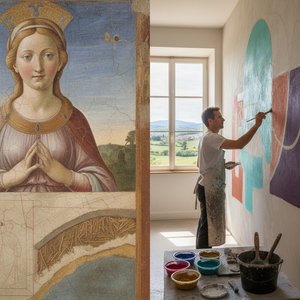
The Enduring Legacy of Fresco Painting: Techniques, History & Contemporary Relevance
Explore the rich history & enduring artistry of fresco painting – from Giotto to Michelangelo! Discover techniques, conservation efforts, & modern applications. Learn how OriginalUniqueArt brings this timeless art form to your home.
Art That Lives With You: The Emotional Power of a Custom Interior Fresco
Discover the emotional power & timeless beauty of custom interior frescoes. Explore history, design tips & expert guidance from – creating lasting legacies.
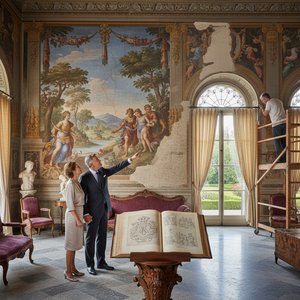
家族の遺産を壁画で彩る:伝統技法が紡ぐ、時を超越する美と記憶
古代から現代までの壁画の歴史と技法を解説。日本の壁画文化やカスタムオーダーによる家族の遺産表現、保存・修復技術まで網羅。専門家が時を超越する美と記憶を紡ぐ芸術的価値をご案内します。

The Enduring Legacy of Fresco: Technique, History & Artistic Expression Across Cultures
Explore the rich history & enduring legacy of fresco painting! Discover ancient techniques, Giotto's masterpieces, and modern applications. Expert insights for art lovers & professionals.


