

 プレビュー
プレビュー
 プリントを購入
 シェアする
シェアする シェアする
シェアする
 詳細を見る
詳細を見る

 ダウンロード
 似ている作品
 X線調査
X線調査 スライドショー
Translokation II

 詳細を見る
詳細を見る




P118B $10

P118H $10

P118W $10

P438Z $10

P508JH $12

P508YH $12

P805H $10

P805Z $10

P919BZ $10

P919G $10

P919XJ $10

P959ZH $10

P968JZ $12

W106C $8

W218G $10

W218JH $8

W218Y $10

W307PJ $10

W316G $10

W316PJ $8

W316Y $10

W398PJ $8

W4111J $10

W500HY $15

W500JH $15

W692G $12

W849H $8

W940BG $15

W953PJ $8




作品のオリジナル比率に合わせた、当店の規定サイズからお選びください。

特定のフレームやスペースに合わせて、ご希望のサイズをご入力いただけます。選択されたサイズが元の画像の比率と異なる場合、アートワークをトリミングするか、手描きで要素を追加して絵画を拡張いたします。デジタルモックアップ を制作し、制作開始前にご確認(承認)をいただきます。
画面上のプレビューは、実際のトリミングや拡張を正確に反映しているものではありません。最終的な構図は、モックアップによってのみ正確にご確認いただけます。
カスタムサイズもご利用いただけますが、元の比率を維持するためには、あらかじめ用意されたリストからサイズを選択することをお勧めいたします。
ご注文後、OriginalUniqueArt.com チームより詳細な指示をお送りするとともに、仕上がりイメージ(モックアップ)をご提供いたします。


 ガラスオプションは、110cm未満のサイズでのみご利用いただけます。

Translokation II
複製技法
複製画のサイズ
-


合計金額
$ 300
アーティストの略歴
The Architect of Abstraction: The Life and Legacy of Camille Graeser
To encounter the work of Camille Graeser is to step into a world where geometry meets emotion, and where the rigid lines of structure dissolve into the profound textures of memory. Born on February 27, 1892, in Carouge, Switzerland, Graeser’s journey was one of constant movement—not just across borders, but through the very evolution of modern visual language. His early years were shaped by the artistic fervor of Stuttgart, Germany, where he first honed his sensibilities as a furniture designer. This foundational period in design instilled in him a lifelong respect for materiality and the structural integrity of form, a discipline that would later become the backbone of his most celebrated abstract compositions.
Graeser’s career was profoundly shaped by the turbulent winds of the twentieth century. As a member of the Deutsche Werkbund, he stood at the intersection of art and industry, participating in major exhibitions that championed the marriage of craftsmanship and modern utility. His talent caught the eye of the legendary architect Mies van der Rohe, who commissioned Graeser to design furniture for his groundbreaking architectural projects. However, the ascent of Nazism in 1933 forced a pivotal shift in his life; fleeing Germany, he sought refuge in Switzerland. This period of exile was not merely a geographical relocation but an artistic rebirth. In the quietude of Switzerland, Graeser turned his full attention toward the exploration of Concrete Art, finding a new voice within the Zurich avant-garde.
A Symphony of Form and Texture
As Graeser integrated into the Swiss art scene, becoming a prominent member of the Allianz group, his work underwent a remarkable transformation. He moved away from the functional constraints of design toward a more systematic, yet deeply expressive, form of geometric abstraction. His canvases became playgrounds for Concrete Art, where he utilized carefully manipulated geometric elements and strikingly bright colors to create a sense of rhythmic balance. Alongside luminaries such as Max Bill and Richard Paul Lohse, Graeser emerged as a leading figure in the Swiss movement, known for his ability to distill visual language into its purest, most essential essence.
What distinguishes Graeser’s oeuvre from the purely mathematical approach of some of his contemporaries is his profound engagement with texture and depth. His technique often involved layered textures—sometimes achieved through the use of encaustic—which imbued his works with a palpable physicality. These layers served as more than mere surface decoration; they acted as conduits for emotional resonance, capturing fleeting impressions of experience and the weight of history. In his hands, a simple geometric shape could carry the gravity of a landscape or the ephemeral quality of a memory, bridging the gap between the cerebral precision of constructivism and the visceral impact of abstract expressionism.
Historical Significance and Enduring Influence
The legacy of Camille Graeser is preserved not only in the museums that house his masterpieces but also through the dedicated stewardship of the Camille Graeser Foundation, established in 1981. His contribution to the trajectory of Swiss art remains immeasurable, particularly in how he bridged the gap between the decorative arts and high abstraction. His ability to navigate the transition from a designer of physical objects to a creator of purely visual experiences offers a profound lesson in artistic resilience and evolution.
Today, Graeser’s work continues to resonate with modern audiences who find beauty in the intersection of order and chaos. His achievements can be summarized through several key pillars of his career:
- Versatility of Medium: From furniture design for Mies van der Rohe to complex abstract paintings and reliefs.
- Pioneering Abstraction: A central figure in the development of Concrete Art in Switzerland.
- Material Mastery: The use of layered textures and encaustic to provide emotional depth to geometric forms.
- Cultural Resilience: Maintaining artistic integrity and contributing to the Swiss avant-garde despite the upheaval of political exile.
Ultimately, Graeser’s art remains a testament to the power of distillation—the ability to strip away the superfluous until only the most potent symbols of color, shape, and texture remain, speaking directly to the human spirit.

基本情報
- Artistic Movement Or Style: Zurich Concrete artists
- Date Of Birth: February 27, 1892
- Full Name: Camille Graeser
- Nationality: Swiss
- Notable Artworks:
- Translokation II
- AUS DER REIHE GELÖSTES GELB YELLOW DETACHED FROM THE ROW
- Komplementär Relation I
- Place Of Birth: Carouge, Switzerland
関連記事

幾何学的抽象絵画を定義した傑作10選|アート、アーティスト、インテリア装飾
モンドリアン、マレーヴィチ…幾何学的抽象絵画を代表する傑作10選。各作品の背景や色彩構成、アーティストの情熱に迫ります。美術館品質の複製画はOriginalUniqueArt.comで。オンラインでアートコレクションをご覧ください。

Kandinsky's Masterpieces: 25 Paintings That Define Abstract Art | OriginalUniqueArt
Journey through Wassily Kandinsky's 25 most iconic abstract paintings. Explore his revolutionary use of color, form & spiritual expressionism. Find museum-quality Kandinsky reproductions and elevate your home decor with OriginalUniqueArt.com. Discover all masterpieces on OriginalUniqueArt.com!

Slate Blue Masterpieces: 10 Iconic Paintings & Timeless Home Decor Ideas
Immerse yourself in the captivating world of slate blue! Explore 10 iconic paintings by Monet, Van Gogh & Renoir. Discover their stories, techniques & find museum-quality art reproductions for your home at .

抽象表現主義を定義する十大傑作:芸術と装飾の深遠な旅
抽象表現主義を定義する10の傑作。ポロック、ロスコら巨匠たちの情熱と色彩の世界へ。各作品に込められた物語と技法を紐解き、至高のアート体験を。OriginalUniqueArt.comで、ミュージアムクオリティの複製画や洗練されたインテリアアイデアを発見してください。
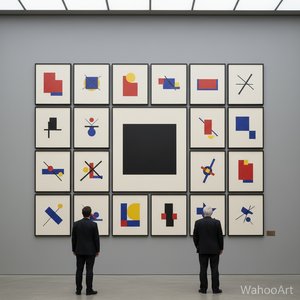
カジミール・マレーヴィチ:至高の25選 - 抽象芸術の革命とホームデコレーション
カジミール・マレーヴィチの至高の25選。シュプレマティズムを代表する「ブラックスクエア」をはじめ、抽象芸術の革命的作品群を紐解きます。ロシア構成主義からミニマリズムまで、美術史に輝く傑作をOriginalUniqueArt.comで。高品質なアートプリントとホームデコレーションの世界へ。今すぐコレクションをご覧ください。

