Anteprima in scala reale
 Invia
Invia Condividi
 Dettagli opera

 Scarica immagine
 Simili
 Radiografia
 Slideshow
Night


 Espandi i dettagli
Giclée / Stampe d'arte
Stampa giclée o su tela di qualità museale, con produzione rapida e diverse opzioni di finitura. ( Acquista il dipinto realizzato a mano Acquista immagine)




P118B $10

P118H $10

P118W $10

P438Z $10

P508JH $12

P508YH $12

P805H $10

P805Z $10

P919BZ $10

P919G $10

P919XJ $10

P959ZH $10

P968JZ $12

W106C $8

W218G $10

W218JH $8

W218Y $10

W307PJ $10

W316G $10

W316PJ $8

W316Y $10

W398PJ $8

W4111J $10

W500HY $15

W500JH $15

W692G $12

W849H $8

W940BG $15

W953PJ $8




Scegli tra le nostre dimensioni predefinite, che rispettano le proporzioni originali dell'opera d'arte.

È possibile inserire dimensioni personalizzate per adattare l'opera a una cornice o a uno spazio specifico. Se la dimensione selezionata non corrisponde alle proporzioni dell'immagine originale, procederemo al ritaglio dell'opera o all'estensione dell'immagine con un bordo specchiato o a tinta unita. Un mockup digitale ti verrà inviato per approvazione prima dell'inizio della produzione.
Si prega di notare che l'anteprima a schermo non riflette il ritaglio o l'estensione effettivi. Solo il mockup mostrerà accuratamente la composizione finale.
Sebbene siano disponibili dimensioni personalizzate, si raccomanda di selezionare una dimensione dall'elenco predefinito per preservare le proporzioni originali.
Consegna in tutto il mondo () in 2 settimane invece delle normali 4/5 settimane. (30 Agosto)

Spedizione espressa gratuita in tutto il mondo

Tela in lino di alta qualità

Assicurazione completa sulla spedizione

Garanzia di rimborso dei dazi doganali

Garanzia di fedeltà cromatica

Politica di reso entro 60 giorni (solo per difetti di fabbricazione)

Garanzia di rimborso al 100%

Offerta per acquisti multipli
 L'opzione vetro è disponibile solo per dimensioni inferiori a 110 cm

Night
Giclée / Stampe d'arte
Dimensioni riproduzione
-


Prezzo totale calcolato
$ 80
A Visceral Encounter with Mortality
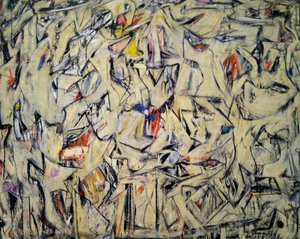
In the hauntingly rendered depths of Willem de Kooning’s 1948 masterpiece, “Night,” viewers are not merely observers but participants in a profound existential drama. The painting presents a striking, unsettling juxtaposition: a female face emerges from the shadows, only to be overlaid with the stark, skeletal imagery of a skull. This collision of beauty and decay establishes a central preoccupation that has defined much of de Kooning’s illustrious career. It is an image that refuses to offer comfort, instead forcing a confrontation with the fragility of life. The subject matter transcends simple portraiture, acting as a window into the human condition where the vitality of femininity battles against the encroaching darkness of mortality.
The emotional resonance of the piece is amplified by its place within the heart of Abstract Expressionism. Born from the profound disillusionment and psychological upheaval of the post-World War II era, "Night" embodies the movement's characteristic intensity. De Kooning abandons the safety of realism to prioritize raw feeling over precise form. There is a palpable sense of anxiety woven into every stroke, reflecting a period when artists were grappling with the trauma of global conflict and the terrifying uncertainties of a new atomic age. To stand before this work is to feel the weight of that historical tension, making it an essential piece for those who appreciate art that speaks to the deepest, often unspoken, layers of the human psyche.
The Language of Gesture and Texture
Technically, "Night" is a masterclass in the action painting style that would soon define the New York School. De Kooning utilized a bold, visceral palette—dominated by deep blacks, fiery reds, and jarring yellows—to create a sense of movement and instability. His technique relies heavily on thick impasto, where layers of oil paint are applied with such vigor that the canvas takes on a three-dimensional, sculptural quality. These heavy, deliberate strokes do not merely depict a scene; they record the physical and emotional energy of the artist himself. The texture is so dense that it creates a rhythmic, almost turbulent surface, mirroring the internal chaos of the subject matter.
Beyond the central figures, the composition is enriched by subtle, enigmatic elements that invite endless reinterpretation. A checkered pattern drifts through the background, adding a layer of geometric tension and depth that contrasts sharply with the organic, fluid forms of the face and skull. The presence of fragmented motifs—hints of a bird or perhaps a distant car—suggests a world in flux, where the boundaries between the subconscious and reality are perpetually blurred. For the discerning collector or interior designer, this painting offers more than just visual impact; it provides a sophisticated focal point that commands attention through its complexity, making it a timeless addition to any space dedicated to profound artistic expression.
Biografia dell'artista
primi anni e carriera
Willem de Kooning, un rinomato artista astrattista americano-olandese, nacque il 24 aprile 1904 a Rotterdam, nei Paesi Bassi. I suoi genitori, Leendert de Kooning e Cornelia Nobel, divorziarono nel 1907 e De Kooning visse con suo padre prima di trasferirsi all'accudimento della madre. Lasciò la scuola nel 1916 e divenne apprendista in un'agenzia di arte commerciale.sviluppo artistico
De Kooning frequentò lezioni serali presso l'Accademia di Belle Arti e Scienze Applicate a Rotterdam dal 1916 al 1924. Nel 1927 si trasferì a New York City, dove lavorò come pittore edile e iniziò a sviluppare il suo stile artistico unico.astrattismo
Il lavoro di De Kooning si spostò verso l'astratto espressionismo negli anni '50, caratterizzato da pennellate audaci e colori vibranti. Il suo dipinto Woman I (1950-1952) è un'opera fondamentale in questo movimento, che fonde la figurazione con la spontaneità e l'intensità emotiva.opere notevoli e collezioni
* The Glazier (137 x 112 cm, olio su tela): un cupo dipinto dalle tonalità terrose ispirato agli affreschi di Boscoreale. * Door to the River (astratto espressionismo): un dipinto con ampie pennellate che ricorda il suo passato come pittore edile. * Standing Man (astratto espressionismo): un esempio caratteristico dello stile astratto espressionista di De Kooning.musei e collezioni
* Museo Boijmans Van Beuningen, Rotterdam, Paesi Bassi: presenta una collezione impressionante di oltre 151.000 opere d'arte. * Universiteitsbibliotheek, Leiden, Paesi Bassi: ospita un importante centro culturale con più di 5.200.000 volumi e 1.000.000 ebook. L'eredità di Willem de Kooning continua a ispirare artisti e appassionati d'arte, consolidando il suo posto come pioniere dell'astratto espressionismo.
Willem de Kooning
1904 - 1997 , Paesi Bassi
Dati rapidi
- Artisti Influenti: ['Arshile Gorky']
- Data Di Morte: 1997
- Data Di Nascita: 24 aprile 1904
- Luogo Di Nascita: Rotterdam, Paesi Bassi
- Movimento Artistico: Espressionismo astratto
- Nazionalità: Olandese-Americano
- Nome Completo: Willem de Kooning
- Opere Notevoli:
- Donna I
- The Glazier
- Excavation
Articoli correlati

Espressionismo Astratto: I 10 Capolavori che Hanno Definito un Movimento Artistico Rivoluzionario
Esplora i 10 capolavori dell'Espressionismo Astratto con ! Scopri Pollock, Rothko e De Kooning: storia, tecnica e significato di opere iconiche per arredare la tua casa con arte di alta qualità. Esplora la collezione online!

Goya: I 25 Capolavori Immortali dell'Anima Spagnola | OriginalUniqueArt
Esplora i 25 capolavori di Francisco Goya, il genio spagnolo tra Romanticismo e Realismo. Ritratti iconici, 'Los Caprichos' e le toccanti 'Disastri della Guerra'. Trova stampe su tela e riproduzioni artistiche di alta qualità per la tua casa su OriginalUniqueArt.com.

Willem de Kooning: Astrazione, Gesto e l'Evoluzione della Pittura Americana del Dopoguerra
Esplora l'evoluzione dell'espressionismo astratto con Willem de Kooning. Analisi approfondita del suo stile, l'influenza italiana e il suo impatto sull'arte moderna. Scopri perché De Kooning è un investimento prezioso per i collezionisti.
Beyond Representation: Exploring the Emotional Landscape of Abstract Expressionism
Explore the profound emotional world of Abstract Expressionism with OriginalUniqueArt. Discover key artists like Pollock & Rothko, learn about collecting, and find museum-quality reproductions to inspire your space.

Kandinsky: I 25 Capolavori che Hanno Rivoluzionato l'Arte Moderna | OriginalUniqueArt
Esplora i 25 capolavori di Wassily Kandinsky, pioniere dell'arte astratta. Scopri la storia, il significato e le tecniche dietro ogni dipinto iconico. Trova riproduzioni d'arte di alta qualità per decorare la tua casa su OriginalUniqueArt.com.