 Acquista l'originale a olio
 Scopri di più su SAINT PIERRE







































 Per opere d'arte o riproduzioni con un lato superiore a 105 cm (circa 41 pollici), la cornice verrà spedita in forma di kit smontato. Questo metodo garantisce una consegna sicura e previene danni durante il trasporto.


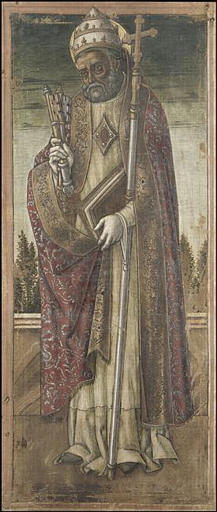
Identification of Saint Pierre by Vittore Crivelli
In this work, titled SAINT PIERRE, we encounter a significant example of the hand of Vittore Crivelli. This Italian Early Renaissance painter, who was born in Venice around 1440, brings a specific sense of gravity to the depiction of this religious figure. His approach reflects the transition of the era, moving through the stylistic shifts that defined the late fifteenth century.
Vittore Crivelli lived until 1501, a period during which his work helped shape the visual language of the Venetian school. In SAINT PIERRE, his characteristic attention to detail is evident, providing a sense of presence that is both quiet and authoritative. The subject is rendered with a focus on the dignity inherent to his role, captured through a style that balances the traditions of the past with the emerging naturalism of the Renaissance.
The Composition and Visual Elements
The figure is positioned centrally, though a subtle asymmetry lends a sense of natural movement to the pose. Saint Pierre faces the viewer directly, while his body is turned slightly to the left, creating a gentle tension in the stance. He holds the traditional attributes of his office: a book and the keys. In his right hand, he carries a tall crosier that extends vertically, providing a strong anchor for the entire composition.
Behind the figure, the landscape is rendered in muted tones, offering a quiet backdrop that does not compete with the subject. This setting provides a sense of space without requiring deep recession, keeping the focus entirely on the saint. The arrangement of the elements emphasizes his presence and authority through a balanced, formal structure.
Technique and Materials Used
The work is executed in tempera or oil paint on a wooden panel, a choice that allows for the meticulous brushwork seen throughout the composition. There is a deliberate variation in how the artist handles the surface to suggest different tactile qualities. The robes are rendered with a high level of detail, where the paint creates a sense of heavy, intricate fabric. In contrast, the skin of the figure is treated with a smoother texture, providing a subtle softness to the facial features.
The background landscape is handled with a different sensibility. It appears more simplified and lacks the dense texture found in the central figure, which helps to keep the focus on the subject. This approach creates a quiet depth, even where the spatial recession remains shallow. The application of color suggests a controlled use of glazes to achieve subtle shifts in tone, particularly in the garments and the skin.
Related Works by the Same Artist
To understand the breadth of this artist's hand, one might look toward the Musée du Petit Palais in Avignon, where several of his compositions reside. There, you will find Saint Michel, a work that shares a certain psychological depth with the figure of Saint Pierre. The collection in Avignon also holds La Vierge adorant l'Enfant, entre deux angelots musiciens and Saint Julien, offering a glimpse into his ability to handle religious subjects with a quiet, contemplative grace.
His reach extended beyond the immediate Venetian sphere, as seen in his commissions for significant religious sites. One notable example is St Louis of France, which was created for the Saint Louis Cathedral in Bordeaux between 1481 and 1502. This work demonstrates his capacity for managing large-scale devotional pieces and the intricate drapery that characterizes his approach to the human form.
- St Louis of France (1481-1502)
- Saint Michel
- Saint Julien
- La Vierge adorant l'Enfant, entre deux angelots musiciens
Where to See This Artwork Today
This depiction of Saint Pierre is held within the collection of the Musée du Petit Palais. Located in Avignon, France, the museum offers a quiet space to observe the work in its intended context. It is a significant part of the institution's holdings, which reflect the artistic history of the region.
The museum is also known as the Petit Palais Museum. As a city of Paris Museum of Fine Arts, it maintains a focused selection of works that allow for a close, personal encounter with the artist's hand. One may find this piece among other religious panels that have been preserved within these walls.
Domande e risposte
SAINT PIERRE è un dipinto fatto a mano o una stampa?
Dipinto a mano: un pittore professionista riproduce SAINT PIERRE a olio su tela di lino.
Che dimensioni dovrei scegliere per SAINT PIERRE?
Le dimensioni vanno da 48.6 x 20.6 cm (€199) a 249.8 x 105.9 cm (€1070); la tabella in questa pagina elenca le opzioni principali e i relativi prezzi.
Quanto tempo richiede la consegna?
La consegna richiede dalle 4 alle 5 settimane, con spedizione espressa gratuita in tutto il mondo; su questa pagina è disponibile un'opzione di produzione urgente. È possibile restituire l'opera entro 100 giorni per un rimborso completo, senza alcuna condizione.
Dove si trova l'originale di SAINT PIERRE?
L'originale fa parte della collezione del Musée du Petit Palais, Avignone.
Quale tecnica ha utilizzato Vittore Crivelli per SAINT PIERRE?
Tempera On Panel
Maggiori informazioni su questo dipinto
 Anteprima in scala reale

 Invia
 Condividi
 Dettagli opera
 Scheda didattica


 Scarica
 Simili
 Radiografia
 Slideshow
 Domande e risposte

 Statistiche


