- Home

- Stampa su tela
- Sébastien Bourdon
- Presentation in the Temple
 Ordina la riproduzione Acquista download
 Invia
Invia
 Condividi
 Dettagli opera
 Aggiungi ai preferiti

 Scarica
 Simili
 Radiografia
 Slideshow
Presentation in the Temple
 Oil On Canvas
- WallArt
- Baroque Painting
 1644
1644- Early Modern
 71.0 x 61.0 cm
 Musée du Louvre
 Scopri di più
Giclée / Stampa d'arte
Stampa giclée o su tela di qualità museale, con produzione rapida e diverse opzioni di finitura.




P118B $10

P118H $10

P118W $10

P438Z $10

P508JH $12

P508YH $12

P805H $10

P805Z $10

P919BZ $10

P919G $10

P919XJ $10

P959ZH $10

P968JZ $12

W106C $8

W218G $10

W218JH $8

W218Y $10

W307PJ $10

W316G $10

W316PJ $8

W316Y $10

W398PJ $8

W4111J $10

W500HY $15

W500JH $15

W692G $12

W849H $8

W940BG $15

W953PJ $8




Scegli tra le nostre dimensioni predefinite, che rispettano le proporzioni originali dell'opera d'arte.

È possibile inserire dimensioni personalizzate per adattare l'opera a una cornice o a uno spazio specifico. Se la dimensione selezionata non corrisponde alle proporzioni dell'immagine originale, procederemo al ritaglio dell'opera o all'estensione dell'immagine con un bordo specchiato o a tinta unita. Un mockup digitale ti verrà inviato per approvazione prima dell'inizio della produzione.
Si prega di notare che l'anteprima a schermo non riflette il ritaglio o l'estensione effettivi. Solo il mockup mostrerà accuratamente la composizione finale.
Sebbene siano disponibili dimensioni personalizzate, si raccomanda di selezionare una dimensione dall'elenco predefinito per preservare le proporzioni originali.
Consegna in tutto il mondo () in 2 settimane invece delle normali 4/5 settimane. (23 Luglio)

Spedizione espressa gratuita in tutto il mondo

Tela in lino di alta qualità

Assicurazione completa sulla spedizione

Garanzia di rimborso dei dazi doganali

Garanzia di fedeltà cromatica

Politica di reso entro 60 giorni (solo per difetti)

Garanzia di rimborso al 100%

Sconto per acquisti multipli
 L'opzione vetro è disponibile solo per dimensioni inferiori a 110 cm

Presentation in the Temple
Giclée / Stampa d'arte
Dimensioni riproduzione
-


Prezzo totale finale
-
Descrizione dell'opera
A Moment of Divine Revelation in Baroque Light
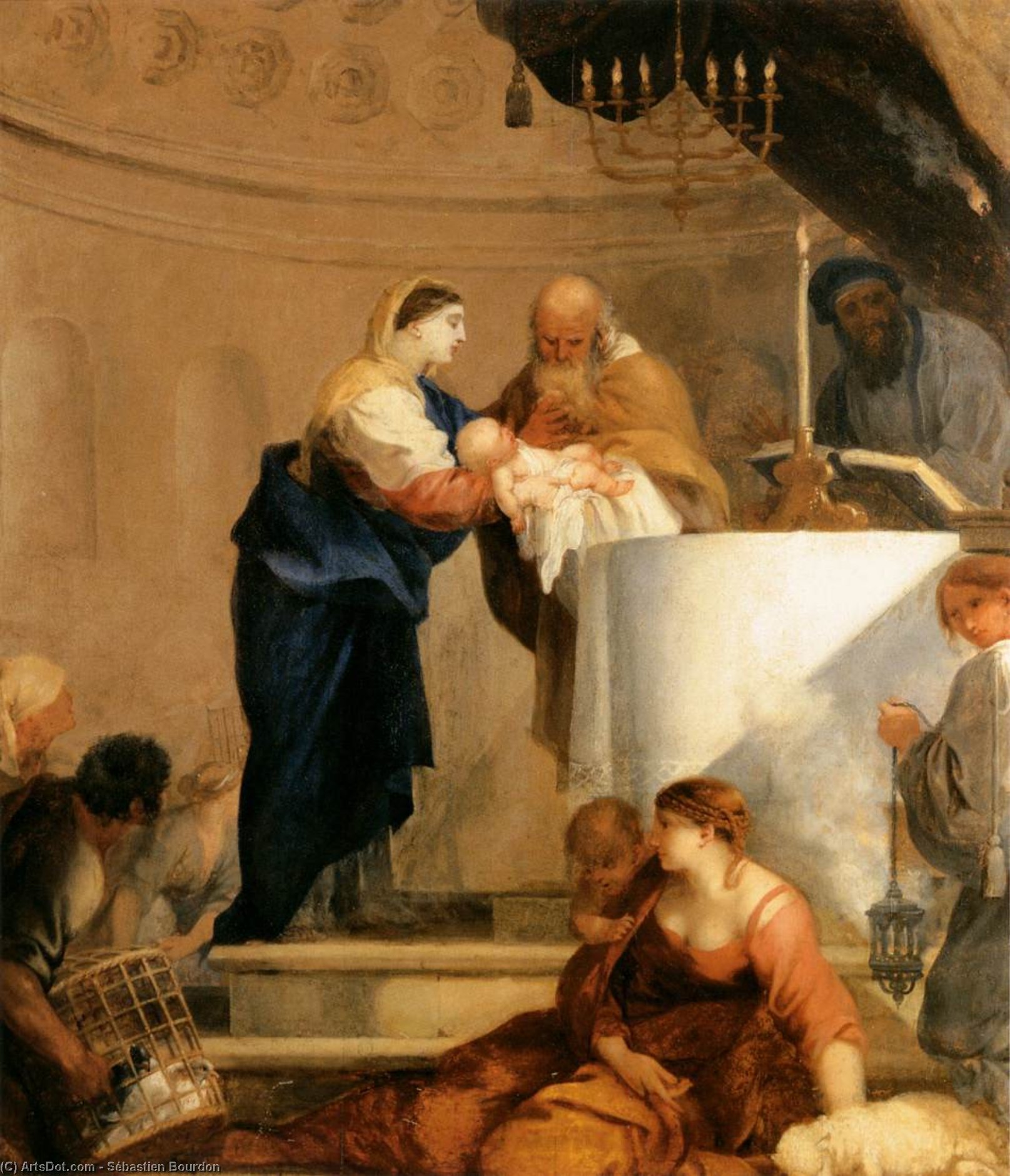
To stand before this depiction of Presentation in the Temple is to be enveloped by the dramatic chiaroscuro that defined the height of the Baroque era. Sébastien Bourdon, a master whose brushstrokes seem imbued with palpable emotion, captures not merely an event, but a profound spiritual moment. The scene unfolds with an immediacy that pulls the viewer directly into the sacred gathering. Observe the central grouping: the tender interaction between mother and child forms the emotional core, while surrounding figures participate in a tableau vivant of devotion. Bourdon’s handling of light is nothing short of miraculous; it does not simply illuminate the scene, it seems to emanate from the divine action itself, carving out figures from deep shadow with masterful precision.
Mastery of Baroque Drama and Composition
Bourdon, trained in the grand traditions that flowed from Rome, understood drama as a compositional element. This painting is a testament to his ability to merge narrative storytelling with technical brilliance. The composition guides the eye effortlessly across the figures—from the solemnity of the old man holding an infant, to the attentive gazes of those nearby. Even the inclusion of seemingly incidental elements, such as the two watchful dogs positioned on either side, adds a layer of grounded realism that anchors the spiritual weight of the subject matter. The placement of the chair near the center suggests both repose and ritual importance, subtly directing our focus toward the unfolding narrative.
Symbolism Woven into Sacred Detail
The symbolism within this work is rich and deeply resonant for the art connoisseur. The act of presentation itself speaks to themes of piety, lineage, and divine acknowledgment. Every gesture—the gentle touch, the upward gaze—is weighted with theological meaning. In Baroque art, animals often serve as silent witnesses or symbolic complements; here, the dogs may represent fidelity or the earthly connection to the sacred rite taking place. To own a reproduction of this piece is to invite into your space not just decoration, but contemplation—a visual meditation on faith and human connection.
Technique and Enduring Emotional Resonance
Executed in 1644, this work showcases Bourdon’s mature technique: a vibrant yet controlled palette used to heighten the emotional stakes. The texture suggested by the paint handling—the softness of drapery against the solidity of flesh—is breathtaking. For those who appreciate historical painting and the dramatic flair of the seventeenth century, this piece offers an unparalleled opportunity. It speaks to a time when art was not merely observed, but experienced; it demands participation from the viewer's heart. Reproducing such a work allows modern interiors to breathe with the grandeur and emotional depth of a Baroque masterwork.
Biografia dell'artista
Sébastien Bourdon: A Baroque Master of Dramatic Light and Emotion
Sébastien Bourdon (1616 – 1671) stands as a pivotal figure in the flourishing artistic landscape of seventeenth-century France, embodying the grandeur and emotional intensity characteristic of the Baroque period. Born in Montpellier, France, he descended from a family steeped in artistic tradition—his father was a glass painter—and received an early education that instilled within him a profound appreciation for visual storytelling.
Bourdon’s formative years were marked by apprenticeship under Jean Baptiste Tourneyn, a Parisian painter who exposed him to the stylistic conventions of his time. Crucially, this training fostered a connection with the artistic currents emanating from Rome, where he embarked on a transformative journey in 1636. Inspired by luminaries such as Nicolas Poussin, Claude Lorrain, and Caravaggio—artists whose mastery captivated Bourdon’s imagination—he honed his skills amidst the intellectual fervor of the papal court.
Bourdon's artistic style is defined by its remarkable versatility and adaptability. While he excelled in portraiture, capturing subjects with sensitivity and nuance – often employing a Rubensian approach or favoring intimate bust-length portraits against muted backgrounds – he equally demonstrated prowess in monumental canvases imbued with Baroque drama. His most celebrated achievement remains “The Crucifixion of St. Peter,” commissioned for the cathedral of Notre Dame, a masterpiece that exemplifies Bourdon’s masterful command of chiaroscuro and his ability to convey profound spiritual emotion.
Other notable works include “The Deposition,” which showcases Bourdon's meticulous attention to detail and his capacity to depict scenes brimming with palpable pathos. His artistic output extended beyond religious commissions; he produced captivating landscapes reflecting the grandeur of the Italian countryside, demonstrating a broader engagement with humanist ideals.
Bourdon’s influence resonated throughout Europe, establishing him as a founding member of the Académie royale de peinture et de sculpture in Paris. He nurtured an extensive atelier, fostering the careers of numerous pupils who carried forward his artistic legacy. Bourdon's dedication to craft and unwavering pursuit of excellence cemented his place as one of the foremost painters of his era.
Bourdon’s enduring legacy resides not only in his impressive oeuvre but also in his role as a champion of Baroque aesthetics—a style characterized by theatrical lighting, dynamic compositions, and an expressive portrayal of human emotion. His paintings continue to inspire admiration for their technical brilliance and emotional depth, securing Bourdon's position as a cornerstone of French art history.
Biography
- Bourdon was born in Montpellier on February 2nd, 1616 – his family were craftsmen of modest means. His father, Marin, was a painter and glazier, his mother, Jeanne Gaultière, was the daughter of a master goldsmith. Sébastien was baptised on February 10th in Montpellier church*. *
- He began his artistic training as an apprentice under Jean Baptiste Tourneyn in Paris, gaining exposure to the stylistic conventions of the Baroque period.
- In 1636 he travelled to Rome, where he studied the paintings of masters such as Nicolas Poussin, Claude Lorrain and Caravaggio—artists whose influence profoundly shaped his artistic vision.
- He faced considerable hardship during this time due to his Protestant faith, fleeing Rome in 1638 after being threatened with prosecution by the Inquisition.
- Bourdon returned to Paris in 1652 where he established himself as a prominent artist and was elected as one of the original twelve elders in charge of the Académie royale de peinture et de sculpture.
Notable Works
- “The Crucifixion of St. Peter”: This monumental canvas, commissioned for Notre Dame Cathedral, exemplifies Bourdon’s mastery of chiaroscuro and his ability to convey profound spiritual emotion.
- “The Deposition”: Demonstrating Bourdon's meticulous attention to detail and his capacity to depict scenes brimming with palpable pathos.
- Landscapes: Bourdon produced captivating landscapes reflecting the grandeur of the Italian countryside, showcasing his broader engagement with humanist ideals.
Influences
- Nicolas Poussin: Bourdon’s artistic style was heavily influenced by Poussin's classical compositions and masterful use of light.
- Claude Lorrain: Lorrain’s atmospheric landscapes and idealized depictions of biblical scenes contributed to Bourdon’s aesthetic sensibilities.
- Caravaggio: Caravaggio’s dramatic chiaroscuro technique—characterized by stark contrasts between light and dark—served as a crucial inspiration for Bourdon's artistic endeavors.
Historical Significance
- Bourdon played a pivotal role in establishing the Académie royale de peinture et de sculpture, shaping the trajectory of French art education and fostering a vibrant artistic community.
- His enduring legacy resides in his contribution to Baroque painting—a style that continues to captivate audiences worldwide with its expressive power and technical sophistication.

Sébastien Bourdon
1616 - 1671 , Francia
Dati rapidi
- Artistic Movement Or Style: Barocco
- Artists Who Influenced This Artist:
- Nicolas Poussin
- Claude Lorrain
- Caravaggio
- Date Of Birth: 2 febbraio 1616
- Date Of Death: 8 maggio 1671
- Full Name: Sébastien Bourdon
- Nationality: Francese
- Notable Artworks:
- Il Battesimo di Cristo
- La Deposizione
- Place Of Birth: Montpellier, Francia
Articoli correlati
Claude Monet: I 25 Capolavori Essenziali per Amare l'Impressionismo | OriginalUniqueArt
Esplora i 25 capolavori di Claude Monet, il maestro dell'Impressionismo. Scopri la storia, i colori e le tecniche dietro ninfee, paesaggi iconici e dipinti famosi. Trova riproduzioni artistiche di alta qualità per arredare casa con stile su OriginalUniqueArt.com.

I 10 Capolavori Barocchi che Hanno Definito un'Epoca | Arte e Decorazioni di Lusso
Esplora i 10 capolavori barocchi di Caravaggio, Bernini e Rembrandt che hanno rivoluzionato l'arte. Scopri storie, tecniche e colori iconici. Trova riproduzioni d'arte di alta qualità per la tua casa su !
I 10 Dipinti Più Famosi Dominati dal Grigio: Maestri e Storie d'Arte per la Tua Casa
Esplora i 10 dipinti più famosi dominati dal grigio, dai capolavori di Monet a Hopper. Scopri storie d'arte, tecniche e l'impatto emotivo di queste opere iconiche. Trova riproduzioni di alta qualità su !

El Greco: I 25 Capolavori Immortali dell'Arte Spirituale | OriginalUniqueArt
Esplora i 25 capolavori immortali di El Greco, il maestro del manierismo e della pittura religiosa. Scopri la storia, lo stile unico e le emozioni dietro ogni opera. Stampe e riproduzioni d'arte su OriginalUniqueArt.com per decorare con bellezza.
Marianne North: I 25 Capolavori di una Pittrice Esploratrice | OriginalUniqueArt
Scopri i 25 capolavori di Marianne North, pittrice vittoriana e botanica appassionata. Ammira paesaggi esotici, fiori dipinti con colori vivaci e la sua arte unica. Riproduzioni artistiche su OriginalUniqueArt.com per decorare casa con stile.