Expressionism
Self-portrait (Paula Modersohn-Becker)
Paula Modersohn-Becker (1876–1907) ha realizzato Self-portrait. Fa parte del movimento Expressionism. È realizzato in Oil On Canvas.
- Oil On Canvas

 Anteprima in scala reale

 Dipinto a olio fatto a mano
 Invia
 Condividi
 Scheda didattica


 Scarica
 Simili
 Radiografia
 Slideshow
 Domande e risposte

 Statistiche
Self-portrait, in breve
- Titolo
- Self-portrait
- Artista
- Paula Modersohn-Becker (1876–1907)
- Artista nato a
- Dresda, Germania
- Tecnica
- Oil On Canvas
- Movimento
- Expressionism
- Epoca
- Modern
- Soggetto
- woman, red hair, green shirt, face, eyes, wall
Cosa raffigura Self-portrait?
Identification of the Self-portrait
Self-portrait is a creation by the German Expressionist painter and draftswoman Paula Modersohn-Becker. This specific piece belongs to a vast body of work produced during her active life. The artist was born on 8 February 1876 in Dresden, Germany, and passed away on 30 November 1907 in Worpswede.
In this work, Paula Modersohn-Becker turns her gaze toward the viewer. The image captures a moment of quiet intensity through the artist's own likeness. It remains a direct encounter with her presence.
The Composition and Visual Details
The subject is positioned in front of a plain wall, seated in a manner that brings her face into sharp prominence. She wears a green shirt that contrasts with her red hair. Her hair is styled in an unconventional manner, contributing to the singular presence of the figure. The composition focuses heavily on the facial features, emphasizing a directness of gaze. Her eyes are open wide, looking straight ahead to meet the viewer's eyes with quiet intensity.
The arrangement of the figure against the background creates a sense of immediate, unmediated encounter. There is a notable focus on the psychological weight of the stare. The simplicity of the setting ensures that the viewer's attention remains fixed on the subject's expression and the specific arrangement of her features. This directness removes any sense of artifice from the encounter.
Technique and Artistic Medium
Executed in oil on canvas, this work exemplifies the principles of Expressionism. The medium allows for a directness of form that prioritizes the psychological state over mere physical likeness. Through the application of pigment, the artist achieves a sense of quiet intensity, focusing on the essential features of the face and the gaze to facilitate a moment of introspection.
The application of paint emphasizes a recognizable simplicity of form. This approach moves away from the atmospheric concerns of Impressionism, opting instead for a more structured and subjective visual language. The surface carries the weight of the artist's presence, using color and composition to explore the nuances of identity.
Where to See This Artwork Today
This work is held at the Paula Modersohn-Becker Museum in Bremen, Germany. The institution serves as a primary repository for the artist's output, housing a significant portion of her creative legacy.
Founded in 1927, the museum holds a unique position in art history as the first museum in the world devoted solely to a female artist. Its collection provides a comprehensive view of her development from her early training to her final years in Paris.
Related Works by the Artist
The artist's exploration of the self continued through several distinct phases of her career. In 1906, she produced Self-Portrait Looking Slightly Left, a work that shares a similar searching quality with her other studies of identity. During that same year, she completed Self-Portrait at 6th Wedding Anniversary, a piece that captures a specific moment of transition. This work is also known as Self-portrait on the sixth anniversary of marriage.
Earlier compositions reveal a different focus on objects and the female form. Around 1904, she created Self-Portrait with a bowl and a glass. Her interest in the intersection of the female form and the natural world is further evidenced in Self-Portrait with Two Flowers, where she cradles blossoms with a deliberate, steady intention.
Immagini ad alta risoluzione di Self-portrait
Pubblico dominio: l'artista è deceduto nel 1907.
Paula Modersohn-Becker, Self-portrait. Pubblico dominio
Domande su Self-portrait, risposte
Con quale tecnica è realizzata "Self-portrait" di Paula Modersohn-Becker?
"Self-portrait" è realizzata con Oil On Canvas.
Cosa rappresenta "Self-portrait" di Paula Modersohn-Becker?
I soggetti di "Self-portrait" sono woman, red hair, green shirt, face, eyes, wall.
"Self-portrait" di Paula Modersohn-Becker è di pubblico dominio?
Stato del copyright per "Self-portrait" di Paula Modersohn-Becker: l'opera è di pubblico dominio - il copyright è scaduto. Ciò determina se sia possibile effettuare liberamente riproduzioni dell'immagine.
Chi ha creato "Self-portrait"?
L'artista che ha creato "Self-portrait" è Paula Modersohn-Becker. L'opera è catalogata sotto il nome di Paula Modersohn-Becker.
A quale movimento artistico appartiene "Self-portrait" di Paula Modersohn-Becker?
Il movimento associato a "Self-portrait" di Paula Modersohn-Becker è Expressionism. Questa classificazione colloca l'opera tra artisti e opere d'arte correlati.
Per quale motivo lo stato del copyright di "Self-portrait" è questo?
Lo stato del copyright di "Self-portrait" - di pubblico dominio - il copyright è scaduto - è determinato dalla data di morte dell'artista, avvenuta nel 1907.
Che posto occupa "Self-portrait" all'interno della produzione artistica di Paula Modersohn-Becker?
"Self-portrait" condivide con le altre opere di Paula Modersohn-Becker lo stile Expressionism e i temi ricorrenti: cézanne, gauguin, van gogh, identity and femininity, self-exploration and agency, pioneer of expressionism.
In che modo il soggetto di "Self-portrait" si relaziona ai temi abituali di Paula Modersohn-Becker?
I temi ricorrenti di Paula Modersohn-Becker includono cézanne, gauguin, van gogh, identity and femininity, self-exploration and agency, pioneer of expressionism; "Self-portrait" si concentra su woman, red hair, green shirt, face, eyes, wall.
Informazioni sull'artista, Paula Modersohn-Becker

1876–1907, Germania
Paula Modersohn-Becker
Una Visionaria dell'Intimo: La Vita e l'Arte di Paula Modersohn-Becker Paula Modersohn-Becker, un nome che risuona con una forza silenziosa negli annali dell'arte moderna iniziale, fu un’artista che osò guardare dentro sé stessa. Nata Minna Hermine Paula Becker l'8 febbraio 1876 a Dresda, in Germania, la sua vita fu tragicamente breve – si spense il 30 novembre 1907 a Worpswede – ma in quei tre decenni forgiò un percorso di notevole innovazione artistica e coraggio personale. La sua storia non è quella di un successo immediato o di un ampio riconoscimento durante la sua vita; piuttosto, è una testimonianza della duratura forza di una voce individuale che sfidò le convenzioni ed esplorò le profondità dell'esperienza umana con onestà implacabile. Proveniente da un’educazione relativamente privilegiata in una famiglia segnata da un’ombra sottile – suo zio aveva tentato di assassinare il re di Prussia – le inclinazioni artistiche di Paula furono coltivate, sebbene non senza aspettative sociali che premevano su di esse.
Su Paula Modersohn-Becker Opere celebri di Paula Modersohn-Becker
Altre opere di Paula Modersohn-Becker
 Ritratto di una giovane donna con cappello rosso1900
 Ritratto a mezzo busto di un vecchio contadino1903
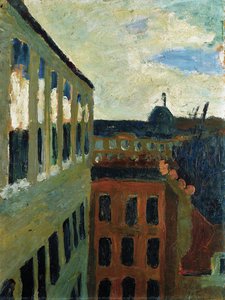 Vista dalla finestra dello studio dell'artista a Parigi1900
 Natura morta con pianta, limone e arancia1906
Saggi su Self-portrait
 Opere polacche degli anni 1900Scopri il simbolismo di Malczewski e Boznańska. Esplora capolavori polacchi del 1900 su OriginalUniqueArt.com.
 Opere tedesche degli anni 1900Scopri l'Espressionismo di Max Beckmann e Franz Marc. Esplora i capolavori tedeschi del 1900 su OriginalUniqueArt.com.
 I 25 capolavori di Egon Schiele: l'emozione pura dell'EspressionismoScopri i 25 capolavori di Egon Schiele e l'essenza dell'Espressionismo. Esplora la collezione su OriginalUniqueArt.com.