Color Field Painting · 1961
Phi (Morris Louis, 1961)
Morris Louis (1912–1962) ha realizzato Phi. Risale al 1961. Fa parte del movimento Color Field Painting. È realizzato in Acrylic On Canvas. È conservata presso il Tate Modern a Londra, Regno Unito.
- 1961
- Acrylic On Canvas
- Tate Modern, Londra

 Anteprima in scala reale

 Dipinto a olio fatto a mano
 Invia
 Condividi
 Scheda didattica


 Scarica
 Simili
 Radiografia
 Slideshow
 Domande e risposte

 Statistiche
Phi, in breve
- Titolo
- Phi
- Artista
- Morris Louis (1912–1962)
- Artista nato a
- Baltimora, Stati Uniti d'America
- Date
- 1961
- Tecnica
- Acrylic On Canvas
- Dove vederlo
- Tate Modern, Londra, Regno Unito
- Movimento
- Color Field Painting
- Soggetto
- color, flowing, ribbon, white background, purple, geometric
Cosa raffigura Phi?
Phi – A Ripple of Color Against White
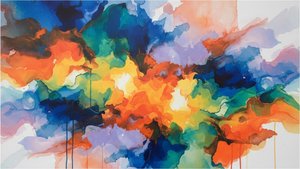
Morris Louis’s “Phi,” created in 1961, stands as a quintessential example of Color Field painting—a movement that sought to elevate abstraction beyond mere visual stimulation and delve into its emotional resonance. More than just pigment on canvas, it's an exploration of proportion, harmony, and the elusive beauty found within simplicity. The artwork’s genesis lies in Louis’s pioneering use of Magna paint, a revolutionary emulsion resin developed specifically for him by Leo Sewell—a material that allowed for unprecedented fluidity and spontaneity during application.- Composition & Technique: Louis employed his signature “stain” technique, pouring diluted Magna onto the canvas and allowing it to spread organically across its surface. This method eschewed brushstrokes altogether, resulting in soft edges and blurred transitions—a deliberate rejection of traditional representational art and a commitment to capturing the essence of color itself. The ribbons of pigment cascade diagonally across the white expanse, creating an illusion of movement and depth without resorting to linear perspective.
- Color Palette & Symbolism: Dominant hues include shades of purple, blue, green, and yellow—a carefully considered palette that reflects Louis’s fascination with the golden ratio (approximately 1.618), a mathematical concept believed to represent divine proportion found throughout nature. The colors aren't blended; instead, they exist as distinct masses, mirroring the idea of interconnectedness and balance. Purple, often associated with spirituality and contemplation, juxtaposed against serene blues evokes feelings of tranquility and introspection.
- Historical Context & Influence: Color Field painting emerged in the wake of Abstract Expressionism, reacting against its gestural brushwork and prioritizing pure color as a primary expressive element. Louis’s work aligns closely with this aesthetic, drawing inspiration from artists like Josef Albers and Barnett Newman—figures who similarly championed flatness and chromatic harmony. The piece embodies the spirit of experimentation and intellectual inquiry that characterized the mid-century art scene.
- Emotional Impact & Aesthetic Response: “Phi” invites viewers to engage in a sensory experience—to contemplate the interplay of color and form without preconceived notions of narrative or subject matter. It’s designed to elicit an emotional response, prompting contemplation on themes of order, balance, and beauty. The artwork's subtle luminosity contributes to its contemplative atmosphere, encouraging reflection on fundamental questions about perception and artistic intention.
- Further Research: For a deeper understanding of Louis’s artistic vision, explore Tate Britain’s online exhibition featuring “Alpha Phi,” alongside reproductions of Newman’s “Virgil” and Albers' "Homage to the Cube." These works exemplify the broader Color Field aesthetic and offer valuable insights into Louis’s conceptual framework.
In quale museo si trova Phi?
Tate Modern
Londra, Regno Unito
La Storia e le Origini della Tate Modern La presenza della Tate Modern a Londra, nel Regno Unito, affonda le sue radici nella storia industriale dello skyline di Southwark. Il sito era originariamente occupato dalla Bankside Power Station, una struttura che ha operato per tre decenni prima del suo definitivo smantellamento. I mutamenti economici, in particolare l'impennata dei prezzi del petrolio, portarono alla chiusura della centrale il 31 ottobre 1981.


Immagini ad alta risoluzione di Phi

Protetta da copyright: l'immagine è mostrata a scopo illustrativo.
Altre dimensioni, ritagli e citazione →Morris Louis, Phi (1961), Tate Modern.
Domande su Phi, risposte
Dove è esposta oggi l'opera "Phi" di Morris Louis?
L'originale di "Phi" di Morris Louis è conservato presso Tate Modern, Londra, Regno Unito. Una riproduzione permette di esporre l'opera in casa propria.
In che anno è stata realizzata "Phi"?
L'opera "Phi" di Morris Louis risale al 1961.
Con quale tecnica è realizzata "Phi" di Morris Louis?
Morris Louis ha utilizzato la tecnica del Acrylic On Canvas per "Phi". La tecnica definisce la natura materica dell'opera originale.
Cosa rappresenta "Phi" di Morris Louis?
I soggetti di "Phi" sono color, flowing, ribbon, white background, purple, geometric, ratio.
"Phi" di Morris Louis è di pubblico dominio?
Stato del copyright per "Phi" di Morris Louis: l'opera è ancora protetta dal diritto d'autore. Ciò determina se sia possibile effettuare liberamente riproduzioni dell'immagine.
Chi ha creato "Phi"?
L'artista che ha creato "Phi" è Morris Louis. L'opera è catalogata sotto il nome di Morris Louis.
A quale corrente artistica appartiene "Phi" di Morris Louis?
"Phi" è un'opera di Color Field Painting. Il movimento indica la tradizione artistica di cui l'opera fa parte.
A quale fase della carriera di Morris Louis appartiene "Phi"?
All'interno della carriera di Morris Louis, "Phi" appartiene al Mid Century Modern. Questa fase permette di confrontarla con le altre opere dell'artista.
Quanti anni aveva Morris Louis quando ha creato "Phi" nel 1961?
Quando "Phi" fu creata nel 1961, Morris Louis - nato nel 1912 - aveva 49 anni.
Informazioni sull'artista, Morris Louis

1912–1962, Stati Uniti d'America
Morris Louis
Primi Anni e Formazione Nascita: Morris Louis Bernstein, 28 novembre 1912, Baltimora, Maryland Genitori: Louis Bernstein (venditore di mobili) e Cecelia Luckman Bernstein. Istruzione: Frequentò le scuole pubbliche a Baltimora; Maryland Institute of Fine and Applied Arts (ora MICA), 1929-1932. Non completò una laurea. Prime influenze includono Eugene Speicher e Paul Cézanne.
Altre opere di Morris Louis
 Sigillo1959
 Ambi I1960
 Numero 281961
 Para III1959
Saggi su Phi
 Paul Jenkins: Astrazione Lirica, Colore e Ricerca dell'Espressione PittoricaEsplora l'universo artistico di Paul Jenkins, pioniere dell'astrazione lirica e del color field painting. Analisi approfondita della sua te…
 Morris Louis: Il Pioniere del Color Field e l'Eredità dell'Espressionismo AstrattoEsplora il rivoluzionario mondo di Morris Louis e del Color Field Painting. Analisi approfondite delle tecniche, opere chiave come Gamma Ta…
 I 25 capolavori di Édouard Manet: il ribelle che ha inventato l'arte modernaScopri i 25 capolavori di Édouard Manet e l'anima dell'Impressionismo. Esplora la collezione su OriginalUniqueArt.com.