Anteprima in scala reale
 Condividi
 Condividi
 Dettagli
 Guida stampabile

 Scarica
 Articoli simili
 Radiografia
 Slideshow
 Statistiche
Donor
 Oil
Oil- WallArt
- Early Netherlandish Renaissance
 1490
1490- Renaissance
 45.0 x 32.0 cm
 Muzeul Național de Artă
 Leggi tutto
Giclée / Stampe d'arte
Stampa giclée o su tela di qualità museale, con produzione rapida e diverse opzioni di finitura. ( Ordina la riproduzione dipinta a mano Passa all'immagine digitale)




P118B $10

P118H $10

P118W $10

P438Z $10

P508JH $12

P508YH $12

P805H $10

P805Z $10

P919BZ $10

P919G $10

P919XJ $10

P959ZH $10

P968JZ $12

W106C $8

W218G $10

W218JH $8

W218Y $10

W307PJ $10

W316G $10

W316PJ $8

W316Y $10

W398PJ $8

W4111J $10

W500HY $15

W500JH $15

W692G $12

W849H $8

W940BG $15

W953PJ $8




Scegli tra le nostre dimensioni predefinite, che rispettano le proporzioni originali dell'opera d'arte.

È possibile inserire dimensioni personalizzate per adattare l'opera a una cornice o a uno spazio specifico. Se la dimensione selezionata non corrisponde alle proporzioni dell'immagine originale, procederemo al ritaglio dell'opera o all'estensione dell'immagine con un bordo specchiato o a tinta unita. Un mockup digitale ti verrà inviato per approvazione prima dell'inizio della produzione.
Si prega di notare che l'anteprima a schermo non riflette il ritaglio o l'estensione effettivi. Solo il mockup mostrerà accuratamente la composizione finale.
Sebbene siano disponibili dimensioni personalizzate, si raccomanda di selezionare una dimensione dall'elenco predefinito per preservare le proporzioni originali.
Consegna in tutto il mondo () in 2 settimane invece delle normali 4/5 settimane. (26 Settembre)

Spedizione espressa gratuita in tutto il mondo

Tela in lino di alta qualità

Assicurazione completa sulla spedizione

Garanzia di rimborso dei dazi doganali

Garanzia di perfetta fedeltà cromatica

Politica di reso entro 100 giorni (solo per difetti di fabbricazione)

Garanzia di rimborso al 100%

Sconto per acquisti multipli
 L'opzione vetro è disponibile solo per dimensioni inferiori a 110 cm

Donor
Giclée / Stampe d'arte
Dimensioni della riproduzione
-


Prezzo totale
$ 80
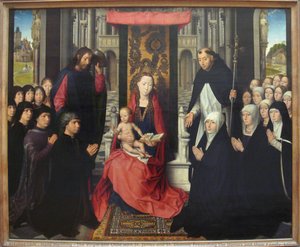
A Window into the Soul: The Devotion of Hans Memling’s Donor
In the quiet, luminous world of the Northern Renaissance, few works capture the intersection of earthly dignity and spiritual yearning as poignantly as Hans Memling’s “Donor.” Created around 1490, this masterpiece serves as more than a mere portrait; it is an intimate encounter with a soul in contemplation. The painting presents a dignified man seated with a profound sense of presence against a muted, atmospheric backdrop. He holds an open book—a gesture that transcends simple literacy to suggest a deep engagement with divine wisdom. Flanked by two figures who lend a sense of communal sanctity to the scene, the composition draws the viewer into a sacred circle, where the boundaries between the observer and the observed begin to dissolve.
The technical brilliance of Memling, often celebrated as the master of Bruges, is on full display through his command of the Early Netherlandish style. This period was defined by an unparalleled realism, achieved through the painstaking application of oil glazes. In “Donor,” one can almost feel the texture of the man’s dark robes and the subtle, shimmering light that dances across the pages of his book. Memling utilized a meticulous process of layering and blending to create surfaces that possess a jewel-like luminosity. This technique does not merely replicate physical likeness; it imbues the subject with an inner radiance, making the skin appear supple and the atmosphere feel heavy with the stillness of prayer.
Symbolism and the Spirit of the Burgundian Renaissance
To gaze upon this work is to read a silent sermon. Every element within the frame is steeped in the symbolic language of the late 15th century. The open book held by the donor is a powerful emblem of divine illumination, representing the humanist pursuit of knowledge intertwined with Christian piety. It suggests an intellect that is open to the light of God, a theme central to the burgeoning Renaissance spirit. The flanking figures act as silent guardians, perhaps representing the intercession of saints or the support of a community of faith, reinforcing the donor's moral virtue and his place within the cosmic order.
Historically, this piece emerged from the cosmopolitan splendor of Bruges, a hub of trade and artistic patronage during the Burgundian Renaissance. This was an era where art served as a bridge between the material wealth of the merchant class and the eternal promises of the Church. For the modern collector or interior designer, bringing a reproduction of “Donor” into a space offers more than just aesthetic beauty; it introduces an aura of serenity, intellectual depth, and timeless reverence. It is a piece that commands attention not through loud colors, but through a quiet, commanding grace that invites long periods of reflection and provides a sophisticated focal point for any curated collection.
Biografia dell'artista
Hans Memling: The Bruges Master of Detail and Patronage
Hans Memling (c. 1430 – August 11, 1494), born in Seligenstadt, Germany, stands as a pivotal figure in Early Netherlandish painting—a movement characterized by exquisite realism, meticulous observation of nature, and profound spiritual contemplation. Though his formative years were spent primarily within the Rhineland’s artistic milieu, Memling's trajectory ultimately led him to Bruges, Belgium, where he established himself as one of the foremost artists of his time and cultivated a prolific workshop that disseminated his distinctive style across Europe. His early life remains shrouded in mystery, but biographical accounts suggest he emerged from Mainz around 1430. His artistic education commenced under the tutelage of Rogier van der Weyden, a titan of Flemish painting whose mastery of oil paint and sculptural modeling profoundly shaped Memling's technique. This apprenticeship instilled in him an unwavering dedication to detail—a hallmark that would define his oeuvre. Van der Weyden’s influence is palpable in Memling’s meticulous rendering of drapery folds and the subtle shading techniques he employed, demonstrating a shared commitment to capturing the nuances of human form and texture.Bruges & The Workshop: A Hub for Artistic Innovation
By 1465, Memling secured citizenship in Bruges, a burgeoning commercial hub and artistic epicenter—a city renowned for its patronage of the arts and its vibrant mercantile spirit. Recognizing the potential for collaborative creativity, he founded a workshop staffed by numerous assistants, fostering an environment of innovation and stylistic consistency. This workshop became internationally celebrated for producing stunning reproductions of masterpieces—a testament to Memling’s skill as both artist and pedagogue. He meticulously oversaw every aspect of production, ensuring that each painting adhered to his exacting standards of craftsmanship and artistic vision. The workshop's output included altarpieces, portraits, and decorative panels—all bearing the unmistakable stamp of Memling’s distinctive style.A Style Defined by Precision & Patronage
Memling’s artistic style is instantly recognizable: characterized by luminous color palettes, delicately rendered drapery folds, and an astonishing level of anatomical accuracy. He meticulously studied human anatomy—drawing inspiration from classical sculpture—to achieve unparalleled realism in his portraits and religious scenes alike. Unlike many contemporaries who favored expressive brushstrokes, Memling prioritized meticulous observation and painstaking execution, resulting in images imbued with serene beauty and profound spiritual depth. His approach mirrored the humanist ideals prevalent during the Renaissance, reflecting a belief in the importance of rational inquiry and artistic representation as vehicles for conveying moral truths. The artist’s palette favoured rich hues—particularly reds and blues—creating dramatic contrasts that heightened visual impact.Notable Works & Artistic Achievements
Memling's most enduring legacy resides in his monumental fresco “The Last Judgment” at St John’s Hospital in Bruges—a masterpiece of composition, color theory, and psychological drama. Executed with breathtaking precision and imbued with a palpable sense of solemnity, the fresco exemplifies Memling’s mastery of artistic technique and his ability to communicate complex theological concepts through visual imagery. Alongside “The Last Judgment,” Memling produced numerous iconic paintings including “Cristo Circondato da Angeli Musicisti” and “L'adorazione dei Magi”, demonstrating his versatility as an artist and cementing his reputation as one of the foremost figures of Early Netherlandish painting. These works continue to inspire awe and admiration for their artistic beauty and spiritual significance.Influence & Legacy: Shaping Flemish Renaissance Art
Memling’s influence extended far beyond his own lifetime, shaping the trajectory of Flemish Renaissance art and inspiring subsequent generations of artists—particularly Quentin Massys, who established the Antwerp School—solidifying Memling's position as a cornerstone of Flemish artistic heritage. His unwavering dedication to detail and profound understanding of human psychology remain remarkably relevant in our contemporary appreciation of art history, ensuring that Hans Memling’s name will forever be associated with excellence, innovation, and enduring beauty.
Hans Memling
Germania
Informazioni rapide
- Artistic Movement Or Style: Pittura fiamminga antica
- Artists Who Influenced This Artist: ['Rogier van der Weyden']
- Date Of Birth: c. 1430
- Date Of Death: 11 agosto 1494
- Full Name: Hans Memling
- Nationality: Germano-Fiammingo
- Notable Artworks:
- St Johns Hospital
- L'ultima giudicatura
- Scene dalla Passione
- Place Of Birth: Seligenstadt, Germania
Articoli correlati

Illuminating Realism: Early Netherlandish Painting (15th-16th Centuries)
Explore the captivating world of Early Netherlandish painting (15th-16th centuries). Discover Jan van Eyck, Hans Memling & more. Uncover revolutionary techniques and hidden symbolism in this definitive guide.

Oil on Canvas: A Historical & Technical Exploration of a Timeless Artistic Medium
Explore the rich history & enduring techniques of oil painting on canvas. Discover the science behind its longevity, conservation practices, and contemporary relevance. Expert insights for art enthusiasts.

The Enduring Legacy of Oil on Canvas: Technique, History & Aesthetic Impact
Explore the rich history & techniques of oil painting – from Renaissance masters to Impressionism. Discover pigments, layering methods, and why this timeless medium endures. Expert insights for artists & art enthusiasts.

Illuminating Realism: A Comprehensive Exploration of the Early Netherlandish Renaissance Movement
Explore the captivating world of Early Netherlandish painting! Discover Jan van Eyck & other Flemish masters, their revolutionary techniques, hidden symbolism, and lasting legacy. A comprehensive guide for art enthusiasts.
Illuminating Realism: Early Netherlandish Painting (15th-16th Centuries)
Explore the captivating world of Early Netherlandish painting! Discover Jan van Eyck, Hans Memling & more. Uncover symbolism, techniques & the legacy of these Flemish masters. A comprehensive guide for art enthusiasts.