- Home

- Stampa su tela
- Max Beckmann
- Perseus. Triptych

 Ordina la riproduzione Acquista download
 Invia
Invia
 Condividi
 Dettagli opera
 Aggiungi ai preferiti

 Scarica
 Simili
 Radiografia
 Slideshow
Perseus. Triptych


 Scopri di più
Giclée / Stampa d'arte
Stampa giclée o su tela di qualità museale, con produzione rapida e diverse opzioni di finitura.




P118B $10

P118H $10

P118W $10

P438Z $10

P508JH $12

P508YH $12

P805H $10

P805Z $10

P919BZ $10

P919G $10

P919XJ $10

P959ZH $10

P968JZ $12

W106C $8

W218G $10

W218JH $8

W218Y $10

W307PJ $10

W316G $10

W316PJ $8

W316Y $10

W398PJ $8

W4111J $10

W500HY $15

W500JH $15

W692G $12

W849H $8

W940BG $15

W953PJ $8




Scegli tra le nostre dimensioni predefinite, che rispettano le proporzioni originali dell'opera d'arte.

È possibile inserire dimensioni personalizzate per adattare l'opera a una cornice o a uno spazio specifico. Se la dimensione selezionata non corrisponde alle proporzioni dell'immagine originale, procederemo al ritaglio dell'opera o all'estensione dell'immagine con un bordo specchiato o a tinta unita. Un mockup digitale ti verrà inviato per approvazione prima dell'inizio della produzione.
Si prega di notare che l'anteprima a schermo non riflette il ritaglio o l'estensione effettivi. Solo il mockup mostrerà accuratamente la composizione finale.
Sebbene siano disponibili dimensioni personalizzate, si raccomanda di selezionare una dimensione dall'elenco predefinito per preservare le proporzioni originali.
Consegna in tutto il mondo () in 2 settimane invece delle normali 4/5 settimane. (19 Luglio)

Spedizione espressa gratuita in tutto il mondo

Tela in lino di alta qualità

Assicurazione completa sulla spedizione

Garanzia di rimborso dei dazi doganali

Garanzia di fedeltà cromatica

Politica di reso entro 60 giorni (solo per difetti)

Garanzia di rimborso al 100%

Sconto per acquisti multipli
 L'opzione vetro è disponibile solo per dimensioni inferiori a 110 cm

Perseus. Triptych
Giclée / Stampa d'arte
Dimensioni riproduzione
-


Prezzo totale finale
-
Descrizione dell'opera
A Descent into Myth and Modernity: Exploring Beckmann’s ‘Perseus. Triptych’
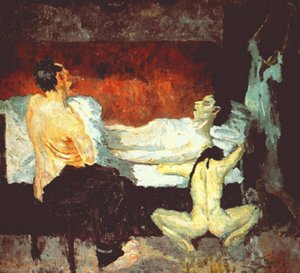
Max Beckmann's “Perseus. Triptych,” painted in 1941 during his self-imposed exile in Amsterdam, is not merely a depiction of Greek mythology; it’s a visceral exploration of trauma, isolation, and the precariousness of human existence rendered through a uniquely distorted lens. Born amidst the turmoil of World War I – an experience that fundamentally reshaped his artistic vision – Beckmann abandoned the polished surfaces and idealized forms of academic painting for a brutally honest portrayal of the world as he perceived it: fractured, chaotic, and imbued with a profound sense of unease. This triptych, measuring a substantial 151cm by 222.5cm, embodies this shift powerfully, inviting viewers into a psychological landscape far removed from classical serenity.
The painting’s composition immediately commands attention. The left panel presents a scene of ambiguous social interaction – perhaps a café or bar – populated by figures rendered with unsettlingly sharp angles and distorted proportions. Their faces are largely obscured, contributing to an atmosphere of detachment and anonymity. This deliberate lack of clarity establishes a sense of disorientation, mirroring the artist’s own experience of displacement and loss during his exile. The central panel explodes with dynamic energy. Here, Perseus – not as the heroic figure of legend, but as a powerfully built, almost monstrous presence – engages in what appears to be a violent struggle. The figures are intertwined, their bodies contorted into unnatural shapes, conveying a sense of desperate conflict and imminent danger. The color palette is dominated by stark contrasts: deep blues and blacks juxtaposed with flashes of crimson and ochre, intensifying the emotional impact.
Expressionist Distortion and the Trauma of War
Beckmann’s artistic style during this period – often categorized as New Objectivity or Neo-Expressionism – is characterized by a deliberate rejection of traditional perspective and realistic representation. He employed distortion not to deceive, but to reveal underlying truths about human psychology. The jagged lines, fragmented forms, and exaggerated proportions are direct responses to the horrors he witnessed in World War I, an event that shattered his faith in reason and order. The painting’s overall effect is profoundly unsettling, reflecting the artist's own anxieties and the pervasive sense of dread that gripped Europe during the lead-up to and throughout the war. The influence of Bosch and Grünewald, masters of depicting human suffering and moral ambiguity, can be clearly discerned in Beckmann’s use of symbolism and his willingness to confront uncomfortable realities.
Symbolism and Narrative Layers
Beyond its immediate depiction of a mythological struggle, “Perseus. Triptych” is rich with symbolic layers. The central panel, depicting Perseus's victory over Medusa, can be interpreted as an allegory for the artist’s own battle against artistic constraints and societal pressures. The confinement suggested in the right panel – a shadowy figure seemingly trapped within a dark space – speaks to themes of isolation, vulnerability, and the loss of freedom. The recurring motif of birds throughout the composition adds another layer of meaning, potentially representing both hope and despair—a reminder of the fleeting nature of beauty amidst chaos. Beckmann’s own life during this period was marked by constant displacement and a struggle for recognition, making these themes deeply personal.
A Legacy of Intensity: Reproduction and Appreciation
“Perseus. Triptych” remains one of Max Beckmann's most compelling and emotionally resonant works. Its raw intensity, masterful use of distortion, and profound exploration of the human condition continue to captivate viewers today. High-quality reproductions offer a remarkable opportunity to experience the power of this iconic painting firsthand. When selecting a reproduction, consider the medium – oil on canvas prints capture the texture and depth of Beckmann’s original brushstrokes with exceptional fidelity. This artwork is not simply a depiction of myth; it's an invitation to confront the complexities of human existence—a timeless testament to the artist’s unique vision and enduring legacy.
Biografia dell'artista
Primi anni di vita e sviluppo artistico
Max Beckmann, rinomato pittore, disegnatore, incisore, scultore e scrittore tedesco, nacque il 12 febbraio 1884 a Lipsia, in Sassonia. Il suo percorso artistico iniziò con rappresentazioni accademicamente corrette, che successivamente si trasformarono in figure e spazi distorti, riflettendo la sua visione alterata dell'umanità dopo aver prestato servizio come infermiere durante la prima guerra mondiale.Stile artistico e influenze
Lo stile di Beckmann, radicato nell’immaginario delle vetrate medievali, fu influenzato da vari artisti, tra cui Cézanne, Van Gogh, Blake, Rembrandt e Rubens. Trasse ispirazione anche dagli artisti nordici del tardo Medioevo e del primo Rinascimento, come Bosch, Bruegel e Matthias Grünewald.Opere notevoli ed esposizioni
- La Barka (acquisita dalla National Gallery di Berlino)
- Autoritratto in frac (acquistato nel 1928)
- Retrospettive alla Städtische Kunsthalle Mannheim (1928) e a Basilea e Zurigo (1930)
Vita successiva ed esilio
La fortuna di Beckmann cambiò con l'ascesa di Adolf Hitler, che portò al suo licenziamento dalla scuola d'arte di Francoforte e alla confisca di oltre 500 delle sue opere. Visse in autoesilio ad Amsterdam per dieci anni, senza riuscire a ottenere un visto per gli Stati Uniti.Eredità
- Insegnò nelle scuole d'arte della Washington University di St. Louis e del Brooklyn Museum
- La prima retrospettiva negli Stati Uniti ebbe luogo nel 1948 al City Art Museum di Saint Louis
- La Max-Slevogt Galerie, in Germania, espone una collezione delle sue opere
- Nato: 12 febbraio 1884
- Morto: 27 dicembre 1950

Max Beckmann
1884 - 1950 , Germania
Dati rapidi
- Artisti Influenti:
- Cézanne
- Van Gogh
- Blake
- Rembrandt
- Rubens
- Bosch
- Bruegel
- Matthias Grünewald
- Data Di Nascita: 12 febbraio 1884
- Luogo Di Nascita: Leipzig, Germania
- Movimento Artistico: Espressionismo tedesco
- Nazionalità: Tedesca
- Nome Completo: Max Beckmann
- Opere Notevoli:
- The Bark
- Self-Portrait in Tuxedo
Articoli correlati

Max Ernst: I 25 Capolavori che Rivoluzionarono l'Arte Moderna | OriginalUniqueArt
Esplora i 25 capolavori di Max Ernst, pioniere del Surrealismo. Scopri la storia, le tecniche e il simbolismo dietro ogni opera iconica. Trova riproduzioni arte su tela di alta qualità per decorare casa con OriginalUniqueArt.com.
I 25 Capolavori del Metropolitan Museum di New York: Arte, Storia e Decorazioni Raffinate
Esplora i 25 capolavori del Metropolitan Museum di New York! Scopri la storia, gli artisti (Van Gogh, Monet, Rembrandt) e le emozioni dietro dipinti iconici. Trova riproduzioni artistiche di alta qualità per decorare casa con stile su OriginalUniqueArt.com.

I Capolavori del DIA di Detroit: 25 Opere d'Arte Indimenticabili per la Tua Casa
Esplora i 25 capolavori del Detroit Institute of Arts! Van Gogh, Monet, Rembrandt e altri maestri. Scopri storie, tecniche e colori che hanno reso queste opere immortali. Trova riproduzioni artistiche di alta qualità per la tua casa su OriginalUniqueArt.com.
I Capolavori della National Gallery di Washington: 25 Opere Indimenticabili per la Tua Casa
Esplora i 25 capolavori imperdibili della National Gallery di Washington! Scopri la storia di Cézanne, Matisse, Picasso e altri maestri. Trova l'arte perfetta per la tua casa su OriginalUniqueArt.com.
Hieronymus Bosch: I 25 Capolavori che Rivoluzionano l'Arte e Decorano la Tua Casa
Esplora i 25 capolavori di Hieronymus Bosch, pittore fiammingo simbolo dell'arte medievale. Scopri il simbolismo del Giardino delle Delizie e altre opere iconiche. Riproduzioni d'arte su OriginalUniqueArt.com!