Passa alle stampe
 Espandi i dettagli







































 Per opere d'arte o riproduzioni con un lato superiore a 105 cm (circa 41 pollici), la cornice verrà spedita in forma di kit smontato. Questo metodo garantisce una consegna sicura e previene danni durante il trasporto.


Still Life: A Window into Chagall’s Dreamscape
Marc Chagall's “Still Life” transcends mere representation; it embodies a profound exploration of memory, emotion, and the artist’s distinctive vision. Painted in 1912 during his formative years in Paris—a period marked by experimentation with Cubism and Fauvism—this artwork stands as a testament to Chagall’s unwavering commitment to capturing not just what he saw but how he felt.
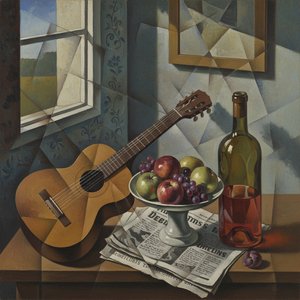
- Subject Matter: The composition centers around a meticulously arranged tableau of commonplace objects – vases, bottles, cups, and a bowl – transforming them into symbols of domestic tranquility and contemplation.
- Style & Technique: Chagall’s signature style is instantly recognizable: fluid brushstrokes imbue the scene with an ethereal quality, blurring boundaries between reality and fantasy. The artist employs vibrant hues—particularly blues and yellows—to evoke a sense of nostalgia and warmth.
Historical Context: Vitebsk's Influence
The painting’s genesis lies in Chagall’s deeply rooted connection to Vitebsk, Belarus – his birthplace and artistic incubator. The town’s multicultural landscape—characterized by Orthodox churches juxtaposed with Jewish marketplaces—served as a constant source of inspiration for Chagall’s oeuvre. This duality is reflected in the artwork's visual language, mirroring the artist’s own intellectual and spiritual journey.
- Symbolism: The vases themselves are laden with symbolic significance, representing fertility and abundance—themes prevalent in Jewish folklore and reflecting Chagall’s personal beliefs.
- Color Palette: The dominant blues and yellows contribute to an atmosphere of serenity and optimism, mirroring the artist's desire to convey a sense of timeless beauty.
Emotional Resonance
"Still Life" isn’t simply about depicting objects; it’s about conveying a feeling—a yearning for simpler times, a celebration of everyday life imbued with magic and wonder. Chagall's masterful use of color and brushwork invites viewers into his dreamscape, prompting contemplation on themes of memory, identity, and the enduring power of imagination.
- Artist’s Vision: Chagall sought to express not just what he observed but how he experienced the world—a characteristic that distinguishes him from many of his contemporaries.
- Legacy: “Still Life” exemplifies Chagall's enduring legacy as one of the most influential artists of the 20th century, whose work continues to inspire awe and admiration worldwide.
Domande e risposte
Qual è il colore dominante di "Titolo Tradotto: Natura Morta" di Marc Chagall?
Il colore dominante di "Titolo Tradotto: Natura Morta" di Marc Chagall è Grigio tortora (#dad0c9).
Quanti anni aveva Marc Chagall quando è stata creata "Titolo Tradotto: Natura Morta"?
Marc Chagall ha realizzato "Titolo Tradotto: Natura Morta" all'età di 25. L'artista è nato nel 1887 e l'opera risale al 1912.
Posso usare la realtà aumentata per vedere "Titolo Tradotto: Natura Morta" di Marc Chagall nella mia stanza?
La pagina Anteprima in AR di "Titolo Tradotto: Natura Morta" di Marc Chagall utilizza la realtà aumentata per visualizzare l'opera d'arte nel tuo spazio, tramite un dispositivo compatibile.
 Anteprima in scala reale
 Invia
Invia Condividi
 Dettagli opera
 Guida
Guida

 Scarica
 Simili
 Radiografia
 Slideshow
 Q&A
Q&A Statistiche