 Anteprima in scala reale
 Invia
Invia Condividi
 Dettagli opera
 Guida
Guida

 Scarica
 Simili
 Radiografia
 Slideshow
 Domande e risposte
 Statistiche
Donna con secchielli: Arrangiamento dinamico


 Espandi i dettagli
Giclée / Stampe d'arte
Stampa giclée o su tela di qualità museale, con produzione rapida e diverse opzioni di finitura. ( Acquista il dipinto realizzato a mano Passa all'immagine digitale)




P118B €10

P118H €10

P118W €10

P438Z €10

P508JH €12

P508YH €12

P805H €10

P805Z €10

P919BZ €10

P919G €10

P919XJ €10

P959ZH €10

P968JZ €12

W106C €8

W218G €10

W218JH €8

W218Y €10

W307PJ €10

W316G €10

W316PJ €8

W316Y €10

W398PJ €8

W4111J €10

W500HY €15

W500JH €15

W692G €12

W849H €8

W940BG €15

W953PJ €8




Scegli tra le nostre dimensioni predefinite, che rispettano le proporzioni originali dell'opera d'arte.

Inserisci la larghezza e l'altezza desiderate, per adattarle alla tua cornice o alla tua parete. Una stampa può essere solo ritagliata, mai resa più grande dell'immagine originale; pertanto, un formato con una forma differente comporterà la perdita di una parte dell'opera. Ti invieremo un mockup digitale da approvare prima di procedere con la stampa. L'immagine mostrata in questa pagina non rappresenta il ritaglio reale — solo il mockup lo mostra.
Consegna in tutto il mondo () in 2 settimane invece delle normali 4/5 settimane. (9 Novembre)

Spedizione espressa gratuita in tutto il mondo

Tela in lino di alta qualità

Assicurazione completa sulla spedizione

Garanzia di rimborso dei dazi doganali

Garanzia di fedeltà cromatica assoluta

Politica di reso entro 100 giorni (solo per difetti di fabbricazione)

Garanzia di rimborso al 100%

Offerta per acquisti multipli
 L'opzione vetro è disponibile solo per dimensioni inferiori a 110 cm

Donna con secchielli: Arrangiamento dinamico
Giclée / Stampe d'arte
Dimensioni riproduzione
-


Prezzo finale calcolato
€ 72
A Fragmented World: Decoding Malevich’s “Woman with Pails Dynamic Arrangement”
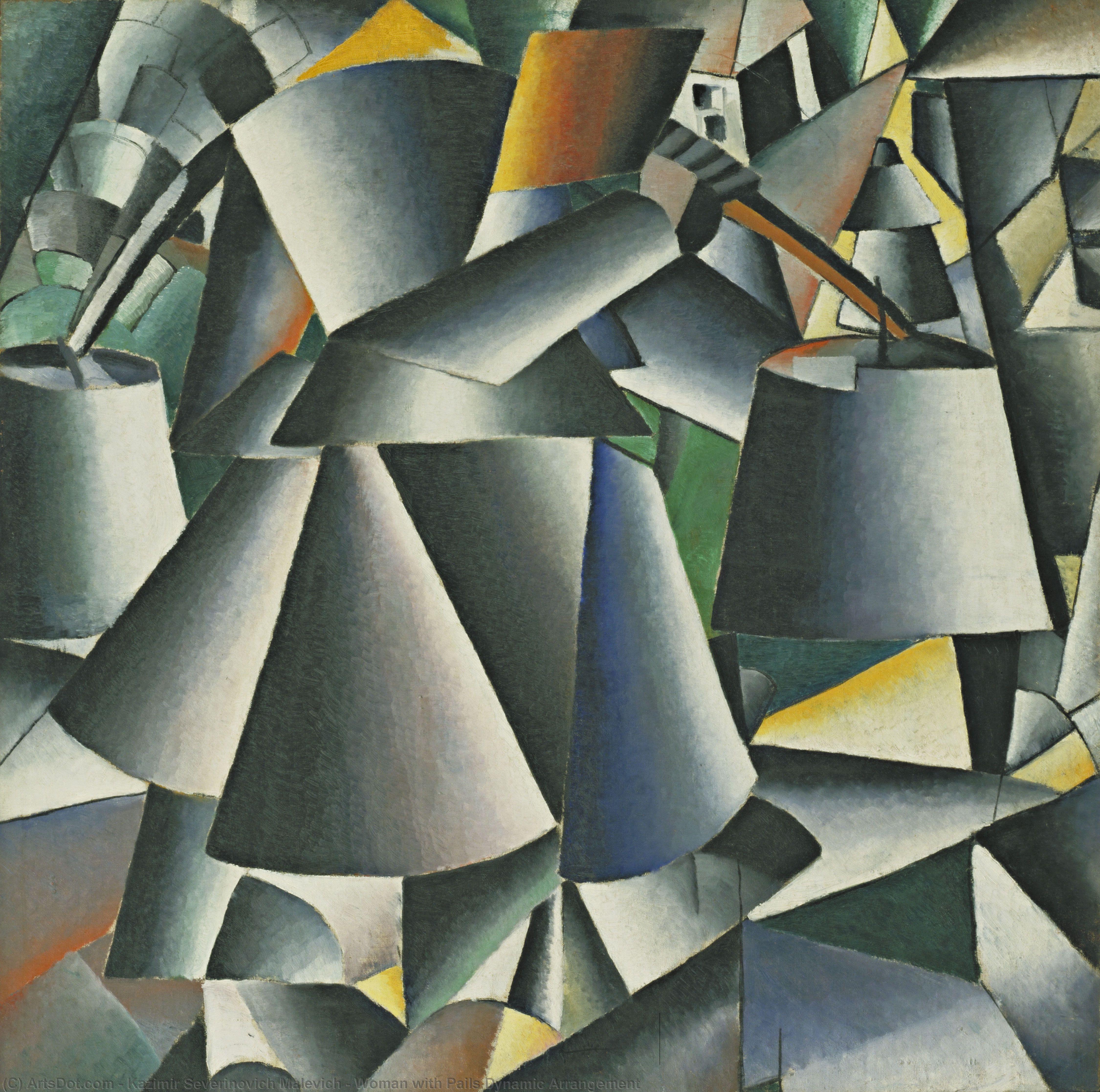
Kazimir Malevich's "Woman with Pails Dynamic Arrangement," painted around 1912, is not simply a depiction of figures carrying pails; it is a radical dismantling of visual representation itself. Emerging from a period of intense artistic experimentation, this work stands as a pivotal moment in the transition from Cubism towards Malevich’s own groundbreaking Suprematism. The painting doesn't invite passive observation but demands active decoding – a journey into a world fractured and reassembled according to a new logic of form and space. It is a testament to Malevich’s relentless pursuit of “pure feeling” in art, stripping away the illusionistic traditions that had dominated Western painting for centuries.
The Birth of Abstraction from Everyday Life
Before achieving complete non-objectivity with his iconic "Black Square," Malevich engaged deeply with the visual language of Cubism. However, “Woman with Pails Dynamic Arrangement” isn’t merely a mimicry of Picasso or Braque. While sharing their penchant for geometric fragmentation and multiple perspectives, Malevich infuses the scene with a distinctly Russian sensibility and a burgeoning spiritual dimension. The subject matter – peasant women engaged in a mundane task – is deliberately humble, elevating the everyday to a level of artistic significance. These are not idealized figures but rather abstracted representations of labor, rendered as interlocking planes of color and shape. The cool palette of blues, greys, greens, and whites, punctuated by accents of yellow and orange, contributes to a sense of restrained energy, avoiding the vibrant exuberance often associated with Fauvism or early Cubist works. The painting’s power lies in its ability to transform this ordinary scene into an exploration of fundamental artistic principles.
Deconstructing Form: Technique and Suprematist Tendencies
The technique employed in “Woman with Pails Dynamic Arrangement” is crucial to understanding Malevich's evolving vision. He eschews traditional modeling and chiaroscuro, opting instead for flat planes of color that intersect and overlap. Lines are sharp and angular, defining the geometric forms – triangles, rectangles, trapezoids – which seem to vibrate against one another. There’s a deliberate lack of depth; space is not created through perspective but rather suggested by the layering of these abstract shapes. This flattening of form anticipates the complete rejection of representational space that would characterize Suprematism. While still tethered to recognizable subject matter, the painting reveals Malevich's growing interest in pure geometric abstraction – an art focused on the inherent qualities of shape and color, divorced from any external reference. The smooth texture, achieved through careful application of oil paints, further emphasizes this focus on surface and form.
A Legacy of Radical Innovation
“Woman with Pails Dynamic Arrangement” occupies a unique position in art history as a bridge between the representational world and the realm of pure abstraction. It embodies Malevich’s revolutionary spirit and his unwavering commitment to pushing the boundaries of artistic expression. The painting's emotional impact is subtle yet profound – it evokes a sense of dynamism, fragmentation, and perhaps even disorientation, reflecting the anxieties and uncertainties of a rapidly changing world. More than just an aesthetic statement, this work represents a philosophical inquiry into the nature of perception and reality. It continues to inspire artists and viewers alike, reminding us that art has the power to challenge our assumptions and open up new ways of seeing.
Photo Description: --Overall Impression--
The artwork presents a dynamic and fragmented scene depicting figures carrying pails. It’s executed in a Cubist style characterized by geometric shapes, overlapping planes, and a flattened perspective. The composition is densely packed with forms, creating a sense of movement and energy.
Composition
The painting lacks traditional depth or spatial relationships. Figures are broken down into angular components and reassembled on the canvas, resulting in an abstract representation of reality. There's no clear focal point; instead, the eye moves across the surface following the lines and shapes.
Color Palette
The color palette is predominantly cool, featuring shades of blue, grey, green, and white. Accents of yellow and orange provide contrast and visual interest. Colors are not blended smoothly but rather applied in distinct planes.
Use of Lines & Shapes
Sharp, angular lines dominate the composition, defining the geometric forms. Triangles, rectangles, and trapezoids interlock and overlap, creating a complex network of shapes. The use of these shapes contributes to the painting’s fragmented and abstract nature.
Texture
While the image is a photograph of a painting, it suggests a relatively smooth texture due to the application of paint in flat planes. There’s no visible impasto or thick brushstrokes.
Lighting
The lighting appears diffused and even, with no strong highlights or shadows. This contributes to the overall flatness of the composition.
Perspective & Depth
Traditional perspective is absent. The painting creates a sense of depth through overlapping shapes rather than linear recession.
Subject Matter
The subject matter is seemingly mundane – people carrying pails – but it’s transformed into an abstract exploration of form and space.
Symbolic/Emotional Elements
The dynamic arrangement and fragmented forms evoke feelings of movement, energy, and perhaps even a sense of disorientation. The painting challenges traditional notions of representation.
Style & Technique
This work is firmly rooted in the Cubist style, pioneered by Pablo Picasso and Georges Braque. Malevich’s interpretation incorporates his own Suprematist tendencies, emphasizing geometric abstraction.
Materials Used
Based on the image, it appears that oil paints were used on canvas.
Domande e risposte
Posso visualizzare "Donna con secchielli: Arrangiamento dinamico" come una presentazione a schermo intero?
È disponibile un diaporama: la pagina Slideshow di "Donna con secchielli: Arrangiamento dinamico" di Kazimir Malevič.
Qual è la luminosità complessiva di "Donna con secchielli: Arrangiamento dinamico"?
Nel complesso, "Donna con secchielli: Arrangiamento dinamico" è classificata come equilibrata. La luminosità percepita indica quanto l'opera appaia chiara o scura.
Che atmosfera saprebbe conferire a una stanza una riproduzione di "Donna con secchielli: Arrangiamento dinamico" di Kazimir Malevič?
L'atmosfera Minimalista di "Donna con secchielli: Arrangiamento dinamico" di Kazimir Malevič si sposa perfettamente con lo spazio consigliato: un/una Zona living.
Biografia dell'artista
Kazimir Malevich: Un Pioniere dell'Arte Astratta
Primi Anni di Vita e Influenze
- Nato nell'Oblast di Kyiv, in Ucraina, nel 1878 all'interno di una famiglia polacca, la giovinezza di Kazimir Severinovich Malevich fu profondamente plasmata dai paesaggi rurali ucraini e dalla loro ricca cultura popolare.
- La sua educazione gli trasmise un profondo apprezzamento per le espressioni artistiche tradizionali che, in seguito, avrebbero influenzato sottilmente la sua opera.
- Sebbene la sua formazione formale sia iniziata a Kyiv, Malevich cercò rapidamente orizzonti artistici più ampi, spostandosi verso Mosca e arrivando infine a confrontarsi con i nascenti movimenti d'avanguardia dell'Europa.
- Influenze Chiave: L'esposizione precoce all'arte popolare, unita al desiderio di una nuova espressione moderna, costituì le fondamenta del suo stile unico.
Sviluppo Artistico e Movimenti Fondamentali
- Inizialmente, Malevich esplorò vari stili tra cui l'Impressionismo, il Simbolismo, il Fauvismo e il Cubismo. Un viaggio cruciale a Parigi nel 1912 lo mise in contatto con le ultime evoluzioni dell'arte europea.
- Gradualmente, l'artista si allontanò dalle forme rappresentative, ricercando un linguaggio puramente artistico basato su forme geometriche e sul colore.
- Questo percorso portò allo sviluppo del Suprematismo intorno al 1915, un movimento astratto focalizzato sulla "supremazia del puro sentimento" nell'arte.
- Il Suprematismo rifiutava ogni tentativo di ritrarre oggetti del mondo visibile, dando invece priorità a forme geometriche elementari come quadrati, cerchi e rettangoli.
Grandi Traguardi e Opere Notevoli
- Quadrato Nero (1915): Probabilmente la sua opera più celebre, rappresenta una rottura radicale con l'arte tradizionale ed è considerata un pilastro fondamentale della pittura astratta.
- Bianco su Bianco (1918): Una serie che esplora la purezza della forma e del colore, caratterizzata da forme geometriche bianche su uno sfondo bianco, spingendo l'astrazione ai suoi limiti estremi.
- Stroyuschiysya dom [Casa in costruzione] (1916): Un esempio precoce di Suprematismo che mostra la sua prospettiva unica sulla cultura ucraina attraverso forme astratte.
- L'artista scrisse anche ampiamente sulla teoria dell'arte, articolando i principi filosofici alla base del Suprematismo e sostenendo la nascita di una nuova coscienza artistica.
Significato Storico e Eredità
- L'opera di Malevich ha avuto un impatto profondo sullo sviluppo dell'arte astratta del XX secolo, influenzando movimenti come il Minimalismo e il Costruttivismo.
- Egli sfidò le nozioni convenzionali di rappresentazione, aprendo la strada all'arte non oggettiva.
- Le sue idee sul puro sentimento e sull'astrazione geometrica continuano a risuonare negli artisti contemporanei.
- Nonostante abbia affrontato la persecuzione politica sotto Stalin – inizialmente sostenuto, poi represso – Malevich perseverò nella sua pratica artistica e nell'insegnamento.
- Influenza sugli Artisti Successivi: Ha influenzato direttamente artisti come El Lissitzky e ha plasmato indirettamente innumerevoli altri attraverso l'eredità duratura del Suprematismo.
Ultimi Anni e Morte
- Negli ultimi anni della sua vita, Malevich tornò alla pittura figurativa, tentando di sintetizzare i suoi principi astratti con forme rappresentative.
- Continuò a insegnare e a scrivere d'arte fino alla sua morte a Leningrado (l'odierna San Pietroburgo) nel 1935.
- La sua opera rimase relativamente oscura per decenni dopo la sua scomparsa, ma visse una rinascita di interesse nella seconda metà del XX secolo, consolidando il suo posto come una delle figure più importanti della storia dell'arte moderna.

Kazimir Malevič
1878 - 1935 , Ucraina
Dettagli rapidi
- Artistic Movement Or Style: Suprematismo, Astrattismo
- Artists Or Movements Influenced By This Artist:
- El Lissitzky
- Minimalismo
- Costruttivismo
- Artists Who Influenced This Artist:
- Impressionismo
- Simbolismo
- Cubismo
- Date Of Birth: 1878
- Date Of Death: 1935
- Full Name: Kazimir Malevich
- Nationality: Ucraino/Russo
- Notable Artworks:
- Quadrato Nero
- Bianco su Bianco
- Casa sotto costruzione
- Place Of Birth (City And Country): Kiev, Ucraina
Articoli correlati

I 25 Capolavori di Kazimir Malevich: Guida al Suprematismo
Scopri i 25 capolavori di Kazimir Malevich e l'essenza del Suprematismo. Esplora la collezione su OriginalUniqueArt.com.

Astrazione Geometrica: 10 Capolavori che Hanno Definito un Movimento Artistico
Esplora i 10 capolavori dell'Astrazione Geometrica: Mondrian, Malevich e Kandinsky rivoluzionano l'arte moderna. Scopri la storia, i colori e le tecniche di questi movimenti iconici. Stampe d'arte di alta qualità su OriginalUniqueArt.com!

Suprematism Explained: The Radical Geometry and Pure Feeling of Kazimir Malevich
Explore the radical world of Suprematism. Discover how Kazimir Malevich revolutionized modern art through pure geometric abstraction, non-objective form, and the supremacy of feeling. An essential guide for art students and collectors seeking deep historical context.

Beyond Form & Color: Geometric Abstraction's Evolution in 20th/21st Century Art
Explore the evolution of geometric abstraction from Cubism to contemporary art. Discover key artists like Malevich & Mondrian, investment insights, and expert collecting advice at OriginalUniqueArt.

Beyond Form & Color: Geometric Abstraction's Enduring Legacy in Art History
Explore the captivating world of geometric abstraction! Discover its origins, key artists like Malevich & Mondrian, and why this movement remains highly valued by art collectors today. Expert insights at OriginalUniqueArt.


![Cerchio nero [1913]](/media/artworks/images-thumb/62/67/6267e452b0c8476772a6511e19ce1616.jpg)