Acquista l'originale a olio
 Scopri di più su Thomas Mifflin







































 Per opere d'arte o riproduzioni con un lato superiore a 105 cm (circa 41 pollici), la cornice verrà spedita in forma di kit smontato. Questo metodo garantisce una consegna sicura e previene danni durante il trasporto.


Portrait of Thomas Mifflin by John Trumbull
This miniature portrait of Thomas Mifflin, painted by John Trumbull in 1790, offers a quiet glimpse into the life of a significant figure from colonial Pennsylvania. Mifflin was a man of considerable influence during the formative years of the American republic. He served as a member of the legislature and eventually held the position of governor of the state. His presence in the political landscape of the era was marked by a steady, formal dignity.
Trumbull captures Mifflin from the chest up, presenting him within an elegant oval frame. The subject is depicted with a sense of gravitas, his attire reflecting the status and respectability of a prominent statesman. There is a certain introspection in his expression, a quality that invites closer observation of the fine details Trumbull has rendered. It is a small work, yet it carries the weight of the history it represents.
Composition and Visual Elements of the Portrait
The composition is centered upon the face and upper torso of Thomas Mifflin, presented from the chest up. While the subject occupies the heart of the arrangement, he is positioned slightly off-center within the oval frame, a subtle choice that lends a sense of movement to an otherwise formal posture. This slight asymmetry prevents the portrait from feeling static, providing a quiet dynamism to his presence. The background remains relatively plain, ensuring that no external distractions pull the eye away from the sitter.
The lighting is soft and diffused, appearing to originate from an unseen source above and slightly to the left. This gentle illumination creates subtle shadows that define the contours of his features and the texture of his clothing. Because of the nature of this miniature, the perspective is relatively flat, typical of the medium. Depth is achieved not through spatial recession, but through the careful layering of tonal variations, where the face appears to sit slightly forward of the clothing.
Technique and Materials Used in the Work
In this miniature portrait, the artist utilizes a meticulous approach to capture the likeness of Thomas Mifflin. The medium is likely watercolor or gouache applied to ivory, a choice that allows for a delicate, luminous quality. Through the use of fine brushstrokes, Trumbull achieves subtle gradations of tone that define the contours of the face and the texture of the hair. This careful layering of tones is essential to the work, as it creates a sense of depth and form within such a small scale. The piece measures 9 x 7 cm, requiring a high degree of precision to execute the details of the cravat and the lapels of the suit.
The physical presence of the original work is captured here through a photograph. The soft, diffused lighting suggests an unseen source from above and to the left, casting gentle shadows that give the subject a sense of quiet introspection. The organic shapes of the face and the voluminous texture of the wig are rendered with a controlled hand, contrasting with the geometric oval of the frame. Every detail, from the fine lines of the facial features to the shading of the skin, relies on the artist's ability to manipulate pigment with extreme restraint.
Related Works by John Trumbull
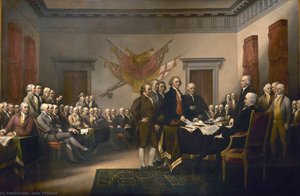
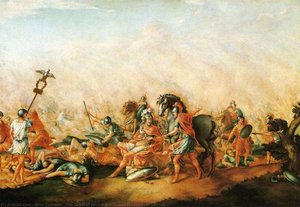
Trumbull’s career was defined by a profound connection to the American Revolution, a period he witnessed firsthand. His ability to capture the gravity of historical moments is evident in his larger compositions, such as his depictions of the Death of General Mercer at the Battle of Princeton and The Resignation of General Washington. These works demonstrate his capacity to translate significant political and military events into visual narratives. He also applied his skill to the monumental Declaration of Independence in 1817, a piece that helped shape the visual memory of the nation's founding.
Beyond these large-scale historical scenes, the artist was a prolific creator of smaller, more intimate works. He produced approximately 250 miniatures throughout his life, demonstrating a remarkable precision in a much more delicate format. This versatility allowed him to move between the grand scale of history painting and the meticulous detail required for private portraiture. His portraits of key figures, such as his 1790 depiction of George Washington and his 1805 portrait of Alexander Hamilton, reflect the same dedication to likeness and character that defines his broader body of work.
Domande e risposte
Thomas Mifflin è un dipinto fatto a mano o una stampa?
Dipinto a mano: un pittore professionista riproduce Thomas Mifflin a olio su tela di lino.
Che dimensioni dovrei scegliere per Thomas Mifflin?
L'originale misura 9 x 7 cm. Le dimensioni vanno da 35.0 x 28.6 cm (€178) a 243.3 x 198.7 cm (€1578); la tabella in questa pagina elenca le opzioni principali e i relativi prezzi.
Quanto tempo richiede la consegna?
La consegna richiede dalle 4 alle 5 settimane, con spedizione espressa gratuita in tutto il mondo; su questa pagina è disponibile un'opzione di produzione urgente. È possibile restituire l'opera entro 100 giorni per un rimborso completo, senza alcuna condizione.
Dove si trova l'originale di Thomas Mifflin?
L'originale fa parte della collezione del Metropolitan Museum of Art, New York.
Quale tecnica ha utilizzato John Trumbull per Thomas Mifflin?
Watercolor
Maggiori informazioni su questo dipinto
 Anteprima in scala reale

 Invia
 Condividi
 Dettagli opera
 Scheda didattica


 Scarica
 Simili
 Radiografia
 Slideshow
 Domande e risposte

 Statistiche