Acquista l'originale a olio
 Scopri di più su John Maunsell







































 Per opere d'arte o riproduzioni con un lato superiore a 105 cm (circa 41 pollici), la cornice verrà spedita in forma di kit smontato. Questo metodo garantisce una consegna sicura e previene danni durante il trasporto.


Identification of the Portrait of John Maunsell
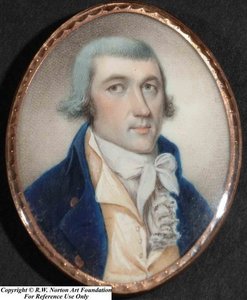
This miniature portrait by John Ramage depicts the British general John Maunsell. Executed in 1785, the work captures the likeness of the subject shortly after his return to New York State from a voluntary exile in Ireland during the revolution. Maunsell, who lived from 1724 to 1795, is presented in a formal manner that reflects his military standing.
Ramage, an Irish-born artist who became a prominent figure in the colonial American art scene, produced this piece during a period of significant political upheaval. The sitter's presence in the portrait is defined by his attire and the specific timing of the commission, which follows his relocation from Ireland to the American colonies.
Composition and Visual Elements
The subject is centered within an oval space, dominating the frame in a strict frontal view. This perspective offers no sense of depth beyond the immediate plane, focusing entirely on the sitter's likeness. He is presented in a red military-style coat layered over a white frilled shirt, establishing a formal silhouette against the background.
A circular copper frame encloses the portrait, featuring a delicate scrolled border. The color palette is restrained, dominated by reds, whites, and browns. These tones emphasize the sitter's attire and the formal dignity of the presentation.
Technique and Physical Materials
Executed in oil on panel, this miniature measures 4 x 3 cm. The artist employed fine brushes to achieve exceptional detail, utilizing meticulously controlled lines to define the subject's facial features and the folds of the red military-style coat. The precision of the brushwork allows for a clear rendering of the white frilled shirt and the textures of the sitter's attire.
The portrait is encased within a circular copper frame. This housing features a delicate scrolled border and includes a pin attached to the reverse for hanging. The composition is contained within this oval space, focusing the viewer's attention on the central figure.
Related Works by John Ramage
Ramage’s practice during the late eighteenth century focused heavily on the intimate scale of portrait miniatures. His ability to capture the likeness of the era's social and political elite is evident in several contemporary commissions. In 1785, he produced a portrait of Governor George Clinton, and by 1787, he had painted William Few. These works reflect the same technical precision used to render the features of prominent figures within the burgeoning American social landscape.
The artist’s reach extended to the highest levels of leadership during the early years of the new nation. In 1789, he received a commission to paint George Washington, becoming the first artist to portray the president while in office. This period of high-profile portraiture also included his work on Mrs. James Bleecker (Elizabeth Garland Bache) in 1788. Through these varied subjects, Ramage documented the faces of a changing society, from political leaders to private citizens.
Domande e risposte
John Maunsell è un dipinto fatto a mano o una stampa?
Dipinto a mano: un pittore professionista riproduce John Maunsell a olio su tela di lino.
Che dimensioni dovrei scegliere per John Maunsell?
L'originale misura 4 x 3 cm. Le dimensioni vanno da 37.3 x 26.8 cm (€178) a 248.7 x 178.3 cm (€1460); la tabella in questa pagina elenca le opzioni principali e i relativi prezzi.
Quanto tempo richiede la consegna?
La consegna richiede dalle 4 alle 5 settimane, con spedizione espressa gratuita in tutto il mondo; su questa pagina è disponibile un'opzione di produzione urgente. È possibile restituire l'opera entro 100 giorni per un rimborso completo, senza alcuna condizione.
Dove si trova l'originale di John Maunsell?
L'originale fa parte della collezione del Metropolitan Museum of Art, New York.
Quale tecnica ha utilizzato Giovanni Ramage per John Maunsell?
Oil On Panel
Maggiori informazioni su questo dipinto
 Anteprima in scala reale

 Invia
 Condividi
 Dettagli opera
 Scheda didattica


 Scarica
 Simili
 Radiografia
 Slideshow
 Domande e risposte

 Statistiche