Anteprima in scala reale
 Invia
Invia Condividi
 Dettagli opera
 Guida
Guida

 Scarica
 Simili
 Radiografia
 Slideshow
 Q&A
Q&A Statistiche
Mountain Landscape with Indians


 Espandi i dettagli
Giclée / Stampe d'arte
Stampa giclée o su tela di qualità museale, con produzione rapida e diverse opzioni di finitura. ( Acquista il dipinto realizzato a mano Passa all'immagine digitale)




P118B €10

P118H €10

P118W €10

P438Z €10

P508JH €12

P508YH €12

P805H €10

P805Z €10

P919BZ €10

P919G €10

P919XJ €10

P959ZH €10

P968JZ €12

W106C €8

W218G €10

W218JH €8

W218Y €10

W307PJ €10

W316G €10

W316PJ €8

W316Y €10

W398PJ €8

W4111J €10

W500HY €15

W500JH €15

W692G €12

W849H €8

W940BG €15

W953PJ €8




Scegli tra le nostre dimensioni predefinite, che rispettano le proporzioni originali dell'opera d'arte.

Inserisci la larghezza e l'altezza desiderate, per adattarle alla tua cornice o alla tua parete. Una stampa può essere solo ritagliata, mai resa più grande dell'immagine originale; pertanto, un formato con una forma differente comporterà la perdita di una parte dell'opera. Ti invieremo un mockup digitale da approvare prima di procedere con la stampa. L'immagine mostrata in questa pagina non rappresenta il ritaglio reale — solo il mockup lo mostra.
Consegna in tutto il mondo () in 2 settimane invece delle normali 4/5 settimane. (2 Novembre)

Spedizione espressa gratuita in tutto il mondo

Tela in lino di alta qualità

Assicurazione completa sulla spedizione

Garanzia di rimborso dei dazi doganali

Garanzia di fedeltà cromatica assoluta

Politica di reso entro 100 giorni (solo per difetti di fabbricazione)

Garanzia di rimborso al 100%

Offerta per acquisti multipli
 L'opzione vetro è disponibile solo per dimensioni inferiori a 110 cm

Mountain Landscape with Indians
Giclée / Stampe d'arte
Dimensioni riproduzione
-


Prezzo finale calcolato
€ 71
A Pioneer’s Vision: John Mix Stanley's “Mountain Landscape with Indians”
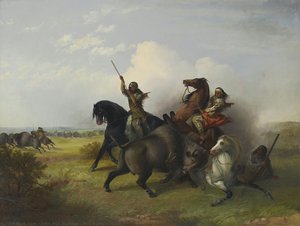
John Mix Stanley’s “Mountain Landscape with Indians,” painted circa 1870-75, isn’t merely a depiction of the American West; it’s a carefully constructed narrative of exploration, cultural encounter, and the burgeoning romanticism of the era. This oil on canvas, now housed within the Detroit Institute of Arts, offers a glimpse into a pivotal moment in American art history – a time when artists were actively seeking to document and interpret the vast, untamed territories of the nation. Stanley’s work stands as a testament to his dedication to capturing both the grandeur of the landscape and the dignity of its indigenous inhabitants, a perspective increasingly rare for the period.
The painting immediately draws the eye with its dramatic composition. A towering mountain range dominates the background, its snow-capped peaks piercing a hazy blue sky – a classic Romantic motif emphasizing the sublime power of nature. Below, a verdant valley unfolds, bisected by a winding river and dotted with small settlements nestled amongst the trees. Yet, it’s not just the landscape that commands attention; several canoes glide across the lake, carrying figures who suggest both peaceful coexistence and the subtle tension inherent in interactions between settlers and Native American tribes. The inclusion of these boats subtly hints at the burgeoning trade and interaction between cultures, a complex dynamic often overlooked in simpler portrayals of westward expansion.
The Artist’s Journey: Stanley's Western Odyssey
Understanding “Mountain Landscape with Indians” requires appreciating John Mix Stanley’s extraordinary life. Born in upstate New York, he was orphaned at twelve and apprenticed as a coach maker – experiences that instilled within him a remarkable self-reliance and an acute observational skill. Stanley’s artistic journey began humbly, painting signs and portraits to make ends meet before embarking on his ambitious project: to document the lives of Native Americans in the American West. This wasn't a casual undertaking; it was driven by a genuine desire to understand and represent these cultures with respect and accuracy – a radical stance for an artist of that time.
His travels took him across vast distances, from the Cherokee Council at Tahlequah to the plains inhabited by the Comanche. He meticulously observed tribal customs, documented their clothing, weaponry, and social structures, translating these observations onto canvas with remarkable detail. Stanley’s decision to accompany Colonel Stephen Watts Kearney's expedition further cemented his role as a chronicler of the West, capturing not only landscapes but also the realities of military campaigns and the challenges faced by both soldiers and indigenous peoples.
Symbolism and Romantic Ideals
The painting is deeply rooted in the tenets of Romanticism. The dramatic lighting, the emphasis on emotional response to nature’s grandeur, and the portrayal of Native Americans as noble figures embodying a connection to the land all align with this artistic movement. Stanley wasn't simply recording what he saw; he was imbuing his work with a sense of awe, wonder, and a romanticized vision of the West – a vision that often idealized both the wilderness and its inhabitants.
The presence of the canoes and the figures within them carries symbolic weight. They represent not just trade or interaction but also a potential for harmony between cultures, albeit one fraught with historical complexities. The mountains themselves can be interpreted as guardians of ancient wisdom, while the river symbolizes the flow of time and the interconnectedness of all things. Stanley’s deliberate use of color – the vibrant greens of the valley contrasting with the stark blues and whites of the mountains – further enhances this symbolic richness.
A Legacy in Reproduction: Bringing Stanley's Vision to Life
Today, “Mountain Landscape with Indians” stands as a significant work of American art, offering a valuable window into the 19th century. OriginalUniqueArt’s meticulously crafted reproductions aim to faithfully capture the essence of Stanley’s original vision, preserving the painting’s dramatic composition, evocative colors, and profound sense of place. By reproducing this iconic artwork with such care, we honor Stanley's legacy as a pioneering artist who sought to document and celebrate the beauty and complexity of the American West – a journey that continues to resonate with viewers today.
Domande e risposte
Il soggetto di "Mountain Landscape with Indians" è coerente con i temi abituali di John Mix Stanley?
I temi ricorrenti di John Mix Stanley includono catlin’s native american portraits, westward exploration, settlement themes, cherokee, creek tribal depictions, stanley’s documented west journey, documenting frontier life, culture; "Mountain Landscape with Indians" si concentra su landscape, indians, mountains, west, exploration, stanley, native americans, 1870.
Quale soggetto e quale atmosfera si incontrano in "Mountain Landscape with Indians" di John Mix Stanley?
"Mountain Landscape with Indians" di John Mix Stanley ritrae landscape, indians, mountains, west, exploration, stanley, native americans, 1870, con un'atmosfera Calm. Il soggetto e l'atmosfera insieme descrivono l'opera.
È possibile visualizzare un'anteprima di "Mountain Landscape with Indians" di John Mix Stanley prima dell'ordine?
È disponibile un'anteprima di "Mountain Landscape with Indians" di John Mix Stanley nella pagina Anteprima in ambiente dell'opera.
Biografia dell'artista
Primi Anni e Formazione
- Nascita: 17 gennaio 1814, a Canandaigua, New York
- Genitori: Seth e Sally (McKinney) Stanley
- Rimasto orfano all'età di 12 anni.
- Apprendistato presso un carrozziere all'età di 14 anni.
- Abilità pittoriche auto-didatta.
- Si trasferì a Detroit, Michigan nel 1832, diventando un pittore itinerante di insegne e ritratti.
Carriera Artistica e Sviluppo
- Primi Anni (1830-1840): Iniziò come pittore di insegne e ritrattista a Detroit e nelle aree circostanti. Viaggiò verso Fort Snelling, Galena e Chicago.
- Esplorazioni del Sud-Ovest (1842-1845): Accompagnò Sumner Dickerman nel Sud-Ovest americano specificamente per dipingere i nativi americani. Si stabilì a Fort Gibson nell'Indian Territory (l'odierna Oklahoma). Documentò la vita tribale, partecipando a un consiglio tra Cherokee e rappresentanti del Texas a Tahlequah.
- Servizio nella Guerra Messicano-Americana (1846): Fu nominato disegnatore per l'espedizione del Colonnello Stephen Watts Kearney in California e nel Territorio dell'Oregon. Produrse schizzi e dipinti della campagna.
- Ritratti hawaiani (1847-1848): Viaggiò alle Hawaii, dove dipinse ritratti del Re Kamehameha III e della sua famiglia.
- Mostre ed Riconoscimenti (1850s): Organizzò ed esibì grandi gallerie di ritratti indiani in varie città. Presentò una grande mostra al Smithsonian Institution nel 1852, esponendo quasi 200 opere che rappresentavano 43 tribù. Ricevette recensioni positive ma non riuscì a vendere la sua collezione al governo o allo Smithsonian.
- Panorama (1854): Espose un panorama di 42 scene di scene occidentali a Washington, D.C., Baltimora, New York e Londra; questo lavoro è ora perduto.
- Perdite e Declino: Una parte significativa delle sue opere fu distrutta in un incendio del 1865 allo Smithsonian Institution. Questo evento contribuì a un declino della reputazione di Stanley per qualche tempo.
Stile Artistico e Influenze
- Soggetti: Si concentrò principalmente su paesaggi, ritratti di nativi americani e raffigurazioni della vita tribale nel West americano e alle Hawaii.
- Influenze: Ispirato dal lavoro di George Catlin, un pioniere nella pittura dei nativi americani.
- Stile: Sebbene documentasse i suoi soggetti con macchina fotografica e matita prima dell'esecuzione, i dipinti di Stanley erano spesso organizzati in modo accademico. Alcuni critici hanno notato una mancanza di profonda empatia per le culture dei nativi americani rispetto a Catlin.
- Documentazione: Le sue opere sono apprezzate come documenti storici che forniscono spunti sugli incontri del XIX secolo tra americani bianchi e tribù native americane.
Realizzazioni Importanti e Significato Storico
- Raffigurazione Pionieristica della Vita dei Nativi Americani: Stanley fu tra i primi artisti a documentare sistematicamente le culture dei nativi americani attraverso la pittura, contribuendo in modo significativo ai registri visivi di queste società.
- Viaggi Estesi e Documentazione: I suoi viaggi attraverso il West americano e le Hawaii hanno prodotto un vasto corpus di opere che raffigurano paesaggi e popoli diversi.
- Documento Storico: Nonostante la perdita di gran parte della sua opera d'arte, i dipinti sopravvissuti forniscono preziose informazioni sulla vita di frontiera del XIX secolo e sulle culture dei nativi americani.
- Riscoperta e Apprezzamento: I contributi di Stanley all'arte americana sono stati rivalutati negli ultimi decenni, con le sue opere ora conservate in musei nazionali e regionali.
Ultimi Anni e Morte
- Tornò a Detroit nel 1863.
- Morì il 10 aprile 1872 a Detroit, Michigan.
- La sua eredità fu inizialmente oscurata dalla perdita della sua opera d'arte ma da allora è stata riconosciuta per il suo valore storico e artistico.

John Mix Stanley
1814 - 1872 , Stati Uniti d'America
Dettagli rapidi
- Artistic Movement Or Style: Paesaggio e arte nativa americana
- Artists Who Influenced This Artist: ['George Catlin']
- Date Of Birth: 17 gennaio 1814
- Date Of Death: 10 aprile 1872
- Full Name: John Mix Stanley
- Nationality: Americano
- Notable Artworks: ['Il Fiume nella Curva']
- Place Of Birth (City And Country): Canandaigua, USA
Articoli correlati

Grant Wood e il Regionalismo Americano: Identità, Mito e Paesaggio Rurale
Esplora il Regionalismo Americano con Grant Wood e i suoi capolavori. Analisi approfondita di 'American Gothic', contesto storico, influenze artistiche e l'eredità di questo movimento iconico. Scopri la vera essenza dell'arte rurale americana.

I 10 Capolavori del Paesaggio Romantico: Arte, Storia e Decorazioni di Lusso
Esplora i 10 capolavori del Paesaggio Romantico con OriginalUniqueArt.com! Caspar David Friedrich, Turner e altri maestri: storia, tecnica e colori che definiscono un'epoca. Trova riproduzioni d'arte di lusso per la tua casa. Scopri la collezione completa online!

John Singer Sargent: I 25 Capolavori Immortali per Arredare con Stile
Esplora i 25 capolavori di John Singer Sargent, pittore americano simbolo dell'Impressionismo e del Gilded Age. Ritratti iconici, acquerelli luminosi e storie affascinanti. Trova la tua opera d'arte ideale su OriginalUniqueArt.com!

I 25 capolavori di John Constable: la poesia della natura inglese
Scopri i 25 capolavori di John Constable e il Romanticismo inglese. Esplora la collezione su OriginalUniqueArt.com.

John Frederick Kensett: Luce, Paesaggio e l'Identità Americana nell'Età dell'Oro della Pittura
Esplora la vita e l'opera di John Frederick Kensett, maestro del Luminismo americano. Scopri i suoi paesaggi sereni, l'innovativa tecnica pittorica e il suo contributo all'arte del XIX secolo. Approfondimenti esclusivi su OriginalUniqueArt.