Passa alle stampe
 Espandi i dettagli







































 Per opere d'arte o riproduzioni con un lato superiore a 105 cm (circa 41 pollici), la cornice verrà spedita in forma di kit smontato. Questo metodo garantisce una consegna sicura e previene danni durante il trasporto.


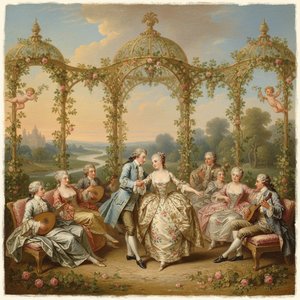
The Country Dance
Jean Antoine Watteau’s Country Dance stands as a cornerstone of Rococo art—a movement defined by elegance, frivolity, and an embrace of pastoral beauty. Created around 1706-1710 during Watteau’s formative years in Paris, this early masterpiece encapsulates his singular vision and establishes him as one of the foremost painters of his era.
Description and Composition
The painting transports us to a tranquil forest scene where a group of villagers engage in lively dancing. At its heart lies a couple entwined in affectionate embrace, symbolizing harmony and intimacy—a motif prevalent throughout Watteau’s oeuvre. A young child playfully mimics the lady's movements, injecting an element of youthful exuberance into the tableau. Notably, musicians positioned at the periphery glance towards the viewer with subtle amusement, fostering an interactive experience that was characteristic of Watteau’s artistic approach.
Watteau’s stylistic brilliance is evident in his masterful juxtaposition of contrasting elements. The dark forest backdrop sharply delineates against the vibrant hues of the peasants' clothing—a deliberate tactic designed to heighten visual impact and draw attention to their refined attire despite the rustic setting. This harmonious blend reflects both the allure of rural landscapes and the aristocratic sensibilities that underpinned the Rococo aesthetic.
Historical Significance
Considered Watteau’s earliest known work, The Country Dance immediately distinguishes itself through Watteau's distinctive style—influenced by Flemish artists like Pieter Bruegel and Peter Paul Rubens—while simultaneously incorporating Venetian landscape traditions.
More than just a depiction of social ritual, the painting embodies the spirit of its time. It reflects the burgeoning interest in idealized pastoral life and celebrates the pleasures of refined company amidst natural surroundings—themes that resonated deeply with audiences captivated by the emerging Rococo movement.
Acquisition and Display
The Country Dance was generously gifted to the Indianapolis Museum of Art (IMA) in 1974 by Mrs. Herman C. Krannert. Currently housed in the Charles O. McGaughey Gallery and bearing accession number 74.98, it offers visitors a privileged glimpse into Watteau’s artistic legacy.
Relevance and Context
Examining The Embarkation for Cythera alongside The Country Dance provides invaluable insight into Watteau’s artistic trajectory and his contribution to the broader history of art. His influence extended far beyond his immediate contemporaries, shaping the aesthetic sensibilities of subsequent generations.
Further Reading and Resources
For a deeper understanding of Jean Antoine Watteau and his remarkable oeuvre, consult:
- Painting by 'Jean Antoine Watteau' | Jean Antoine Watteau:The Country Dance
- The Country Dance on Wikipedia
Explore other noteworthy artworks and artists:
- Discover the Masterpieces of Musée Des Beaux-Arts Strasbourg, France
- List of artworks at the Indianapolis Museum of Art on Wikipedia
Domande e risposte
Il copyright di "La Danse Champetre" di Jean-Antoine Watteau consente la riproduzione dell'opera?
Lo stato del copyright di "La Danse Champetre" di Jean-Antoine Watteau è chiaro: l'opera è di pubblico dominio - il copyright è scaduto. La sua presenza presso Museo d'Arte non ne cambia lo stato.
È disponibile una presentazione a diapositiva per "La Danse Champetre" di Jean-Antoine Watteau?
Il diaporama di "La Danse Champetre" è disponibile nella pagina Slideshow dell'opera.
Dove posso vedere un'anteprima di "La Danse Champetre"?
La pagina di Anteprima in ambiente di "La Danse Champetre" ti permette di visualizzare un'anteprima dell'opera prima dell'ordine.
Maggiori informazioni su questo dipinto
 Anteprima in scala reale
 Invia
Invia Condividi
 Dettagli opera
 Guida
Guida

 Scarica
 Simili
 Radiografia
 Slideshow
 Domande e risposte
 Statistiche