

 Anteprima in scala reale
 Invia
Invia Condividi
 Dettagli opera
 Guida
Guida

 Scarica
 Simili
 Radiografia
 Slideshow
 Statistiche
Italian Landscape
 Oil On Canvas
- WallArt
- Italianate Landscape
 31.0 x 40.0 cm
 Fitzwilliam College
 Espandi i dettagli
Riproduzione a olio fatta a mano
Olio su tela dipinto a mano nelle tue dimensioni e con la tua cornice, realizzato su ordinazione dai nostri artisti. ( Passa alle stampe Passa all'immagine digitale)




P118B €10

P118H €10

P118W €10

P438Z €10

P508JH €12

P508YH €12

P805H €10

P805Z €10

P919BZ €10

P919G €10

P919XJ €10

P959ZH €10

P968JZ €12

W106C €8

W218G €10

W218JH €8

W218Y €10

W307PJ €10

W316G €10

W316PJ €8

W316Y €10

W398PJ €8

W4111J €10

W500HY €15

W500JH €15

W692G €12

W849H €8

W940BG €15

W953PJ €8




Scegli tra le nostre dimensioni predefinite, che rispettano le proporzioni originali dell'opera d'arte.

Inserisci la larghezza e l'altezza desiderate, per adattarle alla tua cornice o alla tua parete. Trattandosi di un'opera dipinta a mano, in caso di dimensioni con un formato differente, l'artista può estendere leggermente il dipinto oltre i bordi dell'immagine o ritagliare una piccola parte — la scelta spetta a te. Ti invieremo un mockup digitale da approvare prima che la realizzazione abbia inizio. L'immagine mostrata in questa pagina non rappresenta il risultato finale — solo il mockup lo fa.
Dopo l'ordine, il team di OriginalUniqueArt.com contatterà il cliente via e-mail per ricevere le istruzioni e fornirà un'anteprima del mockup
Consegna in tutto il mondo () in 3/4 settimane anziché nelle normali 5 settimane. (26 Ottobre). Nessun compromesso sulla qualità.

Spedizione espressa gratuita in tutto il mondo

Tela in lino di alta qualità

Assicurazione completa sulla spedizione

Garanzia di rimborso dei dazi doganali

Garanzia di fedeltà cromatica assoluta

Politica di reso entro 100 giorni (solo per difetti di fabbricazione)

Garanzia di rimborso al 100%

Offerta per acquisti multipli
 L'opzione vetro è disponibile solo per dimensioni inferiori a 110 cm

Italian Landscape
Tecnica di riproduzione
Dimensioni riproduzione
-


Prezzo finale calcolato
€ 263
A Glimpse of Italian Pastoral: Jan Asselijn’s “Italian Landscape”
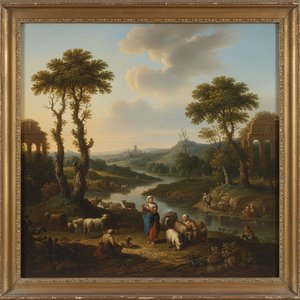
Jan Asselijn's "Italian Landscape," painted circa 1625-1652, isn’t merely a depiction of a picturesque vista; it’s an invitation to step into a carefully constructed world of serene beauty and subtle drama. This oil on canvas transports the viewer to a hypothetical Italian landscape – a deliberate choice by Asselijn that speaks volumes about the evolving artistic sensibilities of the Dutch Golden Age. The painting, now housed in collections like Bonhams, exemplifies the influence of both the Venetian masters and the burgeoning tradition of “pure” landscape painting emerging from Italy itself.
Asselijn’s style is distinctly characterized by a meticulous attention to detail and a masterful command of atmospheric perspective. He leans heavily into the techniques pioneered by Bamboccio – a contemporary painter known for his evocative, almost dreamlike landscapes – creating an image that feels both familiar and subtly unsettling. The composition unfolds with deliberate grace: a modest, classically-inspired building anchors the left foreground, its geometric solidity providing a grounding element against the undulating hills and hazy distance. The artist skillfully employs a muted palette of browns, ochres, and blues, avoiding bright colors to emphasize the painting’s contemplative mood. This restrained approach allows the subtle shifts in tone – from the dark shadows cast by distant trees to the luminous highlights reflecting off water – to create a remarkably convincing sense of depth and atmosphere.
The Influence of Venetian Masters and Italianate Tradition
Asselijn's work is deeply rooted in the artistic currents flowing through Italy at the time. He was profoundly influenced by the Venetian landscape painters, particularly those who favored a looser, more atmospheric style than their predecessors. However, unlike many of his contemporaries who simply copied Italian scenes directly, Asselijn imbued them with a distinctly Dutch sensibility – a focus on light, texture, and a carefully considered composition. This blending of influences is evident in the painting’s balanced structure, its subtle use of color, and its overall sense of quiet contemplation.
Furthermore, “Italian Landscape” reflects the broader trend toward what became known as "Italianate landscape" within Dutch art circles. This style sought to emulate the idealized landscapes depicted by artists like Claude Lorrain, who had established a dominant visual language for representing Italian scenery in Northern Europe. Asselijn’s painting isn't a literal transcription of an Italian vista; rather, it’s a carefully constructed fantasy – a “imaginary Italian Landscape” as described in some historical sources – designed to evoke the spirit and beauty of Italy while adhering to Dutch artistic conventions.
Symbolism and Emotional Resonance
Beyond its technical merits, "Italian Landscape" is rich in symbolic meaning. The solitary building, often interpreted as a villa or farmhouse, suggests themes of rural life, tranquility, and perhaps even isolation. The distant mountains, shrouded in mist, evoke a sense of mystery and the sublime – a recognition of nature’s power and grandeur. The figures scattered across the foreground, riding horses and walking along the riverbank, add a touch of human presence to the scene, reminding us of our connection to the natural world.
The painting's overall effect is one of profound serenity and contemplative beauty. It invites the viewer to slow down, to appreciate the subtle details of the landscape, and to lose themselves in its timeless atmosphere. It’s a testament to Asselijn’s skill as an artist – his ability to capture not just the appearance of a scene but also its emotional essence.
A Reproduction for Today's Spaces
Reproductions of “Italian Landscape” offer a beautiful addition to any interior space. The painting’s calming colors and evocative imagery create a sense of tranquility and sophistication, making it ideal for living rooms, bedrooms, or studies. The detailed depiction of the landscape invites contemplation and provides a visual connection to the natural world – a welcome respite from the stresses of modern life. Consider framing this piece in a classic wooden frame to further enhance its timeless appeal.
Domande e risposte
Quale tavolozza e quale emozione si incontrano in "Italian Landscape"?
La tavolozza Dark di "Italian Landscape" di Jan Asselyn si sposa con il suo tono emotivo Melancholic. Il colore è uno dei mezzi attraverso cui un'opera trasmette emozioni.
Quale soggetto e quale atmosfera si incontrano in "Italian Landscape" di Jan Asselyn?
"Italian Landscape" mostra landscape, figures, ruin, italy, asselijn, pastoral, tranquility, scenic, e l'atmosfera che ne scaturisce è Calm.
"Italian Landscape" di Jan Asselyn è un'opera dai toni chiari o scuri?
Nel complesso, "Italian Landscape" è classificata come shadow. La luminosità percepita indica quanto l'opera appaia chiara o scura.
Biografia dell'artista
A Life Forged in Landscape: The World of Jan Asselijn
Jan Asselin, born Jean Asselin around 1610 in Dieppe, France, was a Dutch Golden Age painter whose artistic journey unfolded against the backdrop of religious upheaval and burgeoning artistic innovation. His family, Huguenots fleeing persecution, relocated to Amsterdam in 1621—a vibrant metropolis brimming with commerce and attracting artists from across Europe—establishing a formative connection to the stylistic currents shaping the era’s visual culture. Initially apprenticed under Jan Martszen the Younger, Asselijn honed his skills primarily in battle scenes, absorbing the dramatic conventions of Baroque art and mastering techniques for conveying movement and emotion. However, it was his encounter with Pieter van Laer—nicknamed Bamboccio—and subsequent immersion into the Roman Bentvueghels society that truly ignited his creative spirit.The Italianate Embrace & The Bentvueghels
Like many ambitious Northern European painters of his time, Asselijn recognized the importance of artistic refinement in Italy. Arriving sometime after 1635, he wholeheartedly embraced the *Italianate* style—a genre distinguished by sun-drenched vistas, classical ruins, and pastoral scenes imbued with a romantic sensibility. Joining the Bentvueghels (“Birds of a Feather”), a collective of Dutch and Flemish artists residing in Rome, Asselijn participated in an unconventional artistic milieu characterized by satirical nicknames, rejection of studio practice, and unwavering dedication to painting directly from observation. This immersive experience profoundly impacted his artistic vision, fostering his ability to capture atmospheric nuances and conveying narrative depth within his compositions—a skill that would become central to his oeuvre. He absorbed the stylistic influences of artists like Rembrandt, whose etchings depicting Asselijn at work subtly acknowledged his physical disability – a gesture reflecting sensitivity toward personal challenges during an era marked by artistic ambition.Mastering Light & Symbolism: Key Works
Asselijn’s distinctive style was characterized by exceptional clarity of execution and masterful manipulation of light—qualities that swiftly garnered him acclaim among his contemporaries. While he produced historical and battle paintings, it was his landscapes and animal depictions that cemented his reputation as a singular artistic voice. The Threatened Swan, completed around 1640-45, stands as Asselijn’s most celebrated masterpiece—a painting that transcends mere visual representation to embody Dutch national resilience against external pressures. Interpreted as an allegory for Johan de Witt, the influential Dutch statesman, this dramatic scene captures a moment of crisis with arresting immediacy and symbolic potency. The swan's defiant posture—facing down encroaching danger—became a potent emblem of resistance and was even subjected to elaborate inscriptions by later owners: “Holland” on one of the eggs and “Enemy of the State” beside the menacing dog – underscoring its political significance. Alongside this iconic work, Asselijn produced other notable paintings that exemplify his artistic prowess. Cavalry Charge at Sunset showcases his formative training in battle painting, skillfully conveying movement and dynamism with meticulous detail. Furthermore, he created evocative depictions of rural life—such as *Drovers with Cattle under an Arch of the Colosseum in Rome*, which seamlessly blend Italianate landscape aesthetics with animal studies—demonstrating his ability to synthesize diverse influences into a cohesive artistic vision. Finally, The Breach of Saint Anthony’s Dike near Amsterdam powerfully portrays a pivotal moment in Dutch history—the siege of Saint Anthony's Dike during the Eighty Years’ War—capturing the urgency and drama of the event with remarkable precision.Influence & Legacy: A Lasting Impression
Jan Asselijn’s artistic legacy extends beyond his own prolific output, shaping the trajectory of landscape painting within the Dutch Golden Age. He served as a mentor to Frederik de Moucheron, fostering the dissemination of the Italianate style and inspiring subsequent generations of artists. His meticulous technique—particularly his masterful handling of light—influenced Rembrandt's etching portraits, reflecting mutual admiration for artistic excellence. Asselijn’s works are now housed in prominent museums across Europe, guaranteeing his enduring recognition as a pivotal figure within Dutch art history. He died prematurely in 1652, leaving behind an impressive body of work that continues to captivate viewers with its beauty, emotional depth, and subtle symbolic resonances—a testament to his contribution to the artistic landscape of his time.
Jan Asselyn
1610 - 1652 , Francia
Dettagli rapidi
- Artistic Movement Or Style: Italianato paesaggistico
- Artists Or Movements Influenced By This Artist: ['Rembrandt']
- Artists Who Influenced This Artist:
- Pieter van Laer
- Esaias van de Velde
- Date Of Birth: c. 1610
- Date Of Death: c. 1652
- Full Name: Jan Asselin
- Nationality: Olandese
- Notable Artworks:
- La Minaccia allo storico cispospo
- Attacco cavalleresco al tramonto
- Place Of Birth: Dieppe, Francia
Articoli correlati

Mastering Light & Land: An Art Historian's Guide to the Dutch Golden Age Landscape
Explore the breathtaking mastery of Dutch Golden Age landscapes. From Italianate light to atmospheric realism, discover the techniques of 17th-century masters and learn how to bring these timeless, museum-quality masterpieces into your home through expert oil reproductions.

I 10 Capolavori dell'Età d'Oro Olandese: Arte, Storia e Stile per la Tua Casa
Esplora i 10 capolavori dell'Età d'Oro Olandese con ! Rembrandt, Vermeer e altri maestri rivivono in dipinti iconici. Scopri storia, tecnica e colori di opere senza tempo per arredare la tua casa con arte di qualità museale. Esplora la collezione online!

Golden Light & Dutch Skies: The Timeless Magic of Dutch Golden Age Landscapes
Discover the breathtaking beauty of Dutch Golden Age landscapes. Explore the mastery of light, chiaroscuro, and 17th-century realism through an expert art history lens, celebrating the enduring legacy of the Dutch Masters for discerning collectors and art lovers.

Golden Light & Dutch Skies: Bringing the Magic of Dutch Golden Age Landscapes into Your Home
Transform your home with the breathtaking light of Dutch Golden Age landscapes. Discover how hand-painted oil reproductions of masterworks like Ruisdael and Vermeer bring timeless elegance, atmosphere, and soulful texture to modern interiors. Elevate your space with museum-quality art.
Nicolaes Berchem e l'Età dell'Oro Olandese: Un Rifugio Idilliaco tra Realismo e Mito
Esplora l'incantevole mondo di Nicolaes Berchem e la pittura del Secolo d'Oro Olandese. Analisi approfondita, simbolismo nascosto e l'eredità artistica di un maestro del paesaggio arcadiaco.


