
 Anteprima in scala reale
 Invia
Invia Condividi
 Dettagli opera
 Guida
Guida

 Scarica
 Simili
 Radiografia
 Slideshow
 Domande e risposte
 Statistiche
Mother And Child 4

 Espandi i dettagli
L'opera d'arte visualizzata in questa pagina è protetta dalle leggi sul diritto d'autore, il che significa che non possiamo legalmente creare o vendere una riproduzione identica. Tale protezione è garantita da accordi internazionali quali la Convenzione di Berna e dalle leggi nazionali, incluse quelle stabilite da Legge sul copyright degli Stati Uniti - Titolo 17. Tutti i diritti riservati. Le immagini presenti su questo sito sono protette da copyright e non possono essere riprodotte o utilizzate senza l'autorizzazione scritta di WahooArt.com o dei rispettivi proprietari del copyright.
Questo metodo è pienamente conforme alle normative sul diritto d'autore poiché non prevede la copia o la duplicazione dell'opera protetta. Si tratta invece di una rielaborazione creativa: un nuovo dipinto che trae ispirazione dall'originale, senza tuttavia esserne identico.
Giclée / Stampe d'arte
Stampa giclée o su tela di qualità museale, con produzione rapida e diverse opzioni di finitura. ( Acquista il dipinto realizzato a mano Passa all'immagine digitale)




P118B €10

P118H €10

P118W €10

P438Z €10

P508JH €12

P508YH €12

P805H €10

P805Z €10

P919BZ €10

P919G €10

P919XJ €10

P959ZH €10

P968JZ €12

W106C €8

W218G €10

W218JH €8

W218Y €10

W307PJ €10

W316G €10

W316PJ €8

W316Y €10

W398PJ €8

W4111J €10

W500HY €15

W500JH €15

W692G €12

W849H €8

W940BG €15

W953PJ €8




Scegli tra le nostre dimensioni predefinite, che rispettano le proporzioni originali dell'opera d'arte.

Inserisci la larghezza e l'altezza desiderate, per adattarle alla tua cornice o alla tua parete. Una stampa può essere solo ritagliata, mai resa più grande dell'immagine originale; pertanto, un formato con una forma differente comporterà la perdita di una parte dell'opera. Ti invieremo un mockup digitale da approvare prima di procedere con la stampa. L'immagine mostrata in questa pagina non rappresenta il ritaglio reale — solo il mockup lo mostra.
Consegna in tutto il mondo () in 2 settimane invece delle normali 4/5 settimane. (8 Novembre)

Spedizione espressa gratuita in tutto il mondo

Tela in lino di alta qualità

Assicurazione completa sulla spedizione

Garanzia di rimborso dei dazi doganali

Garanzia di fedeltà cromatica assoluta

Politica di reso entro 100 giorni (solo per difetti di fabbricazione)

Garanzia di rimborso al 100%

Offerta per acquisti multipli
 L'opzione vetro è disponibile solo per dimensioni inferiori a 110 cm

Mother And Child 4
Giclée / Stampe d'arte
Dimensioni riproduzione
-


Prezzo finale calcolato
€ 72
A Universal Bond: Exploring Henry Moore’s ‘Mother and Child 4’
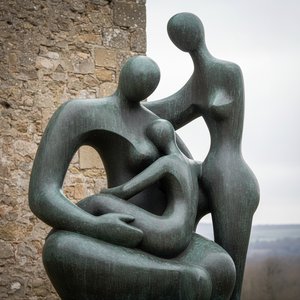
This striking black and white photograph captures a sculpture by one of Britain's most important artists, Henry Moore. The work depicts two abstracted bird-like forms – a larger figure sheltering a smaller one – embodying the timeless theme of motherhood and familial protection. While the material is suggested to be wood or stone, its smooth, organic curves and textured surface speak to Moore’s mastery of form and his deep connection to natural materials. This particular piece, part of a prolific series exploring the mother-and-child motif, exemplifies Moore's signature style developed throughout his long career.Moore’s Sculptural Language: Form & Technique
Henry Moore is renowned for his semi-abstract sculptures, often focusing on the human figure – particularly reclining figures and *mother and child* compositions. He pioneered a technique called “direct carving,” where he worked directly with the material (often stone or wood), allowing the form to emerge organically rather than adhering strictly to a pre-conceived design. This approach is evident in ‘Mother and Child 4’ where the forms appear both monumental and intimately connected. The simplification of shapes, the emphasis on volume, and the interplay of positive and negative space are hallmarks of his style, influenced by prehistoric sculpture, African art, and the works of Michelangelo. Moore wasn't interested in literal representation; instead, he sought to capture the *essence* of form and emotion.Symbolism & Emotional Resonance
The mother-and-child theme held profound significance for Moore throughout his life. Having experienced hardship during World War I while serving as a soldier, he found solace in images of nurturing and protection. The abstracted forms in ‘Mother and Child 4’ transcend specific identities, becoming universal symbols of maternal love, vulnerability, and the enduring bond between generations. The protective gesture of the larger form enveloping the smaller one evokes feelings of safety, comfort, and unconditional care. While seemingly simple, the sculpture resonates with deep emotional power, prompting contemplation on fundamental human experiences. The use of birds as a metaphor adds another layer – suggesting freedom, fragility, and the instinct to nurture offspring.A Lasting Legacy: Moore in Context
Born in 1898, Henry Moore lived through periods of immense social and political change, which profoundly impacted his artistic vision. His work gained prominence in the post-war era, reflecting a desire for renewal and a search for universal values. Moore’s sculptures are now found in public collections and private homes worldwide, celebrated for their beauty, emotional depth, and enduring relevance. ‘Mother and Child 4’, like many of his works, continues to inspire artists and captivate audiences with its powerful simplicity and profound message. A reproduction of this sculpture would bring a sense of serenity, strength, and timeless elegance to any interior space.Domande e risposte
"Mother And Child 4" di Henry Moore è di pubblico dominio? E perché?
"Mother And Child 4" di Henry Moore è di ancora protetta dal diritto d'autore. La durata del copyright decorre dalla morte dell'artista, avvenuta nel 1986.
Quanto è satura la tavolozza di "Mother And Child 4"?
La tavolozza di "Mother And Child 4" presenta una saturazione Muted.
Dove posso scaricare "Mother And Child 4" di Henry Moore?
Puoi scaricare "Mother And Child 4" di Henry Moore dalla pagina Scarica l'opera dell'opera, come download di un'immagine digitale ad alta risoluzione.
Biografia dell'artista
Primi anni di vita e formazione
Moore nacque a Castleford, West Riding dello Yorkshire, Inghilterra, da Mary Baker e Raymond Spencer Moore. Suo padre, un autodidatta con una passione per la musica e la letteratura, incoraggiò i suoi figli a perseguire una formazione formale. Henry Moore frequentò le scuole elementari e primarie di Castleford, dove iniziò a modellare l'argilla e intagliare il legno.Sviluppo artistico e stile
- Le incisioni più antiche documentate di Moore, come la targa per la Scott Society alla scuola secondaria di Castleford, risalgono alla sua adolescenza.
- Successivamente adottò il metodo della scultura diretta, che divenne un marchio distintivo del suo stile, come si può vedere in opere come La Vergine e il Bambino.
- Le forme di Moore sono solitamente astrazioni della figura umana, che tipicamente raffigurano madri e figli o figure reclinanti. Molti interpreti paragonano la forma ondulata delle sue figure reclinanti al paesaggio e alle colline del suo luogo di nascita, lo Yorkshire.
Opere notevoli e eredità
- Le sculture in bronzo monumentali e semi-astratte di Moore si trovano in tutto il mondo come opere d'arte pubbliche, a testimonianza della sua eccezionale abilità e del suo contributo alla scultura britannica moderna.
- La sua capacità di realizzare commissioni su larga scala lo rese estremamente ricco, ma visse frugally, destinando la maggior parte dei suoi guadagni all’istituzione della Fondazione Henry Moore, che continua a sostenere l'educazione e la promozione delle arti.
- Le opere di Moore si possono trovare in vari musei, tra cui The Ingram Collection of Modern British and Contemporary Art, che presenta un’impressionante varietà di arte moderna e contemporanea proveniente dalla Gran Bretagna e da altri paesi.
Influenze e sviluppo successivo
Moore fu influenzato dall'arte preistorica, in particolare dalle sculture ciclopiche ritrovate a Malta nel 1928. Queste forme primitive lo ispirarono ad abbracciare la semplicità e la monumentalità nelle sue opere. Successivamente, studiò le opere di artisti come Michelangelo e Brancusi, che contribuirono a plasmare il suo approccio alla forma e allo spazio. Il suo lavoro si evolse nel tempo, sperimentando con diversi materiali e tecniche, tra cui bronzo, acciaio inossidabile e pietra. La sua ricerca sulla forma umana astratta lo portò a creare alcune delle sculture più iconiche del XX secolo.Significato storico
Henry Moore è ampiamente considerato uno dei più importanti scultori britannici del XX secolo. Il suo lavoro ha avuto un impatto significativo sullo sviluppo della scultura moderna, influenzando generazioni di artisti. La sua capacità di combinare l'astrazione con la rappresentazione figurativa lo rese una figura unica nel panorama artistico internazionale. Le sue opere pubbliche sono diventate parte integrante del paesaggio urbano e rurale in tutto il mondo, testimoniando la sua eredità duratura.
Henry Moore
1898 - 1986 , Regno Unito
Dettagli rapidi
- Data Di Nascita: 1898
- Luogo Di Nascita: Castleford, Regno Unito
- Movimento Artistico: Scultura moderna
- Nazionalità: Britannico
- Nome Completo: Henry Spencer Moore
- Opere Notevoli:
- Torso Appuntito
- Specchio a Taglio Obliquo
- Motive Verticale, Maquette N° 1
- Ninnananna Testa Dormiente
Articoli correlati

I 10 Capolavori Bronzei che Hanno Rivoluzionato la Storia dell'Arte | OriginalUniqueArt
Esplora i 10 capolavori bronzei che hanno segnato la storia dell'arte! Da Rodin a Michelangelo, scopri le storie e le tecniche dietro queste sculture iconiche. Trova riproduzioni d'arte di alta qualità per decorare la tua casa con OriginalUniqueArt.com.
The Enduring Legacy of Bronze: A Historical & Artistic Exploration for the Collector
Explore the rich history & enduring appeal of bronze sculpture with expert insights for collectors at OriginalUniqueArt. Learn about casting techniques, iconic artists, collecting tips & contemporary interpretations.

I 10 Capolavori in Bronzo che Hanno Rivoluzionato la Storia dell'Arte | OriginalUniqueArt
Esplora i 10 capolavori in bronzo che hanno segnato la storia dell'arte! Da Michelangelo a Rodin, scopri le storie e le tecniche dietro queste statue iconiche. Trova riproduzioni artistiche di alta qualità per decorare casa tua con OriginalUniqueArt.com.
Henry Moore: Scultura e Modernità – Forma, Emozione e la Condizione Umana
Esplora l'universo scultoreo di Henry Moore: dalle influenze primordiali alla figura reclinata, un viaggio nella forma, l'emozione e la condizione umana. Approfondimenti storici e artistici su OriginalUniqueArt.

L'Anima del Bronzo: Storia, Tecnica della Cera Persa e Segreti per il Collezionista
Scopri i segreti della fusione a cera persa e la storia del bronzo tra maestri come Rodin. Approfondisci la tecnica e il valore dell'arte.


