Anteprima in scala reale
 Invia
Invia Condividi
 Dettagli opera
 Guida
Guida

 Scarica
 Simili
 Radiografia
 Slideshow
 Q&A
Q&A Statistiche
Il Profit
 Acrilico su tela
- Opere da parete
- Arte Metafisica
 1915
1915 89.0 x 70.0 cm
 Espandi i dettagli
L'opera d'arte visualizzata in questa pagina è protetta dalle leggi sul diritto d'autore, il che significa che non possiamo legalmente creare o vendere una riproduzione identica. Tale protezione è garantita da accordi internazionali quali la Convenzione di Berna e dalle leggi nazionali, incluse quelle stabilite da Legge sul copyright degli Stati Uniti - Titolo 17. Tutti i diritti riservati. Le immagini presenti su questo sito sono protette da copyright e non possono essere riprodotte o utilizzate senza l'autorizzazione scritta di WahooArt.com o dei rispettivi proprietari del copyright.
Questo metodo è pienamente conforme alle normative sul diritto d'autore poiché non prevede la copia o la duplicazione dell'opera protetta. Si tratta invece di una rielaborazione creativa: un nuovo dipinto che trae ispirazione dall'originale, senza tuttavia esserne identico.
Giclée / Stampe d'arte
Stampa giclée o su tela di qualità museale, con produzione rapida e diverse opzioni di finitura. ( Acquista il dipinto realizzato a mano Passa all'immagine digitale)




P118B €10

P118H €10

P118W €10

P438Z €10

P508JH €12

P508YH €12

P805H €10

P805Z €10

P919BZ €10

P919G €10

P919XJ €10

P959ZH €10

P968JZ €12

W106C €8

W218G €10

W218JH €8

W218Y €10

W307PJ €10

W316G €10

W316PJ €8

W316Y €10

W398PJ €8

W4111J €10

W500HY €15

W500JH €15

W692G €12

W849H €8

W940BG €15

W953PJ €8




Scegli tra le nostre dimensioni predefinite, che rispettano le proporzioni originali dell'opera d'arte.

Inserisci la larghezza e l'altezza desiderate, per adattarle alla tua cornice o alla tua parete. Una stampa può essere solo ritagliata, mai resa più grande dell'immagine originale; pertanto, un formato con una forma differente comporterà la perdita di una parte dell'opera. Ti invieremo un mockup digitale da approvare prima di procedere con la stampa. L'immagine mostrata in questa pagina non rappresenta il ritaglio reale — solo il mockup lo mostra.
Consegna in tutto il mondo () in 2 settimane invece delle normali 4/5 settimane. (30 Ottobre)

Spedizione espressa gratuita in tutto il mondo

Tela in lino di alta qualità

Assicurazione completa sulla spedizione

Garanzia di rimborso dei dazi doganali

Garanzia di fedeltà cromatica assoluta

Politica di reso entro 100 giorni (solo per difetti di fabbricazione)

Garanzia di rimborso al 100%

Offerta per acquisti multipli
 L'opzione vetro è disponibile solo per dimensioni inferiori a 110 cm

Il Profit
Giclée / Stampe d'arte
Dimensioni riproduzione
-


Prezzo finale calcolato
€ 71
Giorgio de Chirico’s “The Profit”: A Dreamscape of Alienation
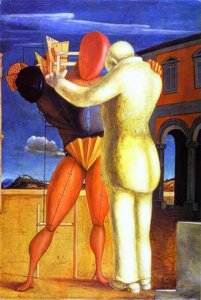
Giorgio de Chirico's "The Profit," painted in 1915, is not merely a depiction of a scene; it’s an immersion into the unsettling logic of the subconscious. This enigmatic work, measuring 89 x 70 cm, embodies the core tenets of de Chirico’s groundbreaking Metaphysical art – a movement that sought to capture the emotional and psychological realities beyond the purely visual. The painting immediately arrests the viewer with its peculiar juxtaposition of familiar elements rendered in an utterly unfamiliar light. A solitary figure, seated on a bench beneath a towering chalkboard filled with cryptic symbols, dominates the composition. This individual, deliberately devoid of identifying features, possesses a haunting stillness that speaks to a profound sense of isolation and detachment – a feeling acutely resonant within the context of World War I’s looming shadow.
De Chirico's mastery lies in his ability to construct spaces that are both recognizable and profoundly unsettling. The architecture, reminiscent of Italian squares and public spaces, is rendered with an unnerving precision, yet it feels strangely deserted and devoid of life. The perspective is deliberately skewed, creating a sense of vastness and disorientation – a key element of Metaphysical painting designed to mimic the way memories and dreams can warp our perception of reality. The muted color palette—dominated by ochres, browns, and greys—further contributes to this atmosphere of melancholy and unease, amplifying the feeling that something is fundamentally amiss.
Symbolism and Philosophical Undercurrents
“The Profit” is rich in symbolic detail, inviting endless interpretation. The figure’s mask or strange hat immediately establishes a sense of anonymity and detachment, suggesting a loss of identity within the larger world. The chalkboard itself is a crucial element, covered with symbols that defy immediate understanding – geometric shapes, letters, and diagrams that hint at a hidden language, perhaps representing the fragmented nature of thought or the complexities of human experience. The presence of two other figures in the background—one standing and another seated—adds to the sense of an incomplete narrative, suggesting a scene frozen in time, caught between past and present.
De Chirico’s artistic vision was deeply influenced by philosophical currents of his era, particularly the writings of Friedrich Nietzsche and Arthur Schopenhauer. These thinkers explored themes of existentialism, the irrationality of human desire, and the subjective nature of reality – ideas that profoundly shaped de Chirico's approach to art. The painting can be interpreted as a meditation on alienation, the loss of meaning in a rapidly changing world, and the struggle to find identity within an increasingly impersonal society. The title itself, “The Profit,” is deliberately ambiguous, prompting viewers to question what exactly is being gained or lost in this unsettling tableau.
Technique and Artistic Legacy
Painted in 1915, "The Profit" exemplifies de Chirico’s distinctive technique – a meticulous attention to detail combined with an expressive use of color and perspective. He employed oil on canvas, layering thin washes of paint to create a sense of depth and luminosity. The sharp lines and precise rendering of architectural elements contrast sharply with the hazy atmosphere, creating a compelling visual tension. De Chirico’s work profoundly influenced the development of Surrealism, paving the way for artists like René Magritte and Salvador Dalí who explored similar themes of dreamlike imagery and psychological landscapes.
Beyond its immediate aesthetic appeal, “The Profit” remains a powerful testament to de Chirico's artistic genius. It’s a painting that lingers in the mind long after it has been viewed, prompting reflection on the nature of reality, identity, and the human condition. OriginalUniqueArt offers meticulously crafted hand-painted reproductions of this iconic work, allowing art lovers to experience its haunting beauty and philosophical depth firsthand.
Domande e risposte
In che modo tecnica e movimento si fondono in "Il Profit"?
In "Il Profit", la tecnica del Acrilico su tela incontra il movimento Arte Metafisica.
È disponibile un download ad alta risoluzione di "Il Profit"?
È possibile acquistare un'immagine digitale di "Il Profit" di Giorgio de Chirico nella sua pagina Immagine digitale ad alta risoluzione: download di un'immagine digitale ad alta risoluzione.
Che tipo di opera d'arte è "Il Profit" di Giorgio de Chirico?
"Il Profit" è un'opera in Opere da parete.
Biografia dell'artista
primi anni di vita e influenze
giorgio de chirico, un rinomato artista italiano, nacque il 10 luglio 1888 a Volos, in Grecia, da una madre genovese e un padre siciliano. I suoi primi anni furono segnati dallo studio dell'arte alla politecnica di Atene sotto la guida dei pittori greci georgios roilos e georgios jakobides. Questa base avrebbe poi plasmato il suo unico stile artistico.il movimento della scuola metafisica
Nel 1910, de chirico promosse il movimento della scuola metafisica, che influenzò profondamente i surrealisti. Le sue opere di questo periodo, caratterizzate da atmosfere inquietanti e scenari onirici, sono esemplificate in dipinti come le perplessità del pensatore (disponibile su OriginalUniqueArt) e l'enigma dell'ora (visionabile su OriginalUniqueArt). Questi lavori evocano un senso di mistero, spesso con forti contrasti di luce e ombra.periodo post-metafisico
Dopo il 1919, l'interesse di de chirico si spostò verso le tecniche pittoriche tradizionali, adottando uno stile neoclassico o neo-barocco. Questo cambiamento è evidente nelle sue opere successive, che, sebbene non ricevano lo stesso plauso critico delle sue prime creazioni, dimostrano un evoluzione matura nel suo approccio artistico.eredità e influenza
L'impatto di de chirico sul movimento surrealista è innegabile, con artisti come andré breton influenzati dai suoi dipinti metafisici. Sebbene il suo lavoro successivo non sia stato così ampiamente apprezzato, de chirico rimane una figura chiave nella storia dell'arte moderna. La sua eredità continua a ispirare, con le sue opere che fanno parte di collezioni in tutto il mondo, tra cui il museo di giorgio de chirico, che ora si trova vicino agli scalini spagnoli a Roma.- esplora altre opere di giorgio de chirico su OriginalUniqueArt
- scopri il movimento della scuola metafisica e la sua influenza sul surrealismo attraverso questo articolo illuminante su OriginalUniqueArt
- impara di più sulla vita e sulle opere di de chirico su wikipedia

Giorgio de Chirico
1888 - 1978 , Grecia
Dettagli rapidi
- Artisti Influenti:
- Arnold Böcklin
- Max Klinger
- Artisti Influenzati:
- Surrealismo
- André Breton
- Data Di Nascita: 10 luglio 1888
- Luogo Di Nascita: Volos, Grecia
- Movimento Artistico: Arte metafisica
- Nazionalità: Italiana
- Nome Completo: Giorgio de Chirico
- Opere Notevoli:
- Le perplessità del pensatore
- L'enigma dell'ora
- La canzone d'amore
Articoli correlati

Beyond Reality's Veil: Exploring the Enigmatic World of Metaphysical Art
Explore the captivating world of Metaphysical art with OriginalUniqueArt. Discover Giorgio de Chirico's iconic paintings, philosophical influences & lasting impact on Surrealism. Expert insights for collectors.
Beyond Reality: Discover the Haunting Beauty and Philosophical Depth of Metaphysical Art
Explore the haunting beauty of Metaphysical Art. Delve into Giorgio de Chirico’s dreamlike landscapes, the movement's profound connection to Surrealism, and the philosophical mysteries hidden within its eerie, silent piazzas.

Riguardo a noi
Scopri la nostra storia! Portiamo l'arte di livello mondiale nella tua vita grazie a una selezione esperta, creazioni personalizzate e anteprime gratuite. Approvato da privati e aziende dal 2000.

Goya: I 25 Capolavori Immortali dell'Anima Spagnola | OriginalUniqueArt
Esplora i 25 capolavori di Francisco Goya, il genio spagnolo tra Romanticismo e Realismo. Ritratti iconici, 'Los Caprichos' e le toccanti 'Disastri della Guerra'. Trova stampe su tela e riproduzioni artistiche di alta qualità per la tua casa su OriginalUniqueArt.com.
Giorgio de Chirico e la Poesia dell'Assenza: Il Realismo Metafisico e l'Inconscio nell'Arte del Novecento
Esplora il rivoluzionario realismo metafisico di Giorgio de Chirico e la sua profonda influenza sull'arte del Novecento, dalla psicanalisi al surrealismo. Analisi approfondite e contesto storico.