Passa alle stampe
 Espandi i dettagli







































 Per opere d'arte o riproduzioni con un lato superiore a 105 cm (circa 41 pollici), la cornice verrà spedita in forma di kit smontato. Questo metodo garantisce una consegna sicura e previene danni durante il trasporto.


Gabriel Metsu's "The Cittern Player": A Dutch Golden Age Intimacy
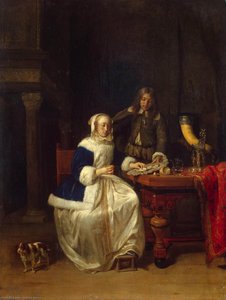
Gabriel Metsu’s “The Cittern Player,” a captivating scene of domestic leisure, offers a poignant glimpse into the world of 17th-century Holland. Executed with remarkable sensitivity and detail, this painting transcends mere representation to evoke a powerful sense of quiet intimacy and human connection. Measuring 37 x 30 cm, this intimate work, created around 1650, is a testament to Metsu’s unique artistic vision – one that eschewed grand historical narratives for the subtle poetry of everyday life. The painting's enduring appeal lies not just in its technical mastery but also in its ability to transport us back to a time when music and conversation formed the heart of domestic tranquility.
- Subject Matter: The scene depicts a woman seated on a wooden bench, engrossed in playing a cittern – an early form of guitar. Her companion holds a glass of wine, while a loyal dog attentively watches the player, creating a tableau of relaxed companionship.
- Setting: A dark room with a fireplace establishes a warm and inviting atmosphere, enhancing the sense of domestic comfort. The inclusion of a vase adds a touch of decorative elegance to the composition.
A Masterclass in Dutch Realism – Metsu’s Technique
Metsu was renowned for his meticulous realism, a hallmark of the Dutch Golden Age. His technique involved layering thin glazes of oil paint—a process known as ‘alla prima’—to achieve luminous color and subtle gradations of light and shadow. This approach is particularly evident in the rendering of the woman's clothing, the dog’s fur, and the textures of the wooden bench and cittern. The artist’s masterful use of chiaroscuro – the dramatic contrast between light and dark – adds depth and volume to the scene, drawing the viewer into the intimate space. The painting’s scale—a modest 37 x 30 cm—further contributes to its captivating effect, allowing for a focused appreciation of Metsu's painstaking detail.
Symbolism and Context within the Dutch Golden Age
“The Cittern Player” is firmly rooted in the cultural context of the Dutch Golden Age (1650-1700), a period characterized by unprecedented economic prosperity, artistic innovation, and a burgeoning interest in secular life. Genre paintings – scenes depicting everyday activities – were particularly popular during this era, reflecting a shift away from traditional religious subjects towards more relatable human experiences. The cittern itself held symbolic significance, representing leisure, entertainment, and the refinement of taste. The presence of the dog is also noteworthy; animals were frequently included in Dutch domestic scenes to symbolize loyalty, companionship, and the connection between humans and nature. Metsu’s work aligns with a broader trend among artists of his time who sought to capture the nuances of human emotion and social interaction within realistic settings.
Emotional Impact and Artistic Legacy
Ultimately, “The Cittern Player” resonates with viewers through its quiet beauty and profound sense of humanity. Metsu’s ability to convey a moment of serene contemplation—a simple pleasure shared between companions—is what elevates this painting beyond mere representation. It is a work that invites us to pause, reflect, and appreciate the small joys of life. Gabriel Metsu's legacy as one of the most accomplished artists of the Dutch Golden Age continues to inspire, and this reproduction offers an exceptional opportunity to experience firsthand the enduring power of his artistic vision.
Domande e risposte
Che posto occupa "La suonatrice di cittern" tra i temi ricorrenti di Gabriël Metsu?
"La suonatrice di cittern" raffigura suonatrice di cittern, età dell'oro olandese, scena musicale, ozio domestico, calice di vino, dettaglio ritrattistico, ambiente con camino, mentre i temi ricorrenti di Gabriël Metsu sono realismo dell'età dell'oro olandese, scene di svago domestico, stile eclettico di metsu, esplorazione della pittura di genere, ritrattistica sociale intima. Il confronto tra i due evidenzia come l'opera si relazioni con i soggetti abituali dell'artista.
A quale movimento e a quale epoca appartiene "La suonatrice di cittern" di Gabriël Metsu?
"La suonatrice di cittern" di Gabriël Metsu appartiene al movimento Pittura barocca olandese, inserendosi nel contesto dell'epoca Età Moderna del suo autore.
"La suonatrice di cittern" di Gabriël Metsu utilizza forti contrasti o armonie delicate?
La composizione cromatica di "La suonatrice di cittern" di Gabriël Metsu coniuga un Equilibrato contrasto con una Tavolozza dai toni sfumati armonia.
 Anteprima in scala reale
 Invia
Invia Condividi
 Dettagli opera
 Guida
Guida

 Scarica
 Simili
 Radiografia
 Slideshow
 Q&A
Q&A Statistiche