 Anteprima in scala reale
 Condividi
 Condividi
 Dettagli
 Guida stampabile

 Scarica
 Articoli simili
 Radiografia
 Slideshow
 Statistiche
Allegory of Music


 Leggi tutto
Giclée / Stampe d'arte
Stampa giclée o su tela di qualità museale, con produzione rapida e diverse opzioni di finitura. ( Ordina la riproduzione dipinta a mano Passa all'immagine digitale)




P118B $10

P118H $10

P118W $10

P438Z $10

P508JH $12

P508YH $12

P805H $10

P805Z $10

P919BZ $10

P919G $10

P919XJ $10

P959ZH $10

P968JZ $12

W106C $8

W218G $10

W218JH $8

W218Y $10

W307PJ $10

W316G $10

W316PJ $8

W316Y $10

W398PJ $8

W4111J $10

W500HY $15

W500JH $15

W692G $12

W849H $8

W940BG $15

W953PJ $8




Scegli tra le nostre dimensioni predefinite, che rispettano le proporzioni originali dell'opera d'arte.

È possibile inserire dimensioni personalizzate per adattare l'opera a una cornice o a uno spazio specifico. Se la dimensione selezionata non corrisponde alle proporzioni dell'immagine originale, procederemo al ritaglio dell'opera o all'estensione dell'immagine con un bordo specchiato o a tinta unita. Un mockup digitale ti verrà inviato per approvazione prima dell'inizio della produzione.
Si prega di notare che l'anteprima a schermo non riflette il ritaglio o l'estensione effettivi. Solo il mockup mostrerà accuratamente la composizione finale.
Sebbene siano disponibili dimensioni personalizzate, si raccomanda di selezionare una dimensione dall'elenco predefinito per preservare le proporzioni originali.
Consegna in tutto il mondo () in 2 settimane invece delle normali 4/5 settimane. (25 Settembre)

Spedizione espressa gratuita in tutto il mondo

Tela in lino di alta qualità

Assicurazione completa sulla spedizione

Garanzia di rimborso dei dazi doganali

Garanzia di perfetta fedeltà cromatica

Politica di reso entro 100 giorni (solo per difetti di fabbricazione)

Garanzia di rimborso al 100%

Sconto per acquisti multipli
 L'opzione vetro è disponibile solo per dimensioni inferiori a 110 cm

Allegory of Music
Giclée / Stampe d'arte
Dimensioni della riproduzione
-


Prezzo totale
$ 80
A Symphony of Symbolism: The Allegory of Music
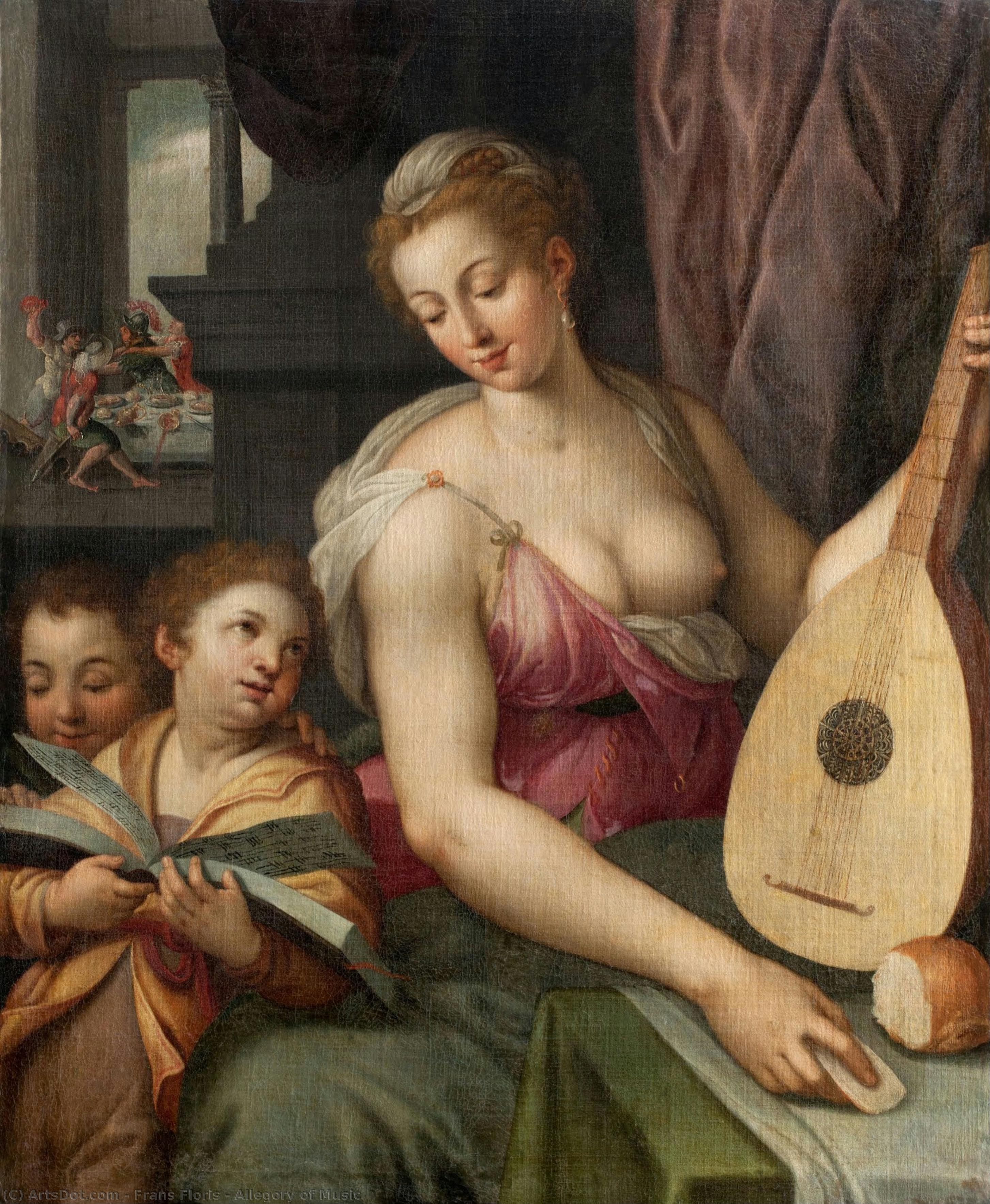
In the delicate interplay of light and shadow within Frans Floris’s Allegory of Music, we encounter a masterpiece that transcends mere portraiture to become a profound meditation on the senses. At the heart of this composition sits a graceful lady, her presence commanding yet serene, cradling a lute in her right hand. As she reaches with her left to grasp a slice of bread from the table before her, the painting weaves together the auditory beauty of melody with the primal, earthly satisfaction of sustenance. This juxtaposition of the ethereal—music—and the material—bread—invites the viewer into a world where every gesture carries a hidden weight, characteristic of the intellectual depth found in Northern Renaissance allegories.
The scene is far from a solitary moment of quietude; behind this central figure, a secondary narrative unfolds. In the background, a troupe of drunken soldiers, clad in the evocative costumes of ancient Rome, provides a chaotic, earthly contrast to the lady's poised elegance. This tension between the disciplined harmony of music and the unbridled disorder of excess is a hallmark of the Romanist style. Through his mastery of composition, Floris utilizes these contrasting elements to explore the duality of human nature—the struggle between our higher, spiritual aspirations and our more base, instinctive impulses.
Technically, the work serves as a testament to Floris’s position as a pioneer of the Flemish Renaissance. His ability to infuse monumental history painting with the fluid grace of Italian masters like Raphael is evident in the soft modeling of the lady's skin and the rich, tactile rendering of the fabrics. The palette, though grounded in the earthy tones of the period, possesses a luminous quality that draws the eye toward the central interaction. For the discerning collector or interior designer, this piece offers more than just visual splendor; it provides a sophisticated focal point that brings a sense of historical gravity and narrative complexity to any curated space.
Beyond its aesthetic allure, the Allegory of Music carries a storied provenance that adds layers of historical prestige to the work. There is much speculation that this painting once graced the illustrious collection of Rudolf II of Habsburg in Prague, a monarch renowned for his profound devotion to the arts and his vast Kunstkammer. The idea that such a treasure might have been swept away as war booty during the looting of 1648 adds a poignant, almost melancholic dimension to its history. To possess a high-quality reproduction of this work is to invite a piece of European heritage into one's home—a fragment of a lost era of imperial splendor and humanist discovery.
Biografia dell'artista
Frans Floris: A Flemish Renaissance Pioneer
Frans Floris, Frans Floris the Elder or Frans Floris de Vriendt (17 April 1519 – 1 October 1570) was a Flemish painter, draughtsman, print artist and tapestry designer who stands as a pivotal figure in Northern Renaissance art. Primarily celebrated for his monumental history paintings imbued with Romanist ideals—a stylistic movement characterized by fervent admiration for Italian High Renaissance masters like Michelangelo, Raphael, and their followers—Floris’s oeuvre transcends mere visual representation; it embodies the intellectual ferment of its time and reflects a profound engagement with humanist thought.Early Life and Artistic Training
Born in Antwerp, Floris descended from a family steeped in artistic tradition. His ancestors practiced stonemasonry for generations, establishing a lineage marked by craftsmanship and creativity. Notably, Jan Florisz. de Vriendt, his grandfather, emigrated to Antwerp in the mid-15th century, adopting ‘floris’ as his surname—a name that would persist through subsequent generations, retaining its original form ‘de vriendt’ in official documents until the late 16th century. This familial heritage undoubtedly instilled within Floris a deep appreciation for artistic excellence and fostered an environment conducive to intellectual curiosity. Karel van Mander's biography of Floris – a sprawling tome published in 1604 – provides invaluable insight into his formative years, detailing his education under Lambert Lombard and highlighting the influence of Venetian art on his developing style. Lombard’s teachings emphasized meticulous observation and anatomical accuracy, shaping Floris’s approach to portraiture and furthering his understanding of classical ideals. He began as a student of sculpture, but later he gave up sculpture for painting. Floris went to Liège where he studied with Lambert Lombard. The choice for Lombard as a teacher was surprising since Antwerp was a cultural centre with many outstanding painters. He may have chosen Lombard as his brother Cornelis was good friends with Lombard, whom he had met in Rome around 1538. It is also possible that Floris trained as a painter in Antwerp before studying under Lombard. Floris became a master in the Antwerp Guild of Saint Luke in 1539–40.Romanism and Artistic Influences
Floris's artistic trajectory was decisively shaped by Romanism, a movement that propelled Flemish artists towards Italy to immerse themselves in the glories of Renaissance Rome. Unlike many contemporaries who merely copied Italian models, Floris actively assimilated these influences into his own distinctive style—a synthesis that resulted in canvases brimming with dynamism and imbued with symbolic richness. The meticulous study of Michelangelo’s frescoes in St. Peter's Basilica and Raphael’s paintings in Vatican City profoundly impacted Floris’s compositional techniques and color palettes. This engagement with Italian art extended beyond mere stylistic imitation; it fostered a broader humanist worldview, prioritizing human dignity and celebrating intellectual pursuits—values that resonated deeply within the Renaissance ethos. He traveled to Rome probably as early as 1541 or 1542 and became fascinated by Michelangelo's Last Judgement (he was in Rome at about the time it was unveiled in 1541).Notable Works and Achievements
Floris achieved considerable renown during his lifetime for several ambitious projects that cemented his reputation as one of Antwerp’s foremost artists. Among his most celebrated paintings are ‘The Awakening of the Arts,’ a monumental allegory depicting the rebirth of human knowledge following the Black Death, and ‘Banquet of the Gods,’ a lavish depiction of mythological figures indulging in opulent feasts—works characterized by masterful brushwork and vibrant color harmonies. Furthermore, Floris’s portraits captured the likenesses of prominent dignitaries and aristocrats, demonstrating his exceptional skill in conveying psychological nuance and capturing the essence of individual character. His contribution to tapestry design was equally significant, elevating Antwerp's textile industry and enriching its artistic heritage. He collaborated extensively with Lucas de Heere and Maarten de Vos, fostering a vibrant artistic community that propelled Antwerp to the forefront of European art production.Legacy and Historical Significance
Frans Floris’s legacy extends far beyond his individual masterpieces; he represents a cornerstone of Northern Renaissance painting—a movement that irrevocably transformed artistic conventions and championed humanist ideals. His unwavering devotion to classical principles, coupled with his masterful execution and profound understanding of symbolism, established him as an exemplar of artistic excellence. Floris's work continues to inspire admiration for its grandeur, beauty, and intellectual depth, serving as a testament to the enduring power of Renaissance art to illuminate human experience and elevate the spirit. His influence can be discerned in subsequent generations of Flemish painters who embraced Romanist aesthetics and sought to emulate his stylistic innovations—a legacy that secures Floris’s place among the titans of Northern Renaissance artistic achievement.
Frans Floris
1519 - 1570 , Belgio
Informazioni rapide
- Artistic Movement Or Style: Romanism
- Artists Or Movements Influenced By This Artist: ['Michelangelo']
- Artists Who Influenced This Artist: ['Lambert Lombard']
- Date Of Birth: 1519/20 Antwerp
- Date Of Death: 1570 Antwerp
- Full Name: Frans Floris
- Nationality: Flemish
- Notable Artworks:
- The Awakening of the Arts
- Banquet of the Gods
- Place Of Birth: Antwerp Belgium
Articoli correlati

Mastering Detail: A Guide to the Timeless Beauty and Technical Brilliance of Flemish Painting
Explore the exquisite precision of Flemish painting. From Jan van Eyck to Robert Campin, discover the revolutionary oil techniques and rich symbolism that defined the Northern Renaissance and continue to inspire fine art collectors today.
Jan Brueghel il Vecchio: Innovazione e Influenza nella Pittura Fiamminga – Esplorando Paesaggi Allegorici e la Nascita del Barocco
Esplora la vita e l'opera di Jan Brueghel il Vecchio, pioniere del paesaggio allegorico fiammingo. Analisi approfondita della sua tecnica, collaborazioni con Rubens e influenza sul Barocco. Scopri i capolavori e l'eredità di questo maestro.
Harmonies on Canvas: Exploring the Visual Representation of Music in Art History
Explore the fascinating history of music's visual representation in art! From ancient symbolism to modern abstraction, discover how artists have captured sound and emotion on canvas. Expert insights & stunning examples.

Mastering Drama and Light: A Definitive Guide to the Flemish Baroque Art Movement
Explore the dramatic brilliance of the Flemish Baroque movement. Discover how masters like Peter Paul Rubens utilized chiaroscuro and dynamic composition to redefine art history through light, shadow, and unparalleled emotion.

Unveiling Hidden Meanings: Allegory in Western Art History
Explore the rich history of allegory in Western art! Discover hidden meanings in masterpieces from Giotto to Bosch & beyond. Expert insights for collectors and enthusiasts at OriginalUniqueArt.