

 Anteprima in scala reale
 Condividi
 Condividi
 Dettagli
 Guida
Guida

 Scarica
 Articoli simili
 Radiografia
 Slideshow
 Statistiche
Camelô Camelô
 Acrilico su tela
- Opere da parete
- Contemporary Realism
 1998
1998 39.0 x 30.0 cm
 Instituto Inhotim
 Leggi tutto
Giclée / Stampe d'arte
Stampa giclée o su tela di qualità museale, con produzione rapida e diverse opzioni di finitura. ( Ordina la riproduzione dipinta a mano Passa all'immagine digitale)




P118B $10

P118H $10

P118W $10

P438Z $10

P508JH $12

P508YH $12

P805H $10

P805Z $10

P919BZ $10

P919G $10

P919XJ $10

P959ZH $10

P968JZ $12

W106C $8

W218G $10

W218JH $8

W218Y $10

W307PJ $10

W316G $10

W316PJ $8

W316Y $10

W398PJ $8

W4111J $10

W500HY $15

W500JH $15

W692G $12

W849H $8

W940BG $15

W953PJ $8




Scegli tra le nostre dimensioni predefinite, che rispettano le proporzioni originali dell'opera d'arte.

È possibile inserire dimensioni personalizzate per adattare l'opera a una cornice o a uno spazio specifico. Se la dimensione selezionata non corrisponde alle proporzioni dell'immagine originale, procederemo al ritaglio dell'opera o all'estensione dell'immagine con un bordo specchiato o a tinta unita. Un mockup digitale ti verrà inviato per approvazione prima dell'inizio della produzione.
Si prega di notare che l'anteprima a schermo non riflette il ritaglio o l'estensione effettivi. Solo il mockup mostrerà accuratamente la composizione finale.
Sebbene siano disponibili dimensioni personalizzate, si raccomanda di selezionare una dimensione dall'elenco predefinito per preservare le proporzioni originali.
Consegna in tutto il mondo () in 2 settimane invece delle normali 4/5 settimane. (21 Settembre)

Spedizione espressa gratuita in tutto il mondo

Tela in lino di alta qualità

Assicurazione completa sulla spedizione

Garanzia di rimborso dei dazi doganali

Garanzia di perfetta fedeltà cromatica

Politica di reso entro 100 giorni (solo per difetti di fabbricazione)

Garanzia di rimborso al 100%

Sconto per acquisti multipli
 L'opzione vetro è disponibile solo per dimensioni inferiori a 110 cm

Camelô Camelô
Giclée / Stampe d'arte
Dimensioni della riproduzione
-


Prezzo totale
$ 80
Camelô: A Childhood Memory Embodied in String
Cildo Pereira Meireles’s “Camelô Camelô” isn't merely a painting; it’s an invitation to revisit the formative landscapes of artistic sensibility. Created in 1998, this piece transcends conventional visual representation, delving into the realm of sensory experience and psychological resonance—a testament to Meireles’s profound understanding of how art can communicate beyond mere aesthetics.
The artwork itself is strikingly simple: a canvas dominated by strands of string meticulously arranged. Yet, within this apparent austerity lies an astonishing depth. As recounted by Cildo Meireles himself during his conversation with Giancarlo Hannud, the inspiration for “Camelô Camelô” stems from a cherished childhood recollection—a journey to Rio de Janeiro undertaken alongside his father. The artist vividly remembers encountering street vendors on Araújo Porto Alegre Street, captivated by their unassuming displays of everyday objects.
"I was fascinated by three of them in particular," Meireles recounted. "One had a tiny tray and sold only collar stiffeners; another sold bundles of pins, ten or twenty, I don’t know how many, all tied together. These objects were identified as being the most basic of manufactured objects. One was a length of metal that you hit on the tip to turn it into a safety pin, the other was a strip of plastic. The third street vendor that awed me sold a kind of cardboard and elastic puppet on a string that he tied to a recess on a building, which in this case was the Museu Nacional de Belas Artes."
"That dancing doll," Meireles continued, "was pure magic for a child. I couldn’t get it out of my mind. I was intrigued as to how a person could make a living by selling something as insignificant as a pin, a trifle of a knickknack, or a piece of string. And behind all that, there were furnaces, factory workers, and all the people involved in making this trifle. I have always been intrigued by that."
The painting’s technique—the application of string onto canvas—is deliberately understated yet remarkably effective. It speaks to a core concept within Meireles's oeuvre: the exploration of resistance through seemingly banal materials. The string itself symbolizes fragility, connection, and the hidden complexities underlying everyday life.
Displayed at the Instituto Inhotim in Brumadinho, Brazil, “Camelô Camelô” invites contemplation on themes of memory, childhood wonder, and the transformative power of observation. Its muted palette—primarily shades of gray and taupe—further enhances its contemplative mood, mirroring the stillness of a bygone era.
More than just an artistic achievement, “Camelô Camelô” embodies Meireles’s commitment to confronting viewers with uncomfortable truths about production, labor, and the human condition. It's a piece that lingers in the mind long after viewing, prompting reflection on the significance of seemingly insignificant details within our environment.
The artwork’s size—39 x 30 cm—contributes to its impact, presenting a concentrated visual experience that demands attention and invites interpretation. It serves as a poignant reminder that beauty can be found in simplicity and that art possesses the capacity to illuminate hidden dimensions of our perception.
Biografia dell'artista
Cildo Pereira Meireles: Exploring Resistance Through Sculpture and Conceptual Installations
Cildo Pereira Meireles (born Rio de Janeiro, Brazil, 1948) stands as a pivotal figure in Brazilian conceptual art, recognized for his uncompromising engagement with political themes and his masterful manipulation of materials to provoke profound phenomenological experiences within the viewer. His work continues to resonate today as a testament to artistic courage and intellectual rigor—a beacon illuminating the intersection of art and social critique.Early Life and Artistic Beginnings
Born into a family steeped in artistic tradition—his father was a sculptor—Meireles’s formative years instilled an early appreciation for visual art. He pursued formal studies at Universidade Estadual Paulista, São Paulo, honing his skills in sculpture and experimenting with diverse mediums before embarking on his groundbreaking conceptual explorations. This familial influence profoundly shaped his artistic trajectory, nurturing a sensitivity to form and materiality that would characterize his entire oeuvre. Initially captivated by Pop Art’s repetition and mass production techniques—particularly Warhol's silkscreen prints—Meireles absorbed the aesthetic principles of reproducibility and questioned the role of the artist in relation to consumer culture. However, he swiftly moved beyond stylistic imitation, prioritizing intellectual rigor and challenging conventional artistic conventions.Conceptual Installations: Challenging Perception
Meireles’s artistic reputation rests primarily on his monumental installations—large-scale projects designed to disrupt viewers' expectations and stimulate critical reflection. These works frequently utilize unconventional materials like steel mesh, spheres of varying sizes, and even banknotes, transforming them into immersive environments that invite sensory engagement. A seminal piece is ‘Glove Trotter’ (1991), which employs a complex geometric structure to symbolize global interconnectedness and the dissemination of ideas. The meticulously crafted mesh creates an illusion of movement, mirroring the flow of information across borders—a deliberate provocation against passive observation. Similarly, ‘Inserções em circuitos ideológicos,’ created in 1976, confronts viewers with Brazilian banknotes—a symbol of national identity—arranged in a pattern that disrupts established visual hierarchies and prompts contemplation on ideological forces shaping society. This project embodies Meireles’s commitment to questioning dominant narratives and exposing hidden assumptions. His installations are not merely objects; they are active agents of perception—forcing audiences to confront uncomfortable realities and reconsider their understanding of the world around them.Influences and Artistic Philosophy
Meireles’s artistic vision draws inspiration from thinkers such as Georges Bataille, Walter Benjamin, and Theodor Adorno, reflecting a preoccupation with concepts of alienation, critique of rationality, and the role of art in confronting social injustices. He champions a phenomenological approach—emphasizing subjective experience—believing that art should transcend mere representation to elicit visceral responses from its audience. Influenced by artists like Hélio Oiticica and Lygia Clark—who similarly blurred the boundaries between art and life—Meireles sought to destabilize traditional artistic conventions, mirroring the spirit of Brazilian neo-conceptualism which emerged in response to Augusto Cesar Cruz Silva’s death in 1973. He argued that “the work is not what we see in a museum exhibition,” emphasizing instead the importance of interaction between artist and viewer—a crucial element in fostering critical engagement with artistic ideas.Major Achievements and Recognition
Meireles’s installations have garnered international acclaim, notably showcased at the Instituto Inhotim Art Museum in Minas Gerais, Brazil. His work has been exhibited extensively throughout Europe and North America, cementing his position as one of Brazil's most influential contemporary artists. He received the Ordway Prize in 2008—a prestigious honor recognizing his contribution to artistic innovation—underscoring the enduring relevance of his conceptual explorations. Cildo Pereira Meireles’s legacy extends beyond individual artworks; it resides in his unwavering dedication to challenging societal norms and advocating for social transformation through creative expression—a testament to the transformative power of art as a tool for intellectual and perceptual liberation.
Cildo Meireles
1948 - , Brasile
Informazioni rapide
- Artistic Movement Or Style: Conceptual Art
- Artists Who Influenced This Artist:
- Hélio Oiticica
- Lygia Clark
- Orson Welles
- Date Of Birth: 1948
- Full Name: Cildo Pereira Meireles
- Nationality: Brazilian
- Notable Artworks:
- Glove Trotter
- Inserções em circuitos ideológicos
- Place Of Birth: Rio de Janeiro, Brazil
Articoli correlati
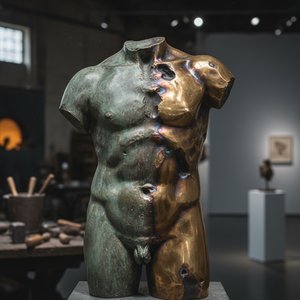
L'Eredità Duratura della Scultura in Bronzo: Storia, Tecniche e Interpretazioni Contemporanee
Esplora la storia e l'arte della scultura in bronzo con . Scopri tecniche antiche, maestri iconici e consigli per collezionisti esperti. Acquista riproduzioni di alta qualità!

I 10 Capolavori Bronzei che Hanno Rivoluzionato la Storia dell'Arte | OriginalUniqueArt
Esplora i 10 capolavori bronzei che hanno segnato la storia dell'arte! Da Rodin a Michelangelo, scopri le storie e le tecniche dietro queste sculture iconiche. Trova riproduzioni d'arte di alta qualità per decorare la tua casa con OriginalUniqueArt.com.

The Enduring Form: Sculpture Across History, Technique & Emotional Resonance
Explore the rich history of sculpture with OriginalUniqueArt. Discover key techniques, influential artists & investment potential for discerning collectors. Expert insights into valuing and collecting timeless masterpieces.

The Enduring Form: Exploring Themes & Techniques in Sculpture Across Historical Periods
Explore the rich history of sculpture from ancient masterpieces to contemporary innovations. Discover key techniques, influential artists & investment potential for discerning art collectors.

I 10 Capolavori in Bronzo che Hanno Rivoluzionato la Storia dell'Arte | OriginalUniqueArt
Esplora i 10 capolavori in bronzo che hanno segnato la storia dell'arte! Da Michelangelo a Rodin, scopri le storie e le tecniche dietro queste statue iconiche. Trova riproduzioni artistiche di alta qualità per decorare casa tua con OriginalUniqueArt.com.
