Anteprima in scala reale
 Invia
Invia Condividi
 Dettagli opera
 Guida
Guida

 Scarica
 Simili
 Radiografia
 Slideshow
 Domande e risposte
 Statistiche
Dieppe


 Espandi i dettagli
Giclée / Stampe d'arte
Stampa giclée o su tela di qualità museale, con produzione rapida e diverse opzioni di finitura. ( Acquista il dipinto realizzato a mano Passa all'immagine digitale)




P118B €10

P118H €10

P118W €10

P438Z €10

P508JH €12

P508YH €12

P805H €10

P805Z €10

P919BZ €10

P919G €10

P919XJ €10

P959ZH €10

P968JZ €12

W106C €8

W218G €10

W218JH €8

W218Y €10

W307PJ €10

W316G €10

W316PJ €8

W316Y €10

W398PJ €8

W4111J €10

W500HY €15

W500JH €15

W692G €12

W849H €8

W940BG €15

W953PJ €8




Scegli tra le nostre dimensioni predefinite, che rispettano le proporzioni originali dell'opera d'arte.

Inserisci la larghezza e l'altezza desiderate, per adattarle alla tua cornice o alla tua parete. Una stampa può essere solo ritagliata, mai resa più grande dell'immagine originale; pertanto, un formato con una forma differente comporterà la perdita di una parte dell'opera. Ti invieremo un mockup digitale da approvare prima di procedere con la stampa. L'immagine mostrata in questa pagina non rappresenta il ritaglio reale — solo il mockup lo mostra.
Consegna in tutto il mondo () in 2 settimane invece delle normali 4/5 settimane. (5 Novembre)

Spedizione espressa gratuita in tutto il mondo

Tela in lino di alta qualità

Assicurazione completa sulla spedizione

Garanzia di rimborso dei dazi doganali

Garanzia di fedeltà cromatica assoluta

Politica di reso entro 100 giorni (solo per difetti di fabbricazione)

Garanzia di rimborso al 100%

Offerta per acquisti multipli
 L'opzione vetro è disponibile solo per dimensioni inferiori a 110 cm

Dieppe
Giclée / Stampe d'arte
Dimensioni riproduzione
-


Prezzo finale calcolato
€ 72
The Scene Unfolds: A Seaside Moment Captured
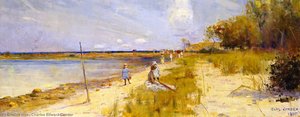
Charles Edward Conder’s “Dieppe,” painted in 1895, isn't merely a depiction of a coastal scene; it’s an immersion into a fleeting moment of tranquility and observation. The canvas breathes with the muted palette of a late afternoon – a symphony of blues deepening towards the horizon, punctuated by the warm ochres and yellows of the sand and distant buildings. The composition immediately draws the eye along a gentle diagonal path created by the sandy track leading toward the figures strolling along the beach. This isn’t a dramatic seascape; rather, it's an invitation to pause, to contemplate the quiet rhythm of daily life unfolding against the vastness of the sea.
The subject matter itself is deceptively simple: a group of people enjoying a seaside walk. Yet Conder elevates this commonplace activity through his masterful use of Impressionistic techniques. He’s less concerned with precise representation and more interested in capturing the *feeling* of the scene – the diffused light, the sense of warmth, the subtle interplay of color and texture. The figures are rendered with loose brushstrokes, their forms dissolving into the atmosphere, suggesting a momentary impression rather than a detailed portrait.
Impressionistic Techniques: A Dance of Light and Color
Conder’s approach is deeply rooted in Impressionism, a movement that sought to capture the subjective experience of light and color. Notice how he employs broken brushstrokes – short, distinct marks applied side-by-side rather than blended smoothly. This creates a shimmering effect, mimicking the way sunlight dances on water and reflects off surfaces. The layering of paint is equally significant; visible texture adds depth and richness to the canvas, inviting the viewer to examine the surface closely.
The color choices are deliberately restrained, contributing to the overall mood of serenity. He avoids bright, saturated hues, opting instead for a harmonious blend of blues, yellows, and browns. This creates a sense of atmospheric perspective – distant elements appear paler and less distinct, reinforcing the feeling of depth and distance. The use of complementary colors—the blue sky contrasted with the warm sand—further enhances the visual interest and vibrancy of the scene.
Historical Context: The Heidelberg School and Australian Modernism
To understand “Dieppe,” it’s crucial to consider Conder's place within the broader context of Australian art. He was a key figure in the Heidelberg School, a group of artists who developed a distinctly Australian style influenced by Impressionism and Post-Impressionism. Based in Melbourne, the Heidelberg School sought to capture the unique landscapes and light conditions of Victoria’s rural areas.
Conder's move to Sydney in 1884 marked a pivotal moment in his career. He quickly established himself as a talented landscape painter, experimenting with new techniques and styles. “Dieppe” reflects this period of artistic exploration, showcasing Conder’s growing mastery of Impressionistic principles while retaining a distinctly Australian sensibility. The painting's subject matter – a seaside scene – resonated deeply with the Heidelberg School’s focus on capturing the beauty of the natural world.
Symbolism and Emotional Resonance: A Moment of Quiet Reflection
Beyond its technical merits, “Dieppe” possesses a subtle yet powerful symbolic resonance. The figures strolling along the beach represent leisure, connection, and the simple pleasures of life. The vast expanse of the sea symbolizes both opportunity and uncertainty – a reminder of the world beyond our immediate surroundings. The painting evokes a sense of quiet contemplation, inviting the viewer to slow down and appreciate the beauty of the present moment.
Ultimately, “Dieppe” is more than just a landscape; it’s a meditation on light, color, and human experience. It's a testament to Conder's artistic vision and his ability to capture the essence of a fleeting scene with remarkable sensitivity and skill. A reproduction of this work offers a beautiful addition to any collection, bringing a touch of Impressionistic serenity into your home.
Domande e risposte
Chi è l'autore e in che anno è stata realizzata "Dieppe"?
"Dieppe" è stata creata da Charles Edward Conder nel 1895.
"Dieppe" di Charles Edward Conder è un ritratto, un paesaggio o una composizione quadrata?
Il formato di "Dieppe" è Landscape. Questa informazione è utile per pianificare il posizionamento di una riproduzione.
Cosa rappresenta "Dieppe" di Charles Edward Conder?
I temi presenti in "Dieppe" di Charles Edward Conder includono seaside, beach, landscape, impressionism, leisure, tranquility, figures, atmosphere, elementi che insieme sintetizzano il soggetto dell'opera.
Biografia dell'artista
vita iniziale e percorso artistico
Charles Edward Conder, pittore, litografo e designer di origine britannica, ha lasciato un segno indelebile nel mondo dell'arte. Nato a Tottenham, Middlesex, il 24 ottobre 1868, la giovinezza di Conder fu segnata dalla scomparsa di sua madre in India quando aveva appena quattro anni.carriera artistica in australia
Nel 1884, all'età di 16 anni, Conder si trasferì a Sydney, in Australia, dove lavorò per suo zio come rilevatore di terreni. Tuttavia, presto scoprì che la sua vera passione risiedeva nel dipingere il paesaggio piuttosto che nella misurazione del terreno. Entro il 1886, era diventato artista per l'Illustrated Sydney News, al fianco di artisti illustri come Albert Henry Fullwood e Frank Mahony.la scuola di heidelberg e opere significative
Il capolavoro di Conder, Departure of the Orient – Circular Quay (1888), ne dimostrò la ritrovata padronanza di forma e pennellata. Questa scena portuale, che ritrae il vivace porto di Sydney Cove, fu rapidamente acquistata dalla Art Gallery of New South Wales, rendendola il primo lavoro di Conder ad entrare in una collezione pubblica.- A Holiday at Mentone (1888), un dipinto pieno di vita che mostra uomini e donne rilassati sulla spiaggia, è un altro esempio notevole dell'opera di Conder.
- L'associazione di Conder con G. P. Nerli, un pittore italiano itinerante, ne influenzò profondamente lo sviluppo come artista.
- I suoi contributi alla 9 by 5 Impression Exhibition a Melbourne, insieme a Tom Roberts e Arthur Streeton, consolidarono la sua posizione all'interno del movimento della Heidelberg School.
eredità e anni successivi
Gli ultimi anni di Conder furono segnati da problemi di salute, inclusa la paralisi e un episodio di delirium tremens. Nonostante ciò, continuò a dipingere, lasciando dietro di sé l'eredità di una figura chiave della Heidelberg School. La sua arte fu accolta meglio in Inghilterra che a Parigi, con il ritratto dipinto da Henri de Toulouse-Lautrec nel 1892. Visualizza le opere di Conder presso la Art Gallery of New South Wales o esplora di più sulla Heidelberg School sulla pagina Charles Edward Conder di OriginalUniqueArt.- Scopri di più sulla vita e le opere di Conder su Wikipedia sulla pagina Charles Conder.
- Esplora la collezione di dipinti di Conder su OriginalUniqueArt, inclusi A Holiday at Mentone (1888) e Departure of the Orient – Circular Quay (1888), sul sito web di OriginalUniqueArt.
conclusione
L'impatto di Charles Edward Conder sull'impressionismo australiano è innegabile. La sua eredità, segnata dai suoi dipinti affascinanti e dall'associazione con la Heidelberg School, continua a ispirare appassionati d'arte in tutto il mondo.
Charles Edward Conder
1868 - 1909 , Regno Unito
Dettagli rapidi
- Artistic Movement Or Style: Impressionismo australiano
- Artists Who Influenced This Artist: ['G. P. Nerli']
- Date Of Birth: 24 ottobre 1868
- Date Of Death: 1909
- Full Name: Charles Edward Conder
- Nationality: Britannico
- Notable Artworks:
- Departure of the Orient
- A Holiday at Mentone
- Place Of Birth (City And Country): Tottenham, Regno Unito
Articoli correlati
Capturing the Soul: The Most Emotionally Moving Impressionist and Post-Impressionist Masterpieces
Discover the profound emotional depth of Impressionist and Post-Impressionist masterpieces. Explore how legends like Monet, Van Gogh, and Gauguin captured light and soul through evocative landscapes and vibrant brushwork for a timeless connection to art history.

Beyond the Horizon: A Curated Guide to Integrating Post-Impressionist Landscapes into Modern Interiors
Transform your home with the emotive power of Post-Impressionist landscapes. Discover expert tips on selecting hand-painted oil reproductions to create a soulful, vibrant interior that reflects your unique style and connection to nature.

I 10 Capolavori Impressionisti che Hanno Rivoluzionato il Paesaggio Pittorico
Esplora i 10 capolavori impressionisti che hanno rivoluzionato il paesaggio pittorico! Monet, Renoir e altri maestri catturati in stampe su tela di alta qualità. Trova l'arte perfetta per la tua casa su OriginalUniqueArt.com.
Golden Fields & Sun-Drenched Meadows: Capturing the Soul of Impressionist Landscapes
Immerse yourself in the luminous world of Impressionist landscapes. Discover how masters like Monet and Gauguin captured ephemeral light through plein air painting, and learn to bring the soul of sun-drenched meadows into your home with exquisite, hand-painted oil reproductions.

I 10 Capolavori Impressionisti che Hanno Rivoluzionato il Paesaggio Pittorico
Esplora i 10 capolavori impressionisti che hanno rivoluzionato il paesaggio pittorico! Monet, Renoir e altri maestri catturati in stampe su tela di alta qualità. Scopri la storia dell'arte e trova l'opera perfetta per arredare casa tua con OriginalUniqueArt.com.