Edizione a olio
 Tutto su Pipe







































 Per opere d'arte o riproduzioni con un lato superiore a 105 cm (circa 41 pollici), la cornice verrà spedita in forma di kit smontato. Questo metodo garantisce una consegna sicura e previene danni durante il trasporto.


The Quietude of Clay
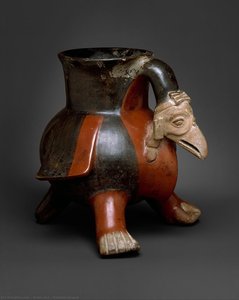
In the dim light of a private collection, this ceramic pipe from 1521 reveals itself through its deep, dark tones. It is a somber object, rendered in shades of brown and black that suggest the earth from which it was shaped. The surface is not merely colored but deeply worked, with geometric patterns carved directly into the clay. These lines—zigzags, curves, and circles—wrap around the body of the pipe, creating a rhythmic texture that catches the light softly. It is a piece of functional art, designed for the ritual of smoking, yet it carries a weight that transcends its utility.
Form and Symbolism
The craftsmanship speaks to a specific moment in the final years of the Aztec Empire. The artisan used hand-carving and burnishing to achieve a surface that is smooth to the touch, despite the intentional roughness of the incised patterns. There is a deliberate precision in the way the shapes repeat, reflecting a worldview where geometry and cosmology were inseparable.
- Material: Ceramic or terracotta
- Technique: Hand-carving and burnishing
- Motifs: Repeating zigzags, curves, and circles
- Color: Limited palette of brown and black
The patterns likely held ritualistic significance, perhaps connecting the user to the cosmic order through the very act of inhalation. The angularity of the shapes reflects the aesthetic conventions of Mesoamerican craftsmanship, where every line serves a purpose.
A Fragment of History
To hold such an object is to touch the edge of a vanished era. Created in 1521, this pipe belongs to the twilight of the Aztec civilization in Tenochtitlan, Mexico. It exists as a physical remnant of a culture that expressed its complex social and religious hierarchies through material objects. The simplicity of its composition—a single object against a neutral void—forces a direct encounter with the hand of the maker. It is a quiet, heavy presence that speaks of the rituals of the past without the need for ornament.
Domande e risposte
Pipe è un dipinto fatto a mano o una stampa?
Dipinto a mano: un pittore professionista riproduce Pipe a olio su tela di lino.
Che dimensioni dovrei scegliere per Pipe?
Le dimensioni vanno da 24.2 x 41.3 cm (€179) a 141.6 x 241.7 cm (€1168); la tabella in questa pagina elenca le opzioni principali e i relativi prezzi.
Quanto tempo richiede la consegna?
La consegna richiede dalle 4 alle 5 settimane, con spedizione espressa gratuita in tutto il mondo; su questa pagina è disponibile un'opzione di produzione urgente. È possibile restituire l'opera entro 100 giorni per un rimborso completo, senza alcuna condizione.
Dove si trova l'originale di Pipe?
L'originale fa parte della collezione del Metropolitan Museum of Art, New York.
Quale tecnica ha utilizzato Impero Azteco per Pipe?
Ceramic
Maggiori informazioni su questo dipinto
 Invia
 Condividi
 Dettagli opera
 Scheda didattica


 Scarica
 Simili
 Slideshow
 Domande e risposte

 Statistiche