Expressionism · 1906
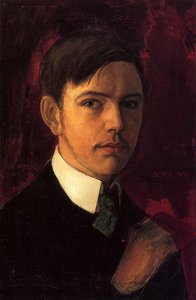
Self-portrait (August Macke, 1906)
August Macke (1887–1914) ha realizzato Self-portrait. Risale al 1906. Fa parte del movimento Expressionism. È realizzato in Oil. Le dimensioni sono 54 × 35 cm.
- 1906
- Oil
- 54 × 35 cm

 Anteprima in scala reale

 Dipinto a olio fatto a mano
 Invia
 Condividi
 Guida


 Scarica
 Simili
 Radiografia
 Slideshow
 Domande e risposte

 Statistiche
Self-portrait: l'essenziale
- Titolo
- Self-portrait
- Artista
- August Macke (1887–1914)
- Artista nato a
- Meschede, Germania
- Date
- 1906
- Tecnica
- Oil
- Dimensioni
- 54 × 35 cm
- Movimento
- Expressionism
- Epoca
- Modern
- Soggetto
- famous people, men, portraits
Cosa raffigura Self-portrait?
A Moment Frozen in Time: The Introspection of August Macke
In the quiet, focused gaze of Self-portrait (1906), we encounter a rare moment of stillness from an artist whose life would soon be swept up in the turbulent currents of German Expressionism. Before the vibrant, kaleidoscopic colors of his later works defined his legacy, this early piece captures August Macke in a state of profound introspection. The painting presents a man with short, neatly groomed hair, dressed in the formal elegance of a white shirt and tie—an attire that suggests a sense of dignity and perhaps a preparation for the public eye. Yet, beneath this composed exterior, there is an unmistakable depth to his expression. His eyes, directed toward the viewer, hold a serious, contemplative weight that invites us to look beyond the surface of the canvas and into the psyche of a young creator on the cusp of greatness.
The composition of this work serves as a masterclass in early twentieth-century portraiture, balancing the intimacy of the subject with a structured, almost architectural background. While the man remains the undeniable focal point, the subtle presence of decorative elements in the periphery hints at an environment rich with culture and aesthetic awareness. The technique employed here reflects Macke’s formative years at the Düsseldorf Art Academy, where he honed his ability to render texture and light with meticulous care. There is a palpable sense of realism in the way the fabric of his shirt catches the light, contrasted against the more shadowed, enigmatic depths of the background. This interplay between clarity and mystery creates a tension that keeps the viewer perpetually engaged, searching for meaning within the artist's steady stare.
For the discerning collector or interior designer, this self-portrait offers much more than mere decoration; it provides a window into the soul of a lost generation. As an era-defining piece from 1906, it carries the historical gravity of the pre-war period, capturing a sense of peace and intellectual rigor before the world was irrevocably changed by conflict. The painting’s sophisticated palette and balanced proportions make it an ideal centerpiece for a curated gallery wall or a refined study. It possesses a timeless emotional impact, evoking feelings of nostalgia, respect, and quiet strength. To possess a reproduction of this work is to bring a piece of art history into one's personal space—a tribute to the enduring power of the human spirit and the transformative beauty of the expressive gaze.
Self-portrait ad alta risoluzione

Pubblico dominio: l'artista è deceduto nel 1914.
Altre dimensioni, ritagli e citazioni →August Macke, Self-portrait (1906). Pubblico dominio
Un esperto digitale verifica la resa cromatica rispetto al dipinto originale e ritocca il file, rispettando fedelmente la pennellata dell'artista.
Acquista l'immagine ad alta risoluzioneDomande su Self-portrait
Dove posso trovare le statistiche relative a "Self-portrait" di August Macke?
La pagina Statistiche di "Self-portrait" di August Macke presenta le statistiche delle visite pubbliche: il numero di visite mensili di quest'opera, un confronto con le opere dell'artista più visualizzate e la provenienza dei visitatori.
Quale emozione trasmette "Self-portrait" di August Macke?
L'atmosfera che traspare da "Self-portrait" di August Macke è Classic, e il suo tono emotivo è Reflective.
Cosa rappresenta "Self-portrait" di August Macke e quale atmosfera trasmette?
"Self-portrait" di August Macke unisce famous people, men, portraits con un'atmosfera Classic.
"Self-portrait" di August Macke è un dipinto, un disegno o una stampa?
"Self-portrait" è un'opera in WallArt.
Quale tavolozza e quale colore dominante definiscono "Self-portrait"?
"Self-portrait" di August Macke utilizza una tavolozza Earthy, con Walnut (#784d29) come colore dominante.
Dove dovrebbe essere appesa una riproduzione di "Self-portrait" di August Macke?
Il formato (Portrait) e l'ambiente consigliato (Office) sono i due dettagli di posizionamento registrati per "Self-portrait" di August Macke.
A quale movimento e a quale epoca appartiene "Self-portrait" di August Macke?
"Self-portrait" appartiene al movimento Expressionism, e il suo autore ha operato nell'epoca Età Moderna.
Quale emozione trasmette l'opera del Expressionism "Self-portrait"?
"Self-portrait" trasmette un tono emotivo Reflective all'interno del movimento Expressionism.
Qual è l'atmosfera generale di "Self-portrait" di August Macke?
"Self-portrait" di August Macke è descritto come Classic per atmosfera. Questa classificazione può aiutare ad abbinare l'opera a un ambiente.
Informazioni sull'artista, August Macke
1887–1914, Germania
August Macke
Le prime esperienze e la formazione artistica La storia di August Macke ha inizio nella cittadina di Meschede, in Germania, dove nacque il 3 gennaio 1887. Figlio unico di August Friedrich Hermann Macke, un appaltatore edile e artista dilettante, e di Maria Florentine, la sua infanzia fu segnata dalle mutevoli fortune dell'azienda paterna, che portarono la famiglia prima a Colonia e successivamente a Bonn. Già da bambino, l'attrazione per l'espressione visiva era evidente: trascorreva i suoi primi anni a schizzare e a progettare scenografie per le recite scolastiche, trovando un modo per trasporre il mondo che lo circondava sulla carta molto prima di varcare la soglia di un'accademia formale. Il suo percorso di studi artistici iniziò ufficialmente con l'arrivo all'Accademia di Düsseldorf, dove studiò dal 1904 al 1906.
Altre opere di August Macke
 Donna con una giacca verde1913
 Ragazze che si fanno la doccia con il paese sullo sfondo1913
 Il Negozio dei Cappelli1913
 Ritratto della moglie dell'artista con cappello1909
Saggi su Self-portrait
 The Inner Landscape: Exploring Themes of Introspection in Visual Art Across Movements & ErasExplore the captivating world of introspective art! Discover how artists across eras – from Rembrandt to Kahlo – used self-portraiture to r…
 I 10 Capolavori dell'Espressionismo che hanno cambiato l'arte per sempreScopri i capolavori dell'Espressionismo tra Munch e Kandinsky. Esplora la collezione su OriginalUniqueArt.com.
 August Macke: Visioni Espressioniste di Armonia e Vita ModernaEsplora il mondo di August Macke e l'Espressionismo tedesco con OriginalUniqueArt. Scopri la sua arte innovativa, le collaborazioni con Der…