

 Anteprima in scala reale
 Condividi
 Condividi
 Dettagli
 Guida stampabile

 Scarica
 Articoli simili
 Radiografia
 Slideshow
 Statistiche
The Lucky Hand (scene 1)
 Acrylic On Canvas
- WallArt
- Expressionist Modernism
 1910
1910 30.0 x 21.0 cm
 Arnold Schönberg Center
 Leggi tutto
Giclée / Stampe d'arte
Stampa giclée o su tela di qualità museale, con produzione rapida e diverse opzioni di finitura. ( Ordina la riproduzione dipinta a mano Passa all'immagine digitale)




P118B $10

P118H $10

P118W $10

P438Z $10

P508JH $12

P508YH $12

P805H $10

P805Z $10

P919BZ $10

P919G $10

P919XJ $10

P959ZH $10

P968JZ $12

W106C $8

W218G $10

W218JH $8

W218Y $10

W307PJ $10

W316G $10

W316PJ $8

W316Y $10

W398PJ $8

W4111J $10

W500HY $15

W500JH $15

W692G $12

W849H $8

W940BG $15

W953PJ $8




Scegli tra le nostre dimensioni predefinite, che rispettano le proporzioni originali dell'opera d'arte.

È possibile inserire dimensioni personalizzate per adattare l'opera a una cornice o a uno spazio specifico. Se la dimensione selezionata non corrisponde alle proporzioni dell'immagine originale, procederemo al ritaglio dell'opera o all'estensione dell'immagine con un bordo specchiato o a tinta unita. Un mockup digitale ti verrà inviato per approvazione prima dell'inizio della produzione.
Si prega di notare che l'anteprima a schermo non riflette il ritaglio o l'estensione effettivi. Solo il mockup mostrerà accuratamente la composizione finale.
Sebbene siano disponibili dimensioni personalizzate, si raccomanda di selezionare una dimensione dall'elenco predefinito per preservare le proporzioni originali.
Consegna in tutto il mondo () in 2 settimane invece delle normali 4/5 settimane. (25 Settembre)

Spedizione espressa gratuita in tutto il mondo

Tela in lino di alta qualità

Assicurazione completa sulla spedizione

Garanzia di rimborso dei dazi doganali

Garanzia di perfetta fedeltà cromatica

Politica di reso entro 100 giorni (solo per difetti di fabbricazione)

Garanzia di rimborso al 100%

Sconto per acquisti multipli
 L'opzione vetro è disponibile solo per dimensioni inferiori a 110 cm

The Lucky Hand (scene 1)
Giclée / Stampe d'arte
Dimensioni della riproduzione
-


Prezzo totale
$ 80
A Descent into the Unseen: "The Lucky Hand" (Scene 1) – A Reflection of Schönberg’s Dark Vision
OriginalUniqueArt.com presents a meticulously crafted hand-painted reproduction of Arnold Schönberg's “The Lucky Hand” (Scene 1), a haunting tableau born from the composer’s intensely personal and profoundly unsettling drama, "Die glückliche Hand." Completed in 1910, this monochrome artwork transcends mere illustration; it is a visual embodiment of Schönberg’s exploration of fate, guilt, and the grotesque – themes that would dominate his later, more radical compositions. The scene, meticulously rendered in shades of grey and black, immediately draws the viewer into a space of palpable unease, mirroring the drama's core anxieties.
- Subject Matter: The artwork depicts a nightmarish scenario – a man lying prone on the stage, seemingly violated by a monstrous hybrid creature. This unsettling image is central to the play’s narrative, representing a descent into psychological torment and the consequences of transgression.
- Composition & Technique: Schönberg's meticulous attention to detail is evident in the layering of textures and the subtle manipulation of light and shadow. The use of a shallow curve for the stage emphasizes claustrophobia, while the strategically placed green-lit faces peering from behind the velvet curtain create an atmosphere of voyeurism and judgment. The artist’s skill lies in conveying both physical horror and psychological dread through a restrained palette.
Historical Context & Schönberg's Artistic Journey
Created during a period of immense artistic upheaval, “The Lucky Hand” reflects the broader anxieties of early 20th-century Europe. Schönberg was at the forefront of musical innovation, challenging traditional harmonic structures and paving the way for atonality – a compositional technique that abandoned established tonal centers. This radical shift mirrored a wider cultural questioning of established norms and values. Born in Vienna in 1874, Schönberg’s early works, such as “Verklärte Nacht,” demonstrated a synthesis of Brahmsian and Wagnerian influences before he fully embraced his revolutionary approach. The work's creation aligns with the period when Schönberg was developing his groundbreaking theories about tone color and exploring the expressive potential of dissonance – concepts that would profoundly impact 20th-century music.
Artist Information: Artist: Arnold Schönberg Birth Year: 1874 Death Year: 1951Symbolism & Emotional Resonance
The imagery within “The Lucky Hand” is laden with symbolic weight. The hyena-like creature, with its bat wings, represents a primal, almost demonic force – a manifestation of guilt and the subconscious. The man’s position, face down, suggests vulnerability and helplessness. The green light emanating from the hidden faces symbolizes judgment and the inescapable scrutiny of conscience. The candles, meticulously arranged on the wall, could represent fleeting moments of hope or perhaps the flickering remnants of sanity in the face of overwhelming darkness. The overall effect is profoundly unsettling, evoking a sense of dread and despair.
Dimensions & Acquisition
This hand-painted reproduction measures 30 x 21 cm (11.8 x 8.3 inches), making it ideal for a variety of settings – from intimate study spaces to larger art collections. Its monochrome palette lends itself beautifully to diverse interior design styles, offering a timeless and sophisticated aesthetic. Order your hand-painted reproduction of “The Lucky Hand” (Scene 1) today and bring this powerful work of art into your home or office.
Biografia dell'artista
Early Life and Musical Beginnings
Arnold Schoenberg, Austrian-American composer who created new methods of musical composition involving atonality, namely serialism and the twelve-tone row. He was also one of the most influential teachers of the 20th century; among his most significant pupils were Alban Berg and Anton Webern. His birth on September 13, 1874, in Vienna, Austria, began a life shaped by humble origins—his father operated a shoe shop—yet Schoenberg’s innate passion for music propelled him to largely self-educate himself in the field. Initially, his musical explorations mirrored the stylistic fusion championed by Johannes Brahms and Richard Wagner, as evidenced in his early masterpiece, “Verklärte Nacht” (1899). However, he swiftly ascended to prominence as a central figure of the Second Viennese School alongside Webern and Berg, marking the dawn of a revolutionary era in musical thought.Notable Works and Musical Innovation
Schoenberg’s compositional breakthroughs fundamentally altered the trajectory of classical music. His seminal works—including “String Quartet No. 2” (1907–1908), “Erwartung” (1909), and “Pierrot Lunaire” (1912)—became emblems of atonality, a radical departure from tonal harmony that challenged established musical conventions. This pioneering approach—later formalized as serialism—involved arranging musical elements in predetermined sequences based on mathematical ratios, fundamentally reshaping the sonic landscape of the time. Furthermore, Schoenberg’s unwavering commitment to artistic integrity led him to resign from the Prussian Academy of Arts in 1933 due to mounting pressure from Nazi ideology, labeling his music as “degenerate.” Despite this perilous period, he persevered in teaching at UCLA (1936–1944), where facilities bear his name—a testament to his enduring legacy.Influence and Legacy
Schoenberg’s influence extended far beyond his immediate contemporaries, shaping the artistic sensibilities of subsequent generations of composers. Theodor W. Adorno and Carl Dahlhaus recognized Schoenberg's profound impact on musicological thought, acknowledging his contribution to redefining musical aesthetics. His aesthetic and music-historical views profoundly impacted the understanding of modern classical music, establishing him as a pivotal figure in shaping its intellectual framework.Later Life and Recognition
As awareness grew of the horrors inflicted during the Holocaust, Schoenberg honored the memory of victims through “A Survivor from Warsaw” (1947), demonstrating his compassion for human suffering. The Israel Conservatory and Academy of Music elected him honorary president in 1951—a poignant acknowledgment of his artistic stature and humanitarian spirit. His final composition, "String Trio" (1946), reflects the somber mood of Vienna during wartime, capturing a moment of vulnerability amidst profound historical upheaval.
Arnold Schoenberg
1874 - 1951 , Austria
Informazioni rapide
- Artistic Movement Or Style: Twelve-tone technique; Expressionism
- Artists Or Movements Influenced By This Artist:
- Anton Webern
- Alban Berg
- Artists Who Influenced This Artist:
- Johannes Brahms
- Richard Wagner
- Date Of Birth: 1874
- Date Of Death: 1951
- Full Name: Arnold Schoenberg
- Nationality: Austrian-American
- Notable Artworks:
- Suite, op. 29
- Music Typewriter
- Staffliner
- Place Of Birth: Vienna, Austria
Articoli correlati

Echoes of Time: Exploring the Enduring Appeal & Historical Context of Vintage Art Prints
Explore the captivating world of vintage art prints! Discover their history, collecting tips & enduring appeal. Expert insights on chromolithography and building a legacy collection with OriginalUniqueArt.

I 10 Dipinti Più Famosi Dominati dal Nero: Maestri e Storie d'Arte
Esplora i 10 dipinti più iconici dominati dal nero, da Caravaggio a Munch. Scopri storie, tecniche e il potere espressivo di artisti come Rembrandt e Goya. Trova stampe d'arte di alta qualità per la tua casa su .

Giclée Prints: Archival Quality & Aesthetic Nuances for the Discerning Collector
Explore the world of giclée prints with OriginalUniqueArt. Learn about archival quality, aesthetic nuances & investment potential. Expert guidance for discerning art collectors seeking museum-quality reproductions and lasting value.
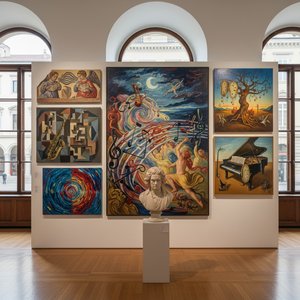
Harmonies on Canvas: Exploring the Visual Representation of Music in Art History
Explore the fascinating history of music's visual representation in art! From ancient symbolism to modern abstraction, discover how artists have captured sound and emotion on canvas. Expert insights & stunning examples.

The Enduring Legacy of Fine Art Prints: Technique, History & Aesthetic Impact
Explore the rich history & techniques of fine art prints. Discover investment potential, assess authenticity, and learn how to preserve your collection with expert guidance. Trusted insights for discerning collectors.


