

 Anteprima in scala reale
 Condividi
 Condividi
 Dettagli
 Guida stampabile

 Scarica
 Articoli simili
 Radiografia
 Slideshow
 Statistiche
Coalizione Chess
 Acrilico su tela
- Opere da parete
- Expressionist Modernism
 1925
1925 60.0 x 60.0 cm
 Arnold Schönberg Center
 Leggi tutto
Riproduzione a olio fatta a mano
Olio su tela dipinto a mano nelle tue dimensioni e con la tua cornice, realizzato su ordinazione dai nostri artisti. ( Passa alle stampe Passa all'immagine digitale)




P118B €10

P118H €10

P118W €10

P438Z €10

P508JH €12

P508YH €12

P805H €10

P805Z €10

P919BZ €10

P919G €10

P919XJ €10

P959ZH €10

P968JZ €12

W106C €8

W218G €10

W218JH €8

W218Y €10

W307PJ €10

W316G €10

W316PJ €8

W316Y €10

W398PJ €8

W4111J €10

W500HY €15

W500JH €15

W692G €12

W849H €8

W940BG €15

W953PJ €8




Scegli tra le nostre dimensioni predefinite, che rispettano le proporzioni originali dell'opera d'arte.

Inserisci la larghezza e l'altezza di cui hai bisogno, per adattarle alla tua cornice o alla tua parete. Trattandosi di un'opera dipinta a mano, in caso di dimensioni con una forma differente, l'artista può dipingere un po' più oltre i bordi dell'immagine o ritagliare leggermente — la scelta spetta a te. Ti invieremo un mockup digitale da approvare prima che la pittura abbia inizio. L'immagine mostrata in questa pagina non rappresenta il risultato reale — solo il mockup lo fa.
Dopo l'ordine, il team di OriginalUniqueArt.com contatterà il cliente via e-mail per ricevere le istruzioni e fornirà un'anteprima del mockup
Consegna in tutto il mondo () in 3/4 settimane anziché nelle normali 5 settimane. (22 Ottobre). Nessun compromesso sulla qualità.

Spedizione espressa gratuita in tutto il mondo

Tela in lino di alta qualità

Assicurazione completa sulla spedizione

Garanzia di rimborso dei dazi doganali

Garanzia di perfetta fedeltà cromatica

Politica di reso entro 100 giorni (solo per difetti di fabbricazione)

Garanzia di rimborso al 100%

Sconto per acquisti multipli
 L'opzione vetro è disponibile solo per dimensioni inferiori a 110 cm

Coalizione Chess
Tecnica di riproduzione
Dimensioni della riproduzione
-


Prezzo totale
€ 262
Coalition Chess: An Unconventional Game Born from War’s Echoes
Arnold Schönberg's Coalition Chess stands as an arresting testament to artistic innovation and intellectual engagement with the anxieties of its time—the turbulent years following World War I. More than just a game of strategy, it embodies a profound exploration of diplomatic relations and negotiation amidst competing forces, mirroring the complexities of international politics during the interwar period. Created in 1925, this remarkable wooden chess set, measuring 60 x 60 cm, transcends mere aesthetics; it’s imbued with symbolic resonance and crafted using meticulous photographic techniques to capture its essence.A Revolutionary Chess Variant
Schönberg fundamentally reimagined the traditional game of chess, introducing nine distinct movement types—a daring departure from the six pieces customary in classical chess. These innovative movements originate either from established chess principles or derive from merging two conventional chess pieces into a single new entity. This ingenious alteration serves as a deliberate reflection of Schönberg’s personal experiences confronting the mechanized warfare apparatus of the First World War, where he sought to translate the pressures of military confrontation into an arena for intellectual discourse and collaborative deliberation. The game's objective isn't simply conquest but rather fostering dialogue between potential coalition partners—a conceptual framework that elevates it beyond a mere pastime.The Artistic Vision: Figurative Pieces Reflecting Historical Trauma
The aesthetic choices underpinning Coalition Chess are equally noteworthy. Schönberg’s pieces retain a figurative character, symbolizing the original motif of the army in modern form. Their names and distribution meticulously correspond to Schönberg's recollections of wartime realities—a conscious effort to distill the psychological impact of conflict into tangible representations. The set’s design utilizes wood as its primary material, complemented by plastic components, resulting in a textured surface that evokes the ruggedness of military equipment. Photographically reproduced, the artwork prioritizes clarity and detail, presenting a frontal view of the chessboard and emphasizing geometric shapes—rectangles representing the board squares and cubes embodying the chess pieces themselves. The lighting is diffused, creating an atmosphere conducive to contemplation and artistic appreciation.Symbolism Beyond Strategy
Beyond its strategic gameplay, Coalition Chess operates on multiple symbolic levels. The colors assigned to each player – Yellow and Black for the dominant forces, Green and Red representing naval and air power respectively – encapsulate the ideological tensions prevalent in Europe during the postwar era. The game’s inherent tension mirrors the delicate balance between cooperation and competition that characterized diplomatic negotiations at the time. Ultimately, Coalition Chess invites viewers to consider not only tactical maneuvers but also the broader implications of human interaction amidst societal upheaval—a timeless exploration of power dynamics and intellectual engagement.A Legacy of Innovation
Arnold Schönberg’s Coalition Chess remains a singular achievement in artistic experimentation. Its enduring appeal lies in its ability to provoke thought, inspire creativity, and serve as a captivating centerpiece for discerning collectors and interior designers alike. The piece embodies Schönberg's unwavering commitment to pushing boundaries within musical composition and extends this pioneering spirit into the realm of visual art—a testament to the transformative power of artistic vision.Domande e risposte
Quale formato e orientamento di stampa si consigliano per "Coalizione Chess" di Arnold Schoenberg?
Formato Large, orientamento Landscape: questa è la configurazione di stampa suggerita per "Coalizione Chess" di Arnold Schoenberg.
Quale tecnica è stata utilizzata per "Coalizione Chess" e quando è stata realizzata?
"Coalizione Chess" è stata realizzata nel 1925, con la tecnica Acrilico su tela.
In che modo lo stile di "Coalizione Chess" si relaziona all'epoca del suo autore?
"Coalizione Chess" di Arnold Schoenberg si inserisce nel movimento Expressionist Modernism, all'interno dell'epoca Età Moderna del suo autore.
Biografia dell'artista
Early Life and Musical Beginnings
Arnold Schoenberg, Austrian-American composer who created new methods of musical composition involving atonality, namely serialism and the twelve-tone row. He was also one of the most influential teachers of the 20th century; among his most significant pupils were Alban Berg and Anton Webern. His birth on September 13, 1874, in Vienna, Austria, began a life shaped by humble origins—his father operated a shoe shop—yet Schoenberg’s innate passion for music propelled him to largely self-educate himself in the field. Initially, his musical explorations mirrored the stylistic fusion championed by Johannes Brahms and Richard Wagner, as evidenced in his early masterpiece, “Verklärte Nacht” (1899). However, he swiftly ascended to prominence as a central figure of the Second Viennese School alongside Webern and Berg, marking the dawn of a revolutionary era in musical thought.Notable Works and Musical Innovation
Schoenberg’s compositional breakthroughs fundamentally altered the trajectory of classical music. His seminal works—including “String Quartet No. 2” (1907–1908), “Erwartung” (1909), and “Pierrot Lunaire” (1912)—became emblems of atonality, a radical departure from tonal harmony that challenged established musical conventions. This pioneering approach—later formalized as serialism—involved arranging musical elements in predetermined sequences based on mathematical ratios, fundamentally reshaping the sonic landscape of the time. Furthermore, Schoenberg’s unwavering commitment to artistic integrity led him to resign from the Prussian Academy of Arts in 1933 due to mounting pressure from Nazi ideology, labeling his music as “degenerate.” Despite this perilous period, he persevered in teaching at UCLA (1936–1944), where facilities bear his name—a testament to his enduring legacy.Influence and Legacy
Schoenberg’s influence extended far beyond his immediate contemporaries, shaping the artistic sensibilities of subsequent generations of composers. Theodor W. Adorno and Carl Dahlhaus recognized Schoenberg's profound impact on musicological thought, acknowledging his contribution to redefining musical aesthetics. His aesthetic and music-historical views profoundly impacted the understanding of modern classical music, establishing him as a pivotal figure in shaping its intellectual framework.Later Life and Recognition
As awareness grew of the horrors inflicted during the Holocaust, Schoenberg honored the memory of victims through “A Survivor from Warsaw” (1947), demonstrating his compassion for human suffering. The Israel Conservatory and Academy of Music elected him honorary president in 1951—a poignant acknowledgment of his artistic stature and humanitarian spirit. His final composition, "String Trio" (1946), reflects the somber mood of Vienna during wartime, capturing a moment of vulnerability amidst profound historical upheaval.
Arnold Schoenberg
1874 - 1951 , Austria
Informazioni rapide
- Artistic Movement Or Style: Twelve-tone technique; Expressionism
- Artists Or Movements Influenced By This Artist:
- Anton Webern
- Alban Berg
- Artists Who Influenced This Artist:
- Johannes Brahms
- Richard Wagner
- Date Of Birth: 1874
- Date Of Death: 1951
- Full Name: Arnold Schoenberg
- Nationality: Austrian-American
- Notable Artworks:
- Suite, op. 29
- Music Typewriter
- Staffliner
- Place Of Birth: Vienna, Austria
Articoli correlati

The Soul of Color: A Journey into the Emotional Resonance of Lyrical Abstraction
Embark on a cultural journey through Lyrical Abstraction. Explore how masters like Kandinsky used color and motion to translate emotion into visual poetry. Discover the profound beauty of abstract expressionism and learn to curate emotional resonance in your own art collection.

Astrazione Geometrica: 10 Capolavori che Hanno Definito un Movimento Artistico
Esplora i 10 capolavori dell'Astrazione Geometrica: Mondrian, Malevich e Kandinsky rivoluzionano l'arte moderna. Scopri la storia, i colori e le tecniche di questi movimenti iconici. Stampe d'arte di alta qualità su OriginalUniqueArt.com!
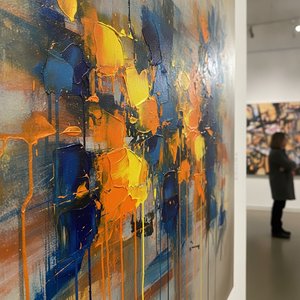
Beyond the Lines: Mastering the High-Impact World of Contemporary Abstraction
Master the high-impact world of contemporary abstraction. Discover how bold colors, textures, and modern movements like Abstract Expressionism can transform your space with premium, high-energy art curated for the design-conscious professional.

Espressionismo Astratto: I 10 Capolavori che Hanno Definito un Movimento Artistico Rivoluzionario
Esplora i 10 capolavori dell'Espressionismo Astratto con ! Scopri Pollock, Rothko e De Kooning: storia, tecnica e significato di opere iconiche per arredare la tua casa con arte di alta qualità. Esplora la collezione online!

Kandinsky: I 25 Capolavori che Hanno Rivoluzionato l'Arte Moderna | OriginalUniqueArt
Esplora i 25 capolavori di Wassily Kandinsky, pioniere dell'arte astratta. Scopri la storia, il significato e le tecniche dietro ogni dipinto iconico. Trova riproduzioni d'arte di alta qualità per decorare la tua casa su OriginalUniqueArt.com.


