
 Anteprima in scala reale
 Invia
Invia Condividi
 Dettagli opera
 Guida
Guida

 Scarica
 Simili
 Radiografia
 Slideshow
 Domande e risposte
 Statistiche
Hilly Landscape


 Espandi i dettagli
Giclée / Stampe d'arte
Stampa giclée o su tela di qualità museale, con produzione rapida e diverse opzioni di finitura. ( Acquista il dipinto realizzato a mano Passa all'immagine digitale)




P118B €10

P118H €10

P118W €10

P438Z €10

P508JH €12

P508YH €12

P805H €10

P805Z €10

P919BZ €10

P919G €10

P919XJ €10

P959ZH €10

P968JZ €12

W106C €8

W218G €10

W218JH €8

W218Y €10

W307PJ €10

W316G €10

W316PJ €8

W316Y €10

W398PJ €8

W4111J €10

W500HY €15

W500JH €15

W692G €12

W849H €8

W940BG €15

W953PJ €8




Scegli tra le nostre dimensioni predefinite, che rispettano le proporzioni originali dell'opera d'arte.

Inserisci la larghezza e l'altezza desiderate, per adattarle alla tua cornice o alla tua parete. Una stampa può essere solo ritagliata, mai resa più grande dell'immagine originale; pertanto, un formato con una forma differente comporterà la perdita di una parte dell'opera. Ti invieremo un mockup digitale da approvare prima di procedere con la stampa. L'immagine mostrata in questa pagina non rappresenta il ritaglio reale — solo il mockup lo mostra.
Consegna in tutto il mondo () in 2 settimane invece delle normali 4/5 settimane. (6 Novembre)

Spedizione espressa gratuita in tutto il mondo

Tela in lino di alta qualità

Assicurazione completa sulla spedizione

Garanzia di rimborso dei dazi doganali

Garanzia di fedeltà cromatica assoluta

Politica di reso entro 100 giorni (solo per difetti di fabbricazione)

Garanzia di rimborso al 100%

Offerta per acquisti multipli
 L'opzione vetro è disponibile solo per dimensioni inferiori a 110 cm

Hilly Landscape
Giclée / Stampe d'arte
Dimensioni riproduzione
-


Prezzo finale calcolato
€ 72
A Pastoral Reverie: Alphonse Legros’s “Hilly Landscape”
Alphonse Legros's "Hilly Landscape," painted in 1876, isn’t merely a depiction of a rural scene; it’s a carefully constructed meditation on light, atmosphere, and the quiet beauty of the English countryside. This evocative work, now housed within the Victoria and Albert Museum’s collection, offers a glimpse into the artist's evolving style—a synthesis of Realist observation with a subtle Impressionistic sensibility—and speaks volumes about his time as an expatriate in London. Legros, having moved from France to England in 1863, found himself immersed in a landscape that both mirrored and subtly diverged from his native French vistas, leading him to develop a unique perspective on the English pastoral.
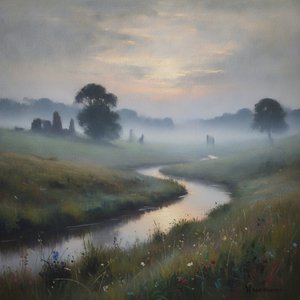
The painting immediately draws the eye with its harmonious blend of greens and blues. The rolling hills, rendered with loose, confident brushstrokes, are bathed in a soft, diffused light—a characteristic of Legros’s approach that suggests an outdoor setting, painted *en plein air*. Notice how he avoids sharp outlines or dramatic contrasts; instead, he employs subtle gradations of color to create a sense of depth and atmospheric perspective. The distant spire of Hampstead church provides a grounding element, anchoring the scene within a recognizable location while simultaneously contributing to the overall feeling of serene distance.
The Influence of Realism and Impressionism
Legros’s artistic journey is defined by his engagement with two significant movements: Realism and Impressionism. Initially trained in traditional academic styles, he was profoundly influenced by Gustave Courbet's rejection of idealized representation and his commitment to depicting the world as it truly appeared. This influence is evident in Legros’s meticulous observation of natural details—the texture of the grass, the subtle variations in the foliage—and his avoidance of overtly sentimental or romanticized imagery. However, he also embraced the Impressionists' focus on capturing fleeting moments and the subjective experience of light and color. The loose brushwork and emphasis on atmospheric effects demonstrate this dual influence, creating a painting that is both grounded in observation and imbued with a sense of immediacy.
Furthermore, Legros’s background as a house decorator and wall-painter—a profession demanding an understanding of materials and spatial relationships—contributed to his ability to create convincing landscapes. He wasn't simply sketching from memory; he was translating three-dimensional space onto a two-dimensional surface with remarkable skill. The composition itself is carefully balanced, guiding the viewer’s eye through the scene and establishing a sense of harmonious unity.
Symbolism and Emotional Resonance
Beyond its technical merits, “Hilly Landscape” resonates with a quiet emotional depth. It evokes a feeling of tranquility and contemplation—a welcome respite from the bustle of urban life. The painting’s muted palette and soft light contribute to this sense of serenity, while the distant church spire suggests a connection to faith and tradition. The scene feels timeless, inviting the viewer to lose themselves in the simple pleasures of nature.
Interestingly, Legros's work often reflected his personal experiences as an expatriate artist. The English countryside, with its rolling hills and picturesque villages, became a source of inspiration for him, offering a contrast to the landscapes of his native France. “Hilly Landscape” can be interpreted as a celebration of this new environment—a testament to the beauty and charm he discovered in England.
A Legacy of British Art
Alphonse Legros’s contribution to British art extends beyond this single painting. He played a pivotal role in establishing etching as a respected medium, teaching at the Slade School of Fine Art and fostering a new generation of artists. His influence can be seen in the work of his students, including Jessie Mothersole and Elinor Hallé, who went on to become prominent figures in the British art world. “Hilly Landscape” stands as a testament to Legros’s artistic versatility and enduring legacy—a beautiful example of a painter who seamlessly blended Realist observation with Impressionistic techniques to create works that continue to captivate viewers today.
Domande e risposte
Con quali pseudonimi o nomi alternativi è conosciuto Alphonse Legros?
Altri nomi registrati per Alphonse Legros, autore di "Hilly Landscape", includono Alphons Legros, Alphonse (nome), Legros.
Chi è l'autore di "Hilly Landscape" e a quale movimento appartiene?
"Hilly Landscape" è stata creata da Alphonse Legros in stile Contemporary Realism. L'artista e il movimento definiscono la tradizione dell'opera.
In che anno è stata creata "Hilly Landscape" di Alphonse Legros?
"Hilly Landscape" di Alphonse Legros è stata creata nel 1876.
Biografia dell'artista
Alphonse Legros: Un Maestro della Linea e dell'Emozione
Alphonse Legros (Dijone, 8 maggio 1837 – Watford, 8 dicembre 1911) è stato un pittore, incisore e scultore francese naturalizzato britannico. La sua arte rappresenta una pietra miliare nella storia del disegno inglese, testimonianza di una visione artistica profondamente radicata nell'esperienza della natura e nella ricerca della bellezza autentica.- Infanzia e Formazione Artistica
- Gli Anni Pionieristici a Parigi
- Il Viaggio in Italia e l’Influenza del Romanticismo
- Londra e la Società degli Incisori
- Un'Eredità Duratura: Legros Oggi
Infanzia e Formazione Artistica
Alphonse Legros nacque nella città francese di Dijone, figlio di un contabile. Fin dalla giovane età fu immerso nell’ambiente rurale della regione natale, dove trascorse estati trascorsi tra i campi e gli animali domestici – esperienze che avrebbero profondamente influenzato la sua sensibilità artistica e lo stile pittorico successivo. Dopo aver studiato presso l'istituto d'arte locale, Legros proseguì il suo percorso accademico a Parigi, dove entrò nella Petite École de Dessin (poi École des Arts Décoratifs), guidata dall’eccellente Horace Lecoq des Boisbaudran. Tra i suoi compagni di studi figurava Auguste Rodin, con cui sviluppò un rapporto intellettuale significativo e che lo avrebbe ricordato anni dopo come “un artista straordinario”, capace di esprimere emozioni profonde attraverso linee semplici ma efficaci.Gli Anni Pionieristici a Parigi
Legros iniziò la sua attività artistica con una serie di opere figurative che riflettevano l’interesse per il paesaggio e la figura umana, elementi ricorrenti nella produzione pittorica degli artisti romantici francesi. Il suo stile si caratterizzava per una linea precisa e controllata, capace di comunicare forza espressiva e profondità emotiva. Tra i suoi primi lavori spicca “L'Angelus” (1857), un quadro che ebbe un grande successo presso la critica parigina e consacrò Legros come uno dei principali rappresentanti del movimento realista francese. Questo periodo fu segnato dalla collaborazione con altri artisti importanti, tra cui James McNeill Whistler, Edgar Degas e Camille Pissarro, artisti condividendo una visione comune dell'arte e della società.Il Viaggio in Italia e l’Influenza del Romanticismo
Come molti artisti romantici francesi, Legros intraprese un viaggio in Italia nel 1863, alla ricerca di ispirazione e nuove fonti di conoscenza estetica. Questo soggiorno ebbe un impatto significativo sulla sua arte, influenzando il suo stile pittorico e la sua visione del mondo. L'esperienza italiana contribuì a rafforzare la sua fiducia nella bellezza della natura e nell’importanza dell’analisi psicologica come strumento per esprimere emozioni autentiche.Londra e la Società degli Incisori
Nel 1863 Legros si trasferì a Londra, dove stabilì una nuova vita professionale e personale. Qui fondò insieme a Jean-Charles Haden la Società degli Incisori (Society of Painter-Etchers), un importante movimento artistico che promuoveva l'utilizzo della tecnica dell’incisione come mezzo espressivo e innovativo. Legros insegnò anche alla Slade School of Art, dove coltivò una vasta comunità di studenti appassionati d'arte e contribuì a diffondere la conoscenza delle tecniche artistiche tradizionali. Tra i suoi allievi spiccano nomi importanti come Dante Gabriel Rossetti e G. F. Watts, artisti che condividevano con Legros un interesse per il simbolismo e l’analisi psicologica.Un'Eredità Duratura: Legros Oggi
Alphonse Legros morì a Watford nel 1911, lasciando una ricca eredità artistica che continua ad affascinare gli studiosi e gli appassionati d’arte di tutto il mondo. Le sue opere sono conservate in importanti musei internazionali e rappresentano un punto di riferimento per lo studio della storia dell'arte inglese e francese del XIX secolo. La sua capacità di esprimere emozioni profonde attraverso linee semplici ma efficaci, insieme alla sua attenzione ai dettagli osservativi e alla ricerca della bellezza autentica, lo rendono uno degli artisti più significativi del suo tempo e un vero maestro della linea.
Alphonse Legros
1837 - 1911 , Francia
Dettagli rapidi
- Artistic Movement Or Style: Realismo
- Artists Or Movements Influenced By This Artist: ['James McNeill Whistler']
- Artists Who Influenced This Artist: ['Gustave Courbet']
- Date Of Birth: 8 maggio 1837
- Date Of Death: 8 dicembre 1911
- Full Name: Alphonse Legros
- Nationality: Francese
- Notable Artworks:
- Donna nella natura selvaggia
- Paesaggio con mulino a vento di Alphonse Daudet
- Place Of Birth: Dijon, Francia
Articoli correlati
Capturing the Mist: The Timeless Beauty of British Landscape Impressionism
Explore the ethereal beauty of British Landscape Impressionism. Discover how masters captured light and mist through plein air techniques, offering a profound connection to the English countryside's timeless, atmospheric soul.

I 10 Capolavori del Realismo Romantico che hanno Incantato la Storia dell'Arte
Esplora l'emozione del Realismo Romantico attraverso 10 capolavori senza tempo. Scopri la storia di maestri come Constable e Friedrich e lasciati ispirare da opere iconiche per il tuo arredamento. Trova riproduzioni d'arte di qualità museale su OriginalUniqueArt.com.

I 10 Capolavori del Paesaggio Romantico: Arte, Storia e Decorazioni di Lusso
Esplora i 10 capolavori del Paesaggio Romantico con OriginalUniqueArt.com! Caspar David Friedrich, Turner e altri maestri: storia, tecnica e colori che definiscono un'epoca. Trova riproduzioni d'arte di lusso per la tua casa. Scopri la collezione completa online!

Evocations of Place: A Historical Journey Through Landscape Art
Explore the rich history of landscape art with OriginalUniqueArt. Discover renowned artists, movements like Impressionism & Romanticism, and expert guidance for collecting timeless pieces. Find your perfect serene escape today!

I 25 capolavori di John Constable: la poesia della natura inglese
Scopri i 25 capolavori di John Constable e il Romanticismo inglese. Esplora la collezione su OriginalUniqueArt.com.


