

 Anteprima in scala reale
 Condividi
 Condividi
 Dettagli
 Guida stampabile

 Scarica
 Articoli simili
 Radiografia
 Slideshow
 Statistiche
Visit to the Studio


 Leggi tutto
Giclée / Stampe d'arte
Stampa giclée o su tela di qualità museale, con produzione rapida e diverse opzioni di finitura. ( Ordina la riproduzione dipinta a mano Passa all'immagine digitale)




P118B €10

P118H €10

P118W €10

P438Z €10

P508JH €12

P508YH €12

P805H €10

P805Z €10

P919BZ €10

P919G €10

P919XJ €10

P959ZH €10

P968JZ €12

W106C €8

W218G €10

W218JH €8

W218Y €10

W307PJ €10

W316G €10

W316PJ €8

W316Y €10

W398PJ €8

W4111J €10

W500HY €15

W500JH €15

W692G €12

W849H €8

W940BG €15

W953PJ €8




Scegli tra le nostre dimensioni predefinite, che rispettano le proporzioni originali dell'opera d'arte.

È possibile inserire dimensioni personalizzate per adattare l'opera a una cornice o a uno spazio specifico. Se la dimensione selezionata non corrisponde alle proporzioni dell'immagine originale, procederemo al ritaglio dell'opera o all'estensione dell'immagine con un bordo specchiato o a tinta unita. Un mockup digitale ti verrà inviato per approvazione prima dell'inizio della produzione.
Si prega di notare che l'anteprima a schermo non riflette il ritaglio o l'estensione effettivi. Solo il mockup mostrerà accuratamente la composizione finale.
Sebbene siano disponibili dimensioni personalizzate, si raccomanda di selezionare una dimensione dall'elenco predefinito per preservare le proporzioni originali.
Consegna in tutto il mondo () in 2 settimane invece delle normali 4/5 settimane. (6 Ottobre)

Spedizione espressa gratuita in tutto il mondo

Tela in lino di alta qualità

Assicurazione completa sulla spedizione

Garanzia di rimborso dei dazi doganali

Garanzia di perfetta fedeltà cromatica

Politica di reso entro 100 giorni (solo per difetti di fabbricazione)

Garanzia di rimborso al 100%

Sconto per acquisti multipli
 L'opzione vetro è disponibile solo per dimensioni inferiori a 110 cm

Visit to the Studio
Giclée / Stampe d'arte
Dimensioni della riproduzione
-


Prezzo totale
€ 69
An Intimate Encounter: The Elegance of Alfred Stevens
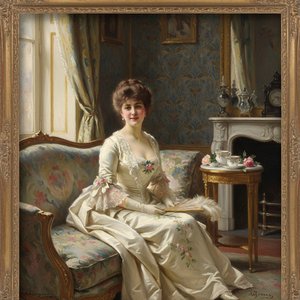
In the quiet, sun-drenched corners of 19th-century Parisian life, few artists captured the essence of modern sophistication quite like Alfred Stevens. His masterpiece, "Visit to the Studio," invites the viewer into a private, whispered moment between two women, suspended in time. This painting is not merely a depiction of a room; it is an exploration of grace, social poise, and the delicate interplay of light and shadow. As we gaze upon the scene, we find ourselves uninvited guests to a serene encounter, where the boundaries between the public persona and private intimacy begin to blur.
The composition is a triumph of Academicism, characterized by a profound sense of balance and harmony. Stevens masterfully positions the two protagonists to create a rhythmic symmetry that guides the eye across the canvas. On the left, a woman stands with an air of poised contemplation, her hand resting on her hip, while on the and, another woman sits in a state of relaxed elegance. This structural equilibrium is deepened by the artist's expert use of chiaroscuro, where light dances across fine fabrics and illuminates the textures of the room, lending a three-dimensional vitality to the entire setting.
A Symphony of Texture and Tradition
Technically, "Visit to the Studio" serves as a testament to Stevens’s command over the oil medium. The artist employs a meticulous approach to detail, a hallmark of the French Academic Art Movement, which allows for a rich, tactile experience. One can almost feel the weight of the elaborate fabrics worn by the women and the smooth surface of the porcelain vase resting nearby. Every brushstroke is purposeful, contributing to a realistic representation that celebrates the beauty of the mundane. The inclusion of everyday objects—a chair, a potted plant, a soft couch in the background—anchors the scene in a tangible reality, making the elegance of the subjects feel both aspirational and accessible.
Beyond the surface level of realism, there is an underlying narrative of social transition. Created during an era when the art world was being shaken by the rise of Impressionism and Art Deco, Stevens’s commitment to the Academic style provides a sense of continuity and timelessness. He captures a specific moment in history where the allure of the upper-middle class was at its zenith. The painting does not seek to shock, but rather to enchant, using the familiar setting of a studio visit to explore themes of companionship and the quiet dignity of the modern woman.
An Inspiration for the Discerning Collector
For the art lover or interior designer, "Visit to the Studio" offers more than just visual beauty; it provides an atmosphere of refined tranquility. The painting’s palette and composition make it a versatile centerpiece, capable of adding a layer of historical depth and sophisticated charm to any high-end space. Whether placed in a contemporary gallery setting or a classic study, the work radiates a sense of calm and cultured taste.
Owning a reproduction of this work allows one to bring the luminous spirit of 19th-century Brussels and Paris into the modern home. It is an invitation to appreciate the enduring power of tradition and the subtle magic found in life's most quiet, elegant moments. To display this piece is to celebrate the mastery of Alfred Stevens and to surround oneself with a legacy of unparalleled craftsmanship and aesthetic grace.
Domande e risposte
È possibile ordinare una riproduzione a olio di "Visit to the Studio"?
"Visit to the Studio" è disponibile come una riproduzione a olio dipinta a mano su tela di lino. L'ordine può essere effettuato su questa pagina, con la possibilità di scegliere diverse dimensioni.
Di cosa è fatto "Visit to the Studio" e in quale stile è realizzato?
"Visit to the Studio" di Alfred Stevens combina la tecnica Oil On Canvas con lo stile Academicism. La tecnica e il movimento descrivono la realizzazione e lo stile dell'opera.
Che atmosfera saprebbe conferire a una stanza una riproduzione di "Visit to the Studio" di Alfred Stevens?
Con la sua atmosfera Classic, "Visit to the Studio" è ideale per Living Room.
Che tipo di opera è "Visit to the Studio"?
"Visit to the Studio" è un'opera di tipo WallArt.
Dove posso acquistare una stampa di "Visit to the Studio" di Alfred Stevens?
"Visit to the Studio" è disponibile come una stampa fine art su tela di cotone o carta canvas d'archivio. Gli ordini possono essere effettuati su questa pagina, nella dimensione che preferisci.
Esiste una guida per "Visit to the Studio" di Alfred Stevens?
È disponibile una pagina Schede didattiche per "Visit to the Studio" di Alfred Stevens: una scheda informativa stampabile sull'opera d'arte, progettata per studenti e uso didattico in classe.
Chi ha creato "Visit to the Studio"?
"Visit to the Studio" è stata creata da Alfred Stevens. Le informazioni contenute in questa pagina descrivono l'opera originale di Alfred Stevens.
Biografia dell'artista
Early Life and Training
Alfred Émile Léopold Joseph Victor Stevens (1823–1906), a Belgian painter of considerable renown, was born on May 11, 1823, in Brussels. His family possessed a deep connection to the visual arts; his elder brother, Joseph (1816–1892), and son Léopold (1866–1935), were both painters, while another brother Arthur (1825–99) served as an art dealer and critic. This familial heritage undoubtedly instilled in Stevens a formative appreciation for artistic expression from a young age. Artistic inclination blossomed early on, nurtured by the encouragement of his family and fueled by the vibrant artistic atmosphere of Brussels during the mid-nineteenth century. Stevens commenced his formal artistic education at the Académie Royale des Beaux-Arts in Brussels, where he received tutelage under François Navez, a prominent neo-classical painter whose stylistic principles profoundly impacted Stevens’ formative years. Navez championed idealized forms and harmonious compositions—elements that would become hallmarks of Stevens' oeuvre. Recognizing his talent and potential, Navez skillfully guided Stevens toward mastering the techniques of classical painting, preparing him for a distinguished artistic career. In 1843, Stevens relocated to Paris, joining his brother Joseph, establishing himself within the bustling Parisian art scene and gaining admittance to the École des Beaux-Arts. Although scholarly debate persists regarding whether he studied directly under Jean Auguste Dominique Ingres—a titan of neoclassical painting—Stevens’ early works undeniably bear the indelible stamp of Ingres' influence, particularly in their meticulous attention to detail and sculptural modeling.Rise to Prominence
Stevens’ artistic breakthrough arrived swiftly upon his debut at the Brussels Salon in 1851. His submission garnered him a third-class medal—a prestigious accolade recognizing excellence within the Belgian art community—and subsequently propelled him to considerable acclaim during the Paris Salon of 1853, securing him a second-class medal and cementing his position as a rising star amongst Parisian artists. The Salon’s discerning judges were captivated by Stevens' painting “Ce qu’on appelle le vagabondage” (Musée d’Orsay, Paris), which powerfully depicted the plight of impoverished Parisians—a subject that resonated deeply with Napoleon III and galvanized public opinion regarding social reform. This monumental undertaking demonstrated Stevens’ commitment to addressing pressing societal issues through artistic representation and solidified his reputation as a socially conscious artist. Stevens' artistic trajectory continued to ascend throughout the latter half of the nineteenth century, marked by consistent recognition and advancement within the French academic art movement. He received the Legion of Honor (Chevalier) from the French government in 1863—a testament to his contributions to French culture—and was elevated to Officer of the Legion of Honor in 1867—further acknowledging his artistic merit and scholarly accomplishments. Throughout his career, Stevens tirelessly pursued excellence, refining his technique and expanding his artistic vision while maintaining unwavering devotion to classical ideals.Notable Works and Legacy
Stevens’ artistic legacy resides primarily in his masterful depictions of women—particularly “La Dame en Rose” (Musées Royaux des Beaux-Arts de Belgique, Brussels), painted in 1866. This iconic portrait exemplifies Stevens' signature style: a harmonious blend of meticulous realism and elegant formalism. The painting skillfully captures the subtle nuances of feminine beauty while simultaneously incorporating Japanese decorative motifs—a stylistic choice that reflects Stevens’ fascination with Eastern art and culture. Furthermore, Stevens produced several preparatory sketches for “Le Panorama du Siècle,” commemorating the Franco-Prussian War, showcasing his versatility as an artist and demonstrating his ability to tackle ambitious artistic projects. His oeuvre includes "Dessin préparatoire au 'Panorama du siècle', 'L'Impératrice Joséphine et sa Cour," a testament to his dedication to capturing historical moments with precision and artistry. Stevens’ enduring influence can be discerned in the works of subsequent Belgian painters who embraced classical principles and sought to emulate his refined aesthetic sensibilities. His paintings continue to inspire admiration for their beauty, technical mastery, and profound engagement with human experience—a legacy that secures his place among Belgium's most celebrated artists. Stevens’ artistic style was profoundly shaped by Dutch Masters, whose emphasis on luminous color palettes and dramatic chiaroscuro techniques served as a cornerstone of Stevens’ artistic vocabulary. He skillfully adopted these stylistic innovations, elevating his paintings to levels of unparalleled grandeur and emotional depth—a testament to his intellectual curiosity and unwavering commitment to artistic excellence.
Alfred Stevens
1823 - 1906 , Belgio
Informazioni rapide
- Artistic Movement Or Style: Realismo Accademico
- Artists Who Influenced This Artist:
- Jean Auguste Dominique Ingres
- Maestri Olandesi
- Date Of Birth: 1823
- Date Of Death: 1906
- Full Name: Alfred Émile Léopold Stevens
- Nationality: Belga
- Notable Artworks:
- La Dame en Rose
- Visit to the Studio
- Dessin préparatoire au 'Panorama du siècle', 'L'Impératrice Joséphine et sa Cour
- Place Of Birth: Bruxelles, Belgio
Articoli correlati

25 Masterpieces by Sir Alfred James Munnings: The Essence of British Equine Art
Immerse yourself in the vibrant world of Sir Alfred James Munnings. Explore 25 iconic equine masterpieces capturing the soul of the British countryside through impressionistic light and movement. Find museum-quality art reproductions at OriginalUniqueArt.com. Discover all masterpieces online.

Masterpieces of Motion: The Top 25 Artworks by Sir Alfred James Munnings
Experience the vibrant spirit of British equestrian art through the top 25 masterpieces by Sir Alfred James Munnings. From impressionistic landscapes to iconic horse portraits, explore timeless stories and museum-quality reproductions for your decor. Discover all masterpieces on OriginalUniqueArt.com.
Alfred Stevens: Capturing Parisian Elegance & Fin-de-Siècle Intimacy
Discover the captivating world of Alfred Stevens, master of Parisian elegance & intimate portraiture. Explore his techniques, influences, and legacy – a prized collection for discerning art enthusiasts.

Mastering the Equine Spirit: The Top 25 Artworks by Sir Alfred James Munnings
Immerse yourself in the vibrant equine world of Sir Alfred James Munnings. Explore 25 iconic masterpieces capturing the soul of the British countryside through impressionistic light and movement. Find museum-quality art reproductions for your collection. Discover all masterpieces on OriginalUniqueArt.com

I 25 Capolavori di Sir Alfred James Munnings: L'Anima della Campagna Inglese
Viaggio nei 25 capolavori di Sir Alfred James Munnings: l'essenza dell'arte equestre e della campagna inglese. Scopri la tecnica impressionista e le splendide riproduzioni d'arte su tela di qualità museale per i tuoi interni. Esplora l'intera collezione su OriginalUniqueArt.com.