Romanticism
Alpine Landscape (Alexandre Calame)
Alexandre Calame (1810–1864) ha realizzato Alpine Landscape. Fa parte del movimento Romanticism. È realizzato in Oil On Canvas. Le dimensioni sono 45 × 31 cm.
- Oil On Canvas
- 45 × 31 cm

 Anteprima in scala reale

 Dipinto a olio fatto a mano
 Invia
 Condividi
 Scheda didattica


 Scarica
 Simili
 Radiografia
 Slideshow
 Domande e risposte

 Statistiche
Alpine Landscape, in breve
- Titolo
- Alpine Landscape
- Artista
- Alexandre Calame (1810–1864)
- Artista nato a
- Vevey, Svizzera
- Tecnica
- Oil On Canvas
- Dimensioni
- 45 × 31 cm
- Movimento
- Romanticism
- Epoca
- 19th Century
- Soggetto
- alpine landscape, mountain scenery, swiss alps view, river valley scene, atmospheric perspective, landscape painting
Cosa raffigura Alpine Landscape?
Identification of the Alpine Landscape
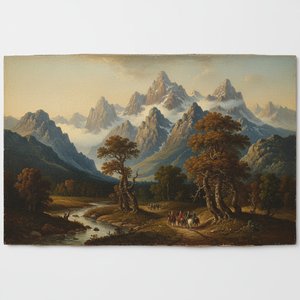
Alpine Landscape is an oil painting by the Swiss artist Alexandre Calame. The canvas captures a mountainous valley where a river winds through the terrain. A rocky outcrop anchors the left side of the scene, leading the eye toward distant, receding peaks. This work reflects the artist's lifelong preoccupation with the rugged topography of his homeland.
Alexandre Calame was born in 1810 in Vevey, Switzerland. He spent much of his life observing the textures of the Alps, from the weight of granite to the movement of mountain streams. The artist eventually passed away in 1864 in Menton, France. In this specific composition, the light remains diffused, as if filtered through an overcast sky or the soft glow of early morning.
The scene focuses on the scale of the natural world. Trees and shrubs ground the foreground, providing a sense of texture against the vastness of the background. The mountains rise in geometric triangles, their forms softening as they vanish into the atmospheric distance. A quiet stillness settles over the valley.
Composition and Visual Elements
A rocky outcrop anchors the left side of the frame, its jagged edges catching the light to pull the eye into the scene. From this stone threshold, the gaze follows a river as it winds through a mountainous valley. In the foreground, the earth is textured with the presence of shrubs and trees, grounding the viewer amidst the wild vegetation. These small, detailed forms provide a tactile entry point before the eye moves toward the vastness of the background.
The composition relies on a steady use of perspective to carve out a sense of immense depth. The mountains recede into the distance, their scale dwarfing the river and the greenery below. This arrangement emphasizes the sheer magnitude of the alpine terrain. The verticality of the peaks meets the horizontal flow of the water, creating a structured balance within the natural chaos. The light remains diffused, casting soft shadows across the mountain slopes and the valley floor. A quiet stillness settles over the stone and the stream.
Technique and Artistic Materials
Oil paint meets canvas in this landscape. The artist applied thin, translucent washes of pigment, layering them one after another in a sequence of glazes. This meticulous process builds a luminous depth, allowing light to settle within the layers. It is a slow accumulation of color. The surface holds the weight of the mountain and the softness of the air.
The brushwork captures the physical reality of the terrain. Roughness defines the stone of the rocky outcrop, while the texture of the foliage is rendered with precise, tactile strokes. Light enters the scene as a diffused glow, suggesting the quiet of an overcast day or the pale clarity of early morning. Shadows settle into the mountain crevices, creating a sense of immense scale through tonal modulation. The atmosphere feels heavy with moisture, as if the light itself is filtered through a mountain mist.
The Artistic Style of Calame
A sense of the sublime anchors this work, a hallmark of the Romanticism movement. Calame was a pivotal figure within the Düsseldorf School of Painting, bringing a disciplined eye to the untamed wilderness. He treats the mountains not as static stone, but as living, breathing entities. Through a mastery of atmospheric perspective, the distant peaks recede into a soft, hazy light, creating a profound sense of depth. This tonal modulation allows the viewer to feel the weight of the air between the rocky foreground and the far horizon.
The brushwork is expressive, capturing the rugged textures of the landscape. He uses these strokes to convey the emotional impact of nature, translating the scale of the valley into a felt experience. There is a palpable emotion in the way light hits the river and the cliffs, suggesting the solitude of the high Alps. His connection to these mountains is evident in the precise, almost tactile rendering of the terrain. The scene remains quiet, held in a delicate balance of light and shadow.
Related Works by Alexandre Calame
The artist’s hand often returned to the weight of the mountains and the movement of the air. In 1838, he captured the tension of a storm at Handeck, where the sky meets the jagged rock. This energy persists in his 1856 work, Storm in the Alps, a scene of chaotic weather and turbulent clouds. He also documented the specific topography of the Valley of Lauterbrunnen in 1856, rendering the deep clefts of the Swiss terrain. These works reflect a lifelong preoccupation with the raw power of the high passes.
Water remains a constant presence in his compositions, shifting from the violent to the still. He painted the Lake of the Four Cantons, near Brunnen, in 1853, finding a different rhythm in the alpine waters. His vision extended beyond the peaks to the warmth of the south, seen in Pozzuoli and the Bay of Naples, 1844. Even in more quiet studies, such as Landscape with Oaks, about 1859, the meticulous observation of nature remains central. The light continues to shift across the stone.
Immagini ad alta risoluzione di Alpine Landscape
Pubblico dominio: l'artista è deceduto nel 1864.
Alexandre Calame, Alpine Landscape.
Alexandre Calame (1810–1864), Alpine Landscape, oil on canvas. Pubblico dominio Immagine di OriginalUniqueArt.com.
Domande su Alpine Landscape, risposte
Con quale tecnica è realizzato "Alpine Landscape"?
"Alpine Landscape" è realizzata con Oil On Canvas.
Quali sono le dimensioni reali di "Alpine Landscape" di Alexandre Calame?
"Alpine Landscape" misura 45 x 31 cm nella sua forma originale. Le dimensioni originali sono un utile riferimento per scegliere la dimensione di una riproduzione.
Cosa rappresenta "Alpine Landscape" di Alexandre Calame?
I temi presenti in "Alpine Landscape" di Alexandre Calame includono alpine landscape, mountain scenery, swiss alps view, river valley scene, atmospheric perspective, landscape painting, nature’s grandeur”, elementi che insieme sintetizzano il soggetto dell'opera.
"Alpine Landscape" è di pubblico dominio?
"Alpine Landscape" di Alexandre Calame è di pubblico dominio - il copyright è scaduto. Questo stato determina le modalità con cui l'immagine dell'opera può essere riprodotta.
Chi è l'artista dietro "Alpine Landscape"?
L'artista che ha creato "Alpine Landscape" è Alexandre Calame. L'opera è catalogata sotto il nome di Alexandre Calame.
A quale movimento artistico appartiene "Alpine Landscape" di Alexandre Calame?
"Alpine Landscape" è un'opera di Romanticism. Il movimento indica la tradizione artistica di cui l'opera fa parte.
A quale periodo della carriera di Alexandre Calame appartiene "Alpine Landscape"?
All'interno della carriera di Alexandre Calame, "Alpine Landscape" appartiene al Mature Period. Questa fase permette di confrontarla con le altre opere dell'artista.
"Alpine Landscape" di Alexandre Calame è di pubblico dominio? E perché?
"Alpine Landscape" di Alexandre Calame è di di pubblico dominio - il copyright è scaduto. I termini del copyright si calcolano a partire dalla morte dell'artista, e Alexandre Calame è deceduto nel 1864.
In che modo "Alpine Landscape" si inserisce nel percorso artistico di Alexandre Calame?
"Alpine Landscape" appartiene alla produzione Romanticism di Alexandre Calame, i cui temi ricorrenti includono romantic nature's beauty, düsseldorf school influence, swiss landscape focus", alpine sublime ideal, detailed observation, calame's signature style, nature as spiritual space.
Informazioni sull'artista, Alexandre Calame

1810–1864, Svizzera
Alexandre Calame
Alexandre Calame (1810 – 1864): Catturare la Maestosità Alpina Alexandre Calame, nato ad Arabie (l'odierna Vevey), in Svizzera, nel 1810, fu un pittore di paesaggi svizzero che ottenne considerevole fama durante l'era Romantica ed è considerato una figura cruciale all'interno della Scuola di Düsseldorf. Il suo percorso artistico ebbe inizio in circostanze difficili: la rovina finanziaria del padre gli impedì di proseguire gli studi formali, costringendolo a lavorare come impiegato bancario fin dall'adolescenza. Eppure, questa necessità pragmatica alimentò la sua passione per l'arte, nutrita dall'incontro con il banchiere Diodati, che gli assicurò un'inestimabile formazione sotto la guida di François Diday, celebre pittore di paesaggi della Scuola di Düsseldorf. Riconoscendo il suo talento innato e la sua dedizione, Calame abbandonò rapidamente i compiti d'ufficio per perseguire l'eccellenza artistica.
Altre opere di Alexandre Calame
 Torrente nelle Alpi1849
 Valle di Lauterbrunnen1856
 Il Mythen1861
 Paesaggio1837
Saggi su Alpine Landscape
 Alpine Grandeur: A Study of Mountain Landscapes in Classical and Romantic ArtExplore the evolution of mountain landscapes from Flemish masters to German Expressionism. Discover the sublime power of Alpine art history.
 Pittori svizzeri del XIX secoloScopri i capolavori di Böcklin, Hodler e Anker. Dai simbolismi al realismo, esplora la collezione su OriginalUniqueArt.com.
 Majestic Peaks on Canvas: A Historical & Artistic Exploration of Mountains in Fine ArtExplore the history of mountain painting! Discover Romantic masterpieces & key artists like Dahl & Calame. Learn about the Sublime & Pictur…