Acquista l'originale a olio
 Scopri di più su Second Class - the parting:







































 Per opere d'arte o riproduzioni con un lato superiore a 105 cm (circa 41 pollici), la cornice verrà spedita in forma di kit smontato. Questo metodo garantisce una consegna sicura e previene danni durante il trasporto.


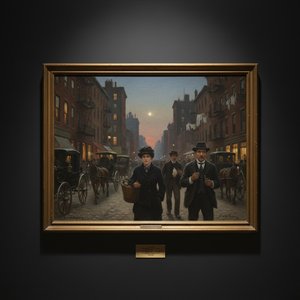
From the early 1800s, the British were encouraged to emigrate to Australia and become wealthy by working the land or, from the 1850s, by trying their luck on the goldfields. This work represents the changing popular response to emigration to Australia.When Abraham Solomon painted Second Class in 1854, circumstances in England and Australia had changed dramatically. Gold had been discovered in Australia, transportation had virtually ceased and the political print had lost its popularity in England. Solomon’s painting shows a young man leaving for the goldfields, his family accompanying him on the train journey. The work is aimed at a sentimental middle-class market – when will the mother see her son again?This painting forms part of a wider genre presenting free settlers (and gold rush emigrants) to Australia and other British empire colonies. After receiving accolades at the Royal Academy, Second Class, together with its counterpart First Class 1954, became popular through printed reproductions,being produced as a lithographic print both in England and Germany.Roger ButlerText © National Gallery of Australia, Canberra 2010From: Anne Gray (ed), Australian art in the National Gallery of Australia, National Gallery of Australia, Canberra, 2002
Domande e risposte
Second Class - the parting: è un dipinto fatto a mano o una stampa?
Dipinto a mano: un pittore professionista riproduce Second Class - the parting: a olio su tela di lino.
Che dimensioni dovrei scegliere per Second Class - the parting: ?
L'originale misura 966 x 694 cm. Le dimensioni vanno da 25.8 x 38.7 cm (€179) a 164.8 x 246.8 cm (€1363); la tabella in questa pagina elenca le opzioni principali e i relativi prezzi.
Quanto tempo richiede la consegna?
La consegna richiede dalle 4 alle 5 settimane, con spedizione espressa gratuita in tutto il mondo; su questa pagina è disponibile un'opzione di produzione urgente. È possibile restituire l'opera entro 100 giorni per un rimborso completo, senza alcuna condizione.
Dove si trova l'originale di Second Class - the parting: ?
L'originale fa parte della collezione del Galleria Nazionale dell'Australia, Canberra.
Maggiori informazioni su questo dipinto
 Anteprima in scala reale

 Invia
 Condividi
 Dettagli opera
 Scheda didattica


 Scarica
 Simili
 Radiografia
 Slideshow
 Domande e risposte

 Statistiche