Stuck portréja

A 100 legnevezesebb Stuck festmény, egy galériaválaszték

Frissítve: október 2026 · rangsorolva népszerűségi pontszámunk alapján (minden mű keresései, látogatásai és megrendelései alapján) · 259 mű Stuck alkotása a katalógusunkban

Röviden

Stuck hagyatékából a leghíresebb alkotás A bűn (1893), amely a Munchen városi Bavári Állami Festırménygyűjtemények gyűjteményében található. Röviddel ezután követik őket Lucifer (1890) és Wounded Amazon (1904). Katalógusunkban 259 mű található Stuck alkotótól; a galéria megőrizte a világ által leginkább csodált 100 darabot, melyeket a dátummal, a múzeummal és a történetükkel együtt mutatunk be.

1863 – 1928, Tettenweis Szimbolizmus A legtöbb mű: Bavári Állami Festırménygyűjtemények

Stuck legjobb 10 festménye: a galéria válogatása

1
A bűn (1893) (1889) -ja Stuck

A bűn

1893 · Olajfestmény vászonon · Bavári Állami Festırménygyűjtemények, Munchen

The Sin is an 1893 painting by the German artist Franz von Stuck. In this work, the artist presents the figure of Eve, depicted nude and entwined with a large serpent that wraps around her body. This specific motif emerged from a previous exploration of subject matter, specifically developing from Stuck's 1889 painting Sensuality (Die Sinnlichkeit).

2
Lucifer (1890) (1889) -ja Stuck

Lucifer

1890 · Olajfestmény vászonon · National Gallery of Bulgaria, Sofia

1890-ben Franz von Stuck megalkotta a Lucifer című művet vászonon olajjal, egy olyan alkotás, amely rögzíti művész "sötét monumentális" korszakát. A alak egy ürességből emelkedik elő, egy ülő ember-szellem, aki a nehéz, gondolkodó nyugalom pillanatában fagyult meg. Izom és árnyék lényegéből álló teremtés, alakját a test feszültsége határozza meg, amely egyszerre emberi és valami sokkal ősiebb. Bálnéja fix, áttarájítja a sötétséget, és közvetlenül találkozik a nézővel.

3
Wounded Amazon (1904) (1889) -ja Stuck

Wounded Amazon

1904 · Oil On Canvas

In the hauntingly evocative Wounded Amazon, created in 1904, Franz Ritter von Stuck invites us into a moment of profound vulnerability and raw conflict. The painting presents a nude female figure, an Amazon, captured in a state of intense distress. She is positioned kneeling upon the ground, her body bearing the mark of battle with a visible wound beneath her breast. As she shields herself from unseen threats, her arms…

4
Sin (1893) (1889) -ja Stuck

Sin

1893 · Oil On Canvas · Neue Pinakothek, Munich

Franz Ritter von Stuck: The Sin The dark, decadent art of Franz Ritter von Stuck is ushered into the light for its first American retrospective. Jo-Ann Birnie Danzker, curator at the Frye Art Museum, hopes that it will lead to a reevaluation of Stuck’s importance as an artist in his own right – his work seemed old-fashioned and irrelevant to a generation that had endured World War I. Stuck's reputation…

5
Lucifer (1889) -ja Stuck

Lucifer

Oil On Canvas

Franz von Stuck presents the fallen angel in Lucifer, an oil on canvas executed between 1890 and 1891. The figure is rendered as a seated, naked, and brooding presence within an undefined dark space. This depiction of a central figure from Christian mythology emphasizes an intense, muscular physicality. The subject's posture is heavy, conveying a sense of profound melancholy and internal struggle.

6
Wine (1889) (1889) -ja Stuck

Wine

1889 · Oil On Canvas · Kunsthaus Zürich, Zürich

To stand before Franz Ritter von Stuck’s Wine is to step directly into the charged, evocative atmosphere of late 19th-century German Symbolism. This piece from 1889 is far more than a mere depiction; it is an emotional tableau, a meditation on human connection, nature's embrace, and perhaps, the intoxicating mystery of desire itself. The composition immediately draws the eye to the central drama: a nude male figure clinging with desperate…

7
The Sin (1912) (1889) -ja Stuck

The Sin

1912 · Oil On Canvas · Alte Nationalgalerie, Berlin

, also known as Die Sünde, is an oil on canvas work by the German artist Franz von Stuck. Created in 1912, this piece represents one of several versions of this specific theme developed by the artist. The work is a significant example of the Symbolist movement, focusing on psychological depth and dramatic tension.

8
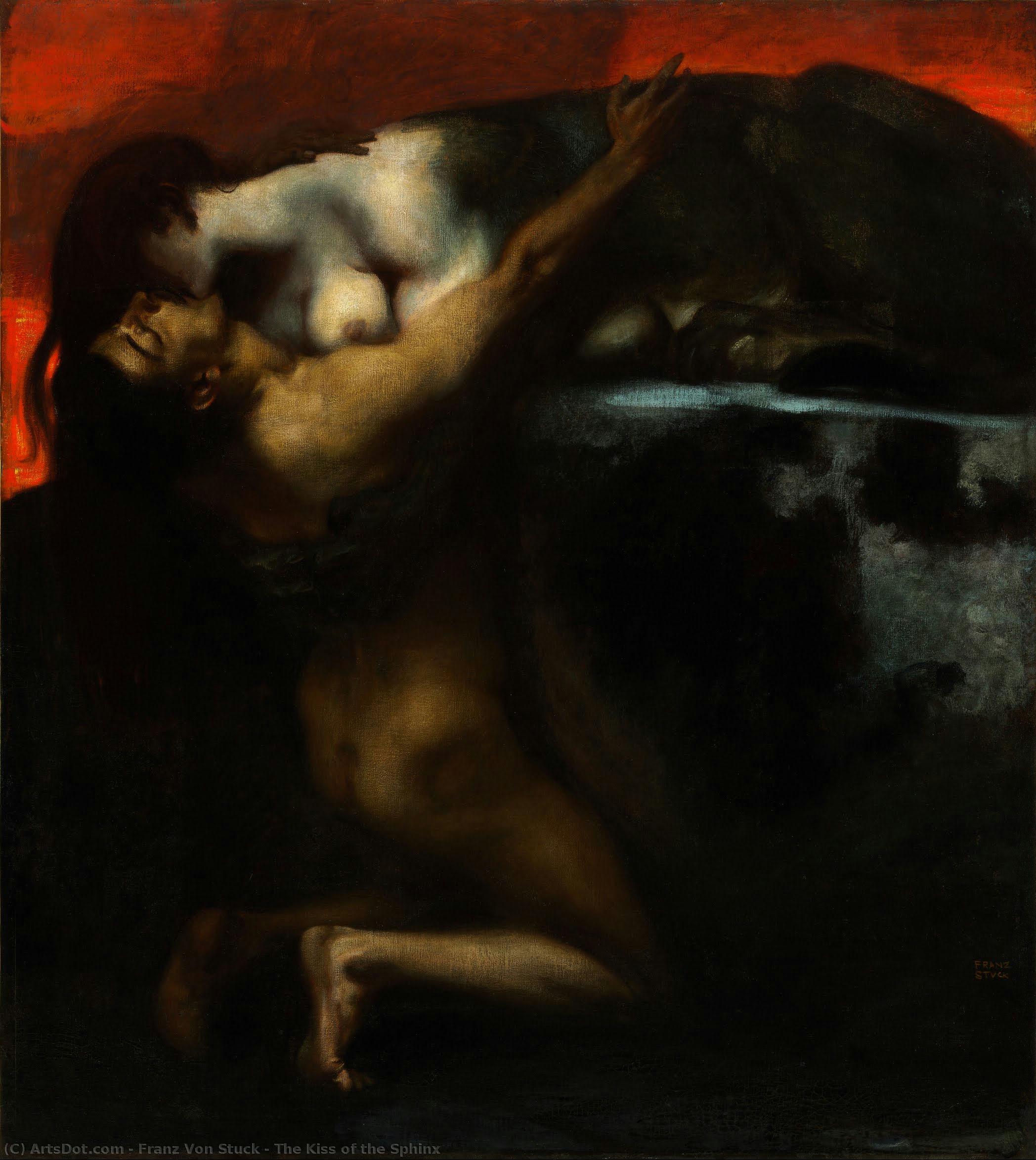
The Kiss of the Sphinx (1895) (1889) -ja Stuck

The Kiss of the Sphinx

1895 · Oil On Canvas · Szépművészeti Múzeum, Budapest

In the twilight of the nineteenth century, few images captured the psychological tremors of the era as profoundly as Franz Ritter von Stuck’s "The Kiss of the Sphinx." Completed in 1895, this masterpiece serves as a haunting cornerstone of German Symbolism, inviting the viewer into a realm where the boundaries between the physical and the metaphysical dissolve. The painting presents a dramatic tableau of a sensual encounter, set against the…

9
Sisyphus (1920) (1889) -ja Stuck

Sisyphus

1920 · Oil

In the 1920 painting titled Sisyphus, the artist Franz von Stuck depicts a man engaged in a repetitive physical struggle. The subject is shown in the process of pushing a large boulder up a steep incline. The man is positioned with the weight of the rock resting directly upon his back. He wears a simple loincloth, leaving his muscular form exposed as he labors against the terrain. One hand is…

10
Glow Worms (1898) (1889) -ja Stuck

Glow Worms

1898 · Oil On Canvas

In this work, titled Glow Worms, we encounter a piece from 1898 by the German artist Franz von Stuck. It is a quiet moment captured in oil on canvas, reflecting the specific sensibilities of the late nineteenth century. The artist, who was born in Tettenweis, Germany, brings a particular sense of atmosphere to this nocturnal scene, moving away from the rigid academicism of his era toward something more personal and…

A Stuck válogatás folytatódik: 11 – 100

11Wild Chase (1889) (1889) -ja StuckWild Chase1889 · Lenbachhaus 12Inferno (1908) (1889) -ja StuckInferno1908 · Metropolitan Művészeti Múzeum 13Portrait of Frau Feez (1889) -ja StuckPortrait of Frau Feez 14The Guardian of Paradise (1889) (1889) -ja StuckThe Guardian of Paradise1889 · Villa Stuck múzeum 15von Lucifer (1889) -ja Stuckvon Lucifer 16Gertrud Littmann (1911) (1889) -ja StuckGertrud Littmann1911 · Bavári Állami Festırménygyűjtemények 17Amazon and Centaur (1889) -ja StuckAmazon and Centaur 18Faun and Nymph (Teasing) (1892) (1889) -ja StuckFaun and Nymph (Teasing)1892 · National Gallery Prague 19Florentine Lady (1901) (1889) -ja StuckFlorentine Lady1901 20Professor Lujo Brentano (1914) (1889) -ja StuckProfessor Lujo Brentano1914 · Bavári Állami Festırménygyűjtemények 21The Murderer (1891) (1889) -ja StuckThe Murderer1891 22Sin (1893) (1889) -ja StuckSin1893 23Junge (1889) -ja StuckJunge 24Crucifixion (1913) (1889) -ja StuckCrucifixion1913 · Museum der bildenden Künste 25Salome (1906) (1889) -ja StuckSalome1906 · Lenbachhaus 26The Architect Max Littmann (1903) (1889) -ja StuckThe Architect Max Littmann1903 · Bavári Állami Festırménygyűjtemények 27Young Girl with Wreath (Bust, octagonal) (1862) (1889) -ja StuckYoung Girl with Wreath (Bust, octagonal)1862 28a Lady Monna Vanna (1879) (1889) -ja Stucka Lady Monna Vanna1879 · Stadtisches Museum 29Portrait of the Artist's Wife (1888) (1889) -ja StuckPortrait of the Artist's Wife1888 30Children Sledding (1888) (1889) -ja StuckChildren Sledding1888 31Double Portrait of Two Girls (1888) (1889) -ja StuckDouble Portrait of Two Girls1888 32Portrait of a Lady in Profile (1888) (1889) -ja StuckPortrait of a Lady in Profile1888 33Female Portrait (Back View and Profile) (1888) (1889) -ja StuckFemale Portrait (Back View and Profile)1888 34Female Portrait (1888) (1889) -ja StuckFemale Portrait1888 35Female Nude, Venus (1888) (1889) -ja StuckFemale Nude, Venus1888 36Self-Portrait in Profile (1888) (1889) -ja StuckSelf-Portrait in Profile1888 · Stadtisches Museum 37Sphinx (1892) (1889) -ja StuckSphinx1892 38Lost (1891) (1889) -ja StuckLost1891 39bathing nymph + looking Satyr (1888) (1889) -ja Stuckbathing nymph + looking Satyr1888 40portrait of Tilla Durieux as line (1888) (1889) -ja Stuckportrait of Tilla Durieux as line1888 41Susanna and the two eldermen (1888) (1889) -ja StuckSusanna and the two eldermen1888 42Helios (1888) (1889) -ja StuckHelios1888 43girl with wreath of violets (1888) (1889) -ja Stuckgirl with wreath of violets1888 44Portrait of a man (1888) (1889) -ja StuckPortrait of a man1888 45Female head (1888) (1889) -ja StuckFemale head1888 46A crying nix - woman (1888) (1889) -ja StuckA crying nix - woman1888 47Head of Medusa (1892) (1889) -ja StuckHead of Medusa1892 48Portrait of Beethoven (1889) -ja StuckPortrait of Beethoven 49Drunken Cantaur (1889) (1889) -ja StuckDrunken Cantaur1889 50Boy Bacchus Riding on a Panther (1889) -ja StuckBoy Bacchus Riding on a Panther 51Innocentia (1889) (1889) -ja StuckInnocentia1889 52Sensuality (1897) (1889) -ja StuckSensuality1897 53Franz and Mary Stock in the Studio (1902) (1889) -ja StuckFranz and Mary Stock in the Studio1902 54Portrait of a Girl (1899) (1889) -ja StuckPortrait of a Girl1899 55Portrait of the Artist's Daughter (1903) (1889) -ja StuckPortrait of the Artist's Daughter1903 56Portrait of His Wife (1903) (1889) -ja StuckPortrait of His Wife1903 57Portrait of a Woman (Wife of the Artist) (1903) (1889) -ja StuckPortrait of a Woman (Wife of the Artist)1903 58Runner (1903) (1889) -ja StuckRunner1903 59Portrait of a Woman (his wife) (Lady's Portrait) (1903) (1889) -ja StuckPortrait of a Woman (his wife) (Lady's Portrait)1903 60Portrait of a lady (1902) (1889) -ja StuckPortrait of a lady1902 61Head of a girl (1903) (1889) -ja StuckHead of a girl1903 62Portr. of a lady (1903) (1889) -ja StuckPortr. of a lady1903 63Half-length. ............ (1903) (1889) -ja StuckHalf-length. ............1903 64dancers (1903) (1889) -ja Stuckdancers1903 65Lady with head-dress (1903) (1889) -ja StuckLady with head-dress1903 66Wind + wave (1903) (1889) -ja StuckWind + wave1903 67The see - saw (1903) (1889) -ja StuckThe see - saw1903 68Rape of a maremaid (1902) (1889) -ja StuckRape of a maremaid1902 69head of a girl (1903) (1889) -ja Stuckhead of a girl1903 70Susanna in the bath (1904) (1889) -ja StuckSusanna in the bath1904 · Kunstmuseum 71Bacchanal (1905) (1889) -ja StuckBacchanal1905 72The Ride (1903) (1889) -ja StuckThe Ride1903 73The Kiss of the Sphinx (1905) (1889) -ja StuckThe Kiss of the Sphinx1905 74The Artist's Daughter with Cornflowers in Her Hair (1909) (1889) -ja StuckThe Artist's Daughter with Cornflowers in Her Hair1909 · Westfälisches Landesmuseum 75"The swing of love" (1909) (1889) -ja Stuck"The swing of love"1909 76Portrait of a girl (1907) (1889) -ja StuckPortrait of a girl1907 77Portrait of lady between Doric columns (1906) (1889) -ja StuckPortrait of lady between Doric columns1906 78Bathsheba (1912) (1889) -ja StuckBathsheba1912 · Nemzeti Szépművészeti Múzeum 79Phryne (1917) (1889) -ja StuckPhryne1917 · Portland Art Museum 80Spanish duel "the deal" (1917) (1889) -ja StuckSpanish duel "the deal"1917 81Pygmalion (1926) (1889) -ja StuckPygmalion1926 82Wind and Waves (unfinished) (1928) (1889) -ja StuckWind and Waves (unfinished)1928 83The Struggle for Woman (1889) -ja StuckThe Struggle for Woman 84Pietà (1891) (1889) -ja StuckPietà1891 · Städel Múzeum 85Fighting Centaurs (1894) (1889) -ja StuckFighting Centaurs1894 · Städel Múzeum 86Fighting Fauns (1889) (1889) -ja StuckFighting Fauns1889 · Bayerische Staatsgemäldesammlungen 87Encounter (1921) (1889) -ja StuckEncounter1921 · Bavári Állami Festırménygyűjtemények 88The Spring (1902) (1889) -ja StuckThe Spring1902 · Szépművészeti Múzeum 89Mary with a red hat (1902) (1889) -ja StuckMary with a red hat1902 90War (1894) (1889) -ja StuckWar1894 · Bavári Állami Festırménygyűjtemények 91Ostrich Hunt (1919) (1889) -ja StuckOstrich Hunt1919 · Bavári Állami Festırménygyűjtemények 92The Diner (1889) -ja StuckThe DinerBavári Állami Festırménygyűjtemények 93Evening Star (1889) -ja StuckEvening Star 94Portrait of Marie Stuck (1889) -ja StuckPortrait of Marie Stuck 95The Wild Hunt (1899) (1889) -ja StuckThe Wild Hunt1899 · Musée d'Orsay 96Pallas Athene (1898) (1889) -ja StuckPallas Athene1898 97children on sledges (1888) (1889) -ja Stuckchildren on sledges1888 98Landscape with Waterfall (1896) (1889) -ja StuckLandscape with Waterfall1896 · Bavári Állami Festırménygyűjtemények 99Dancers (1896) (1889) -ja StuckDancers1896 100Fighting Amazon (1897) (1889) -ja StuckFighting Amazon1897 · Lenbachhaus

A témák, amelyek Stuck figyelmét meghúzták

A négy leggyakorobban előforduló téma ebben az eredeti művekben, mindegyik a legkiválóbb példájával.

A műemlékek, amelyek Stuck eredeti műveit őrzik

A 8 olyan múzeum, amely a legtöbb ezen az oldalon szereplő festményet őrzi.

Múzeum Város Stuck művei Ebből a listából származó festmények
Bavári Állami Festırménygyűjtemények, MunchenBavári Állami Festırménygyűjtemények Munchen 9 A bűn, Gertrud Littmann, Professor Lujo Brentano
Lenbachhaus, MünchenLenbachhaus München 4 Wild Chase, Salome, Fighting Amazon
Szépművészeti Múzeum, BudapestSzépművészeti Múzeum Budapest 2 The Kiss of the Sphinx, The Spring
Stadtisches Museum, GelsenkirchenStadtisches Museum Gelsenkirchen 2 a Lady Monna Vanna, Self-Portrait in Profile
Städel Múzeum, FrankfurtStädel Múzeum Frankfurt 2 Pietà, Fighting Centaurs
Alte Nationalgalerie, BerlinAlte Nationalgalerie Berlin 4 The Sin
Villa Stuck múzeum, MunchenVilla Stuck múzeum Munchen 3 The Guardian of Paradise
National Gallery of Bulgaria, SofiaNational Gallery of Bulgaria Sofia 1 Lucifer

Stuck évtizede folgtva: az eredeti művek, amelyek meghatározzák az egyes korzakot

Művek évtizedenként

Váassz ki egy évtizedet, hogy megnézhesd az azt meghatározó eredetiműveket.

Gyűjtői kérdések Stuck festményeivel kapcsolatban

Melyik művel a(z) Stuck a leghíresebb?Fedje fel a választ

A bűn (1893), Bavári Állami Festırménygyűjtemények, Munchen. Ezután Lucifer (1890) és Wounded Amazon (1904) következik.

Hány éves volt Stuck, amikor a A bűn készült?Fedje fel a választ

30 éves: A bűn 1893-ből származik, Stuck pedig 1863-ben született.

Melyek a tíz leghíresebb Stuck festmény?Fedje fel a választ

A bűn, Lucifer, Wounded Amazon, Sin, Lucifer, Wine, The Sin, The Kiss of the Sphinx, Sisyphus és Glow Worms. A fenti rangsor a művek évszamarát és a múzeumát jelzi.

Hány festményet hagyott hátra Stuck?Fedje fel a választ

Katalógusunkban 259 mű található Stuck alkotótól, 1879 és 1928 év közötti időszakból.

Mely múzeumokban állnak Stuck remekművei?Fedje fel a választ

Leginkább Bavári Állami Festırménygyűjtemények (Munchen), Lenbachhaus (München) és Szépművészeti Múzeum (Budapest) található. A fenti múzeumi táblázatban mindegyik felsorolásra került.

Mely években festette Stuck leghíresebb műveit?Fedje fel a választ

1900s alatt: a jelen laphonon található 100 műből 31 készült ebben az időszakban, köztük Wounded Amazon.

Mikszétek az első és az utolsó híres eredeti műve a(z) Stuck alkotótól?Fedje fel a választ

Ezen az oldalon a leghitelesebb a Lady Monna Vanna (1879), a legutóbbi pedig Wind and Waves (unfinished) (1928).

Milyen témaköröket választott leggyakrabban Stuck?Fedje fel a választ

Woman (11), Man (10) és Mythology (8), a jelen oldalon található 100 műművészeti alkotás között.

Melyik technikát alkalmazta leggyakrabban Stuck?Fedje fel a választ

Oil On Canvas, a jelen oldalon található 100 műből 26 darab esetén.

Mely művészeti irányba tartozik Stuck?Fedje fel a választ

Szimbolizmus, ezen az oldalon található eredetiek alapján.

Mely Stuck művei láthatóak a Bavári Állami Festırménygyűjtemények kiállتításán?Fedje fel a választ

A bűn, Gertrud Littmann és Professor Lujo Brentano: a Bavári Állami Festırménygyűjtemények, Munchen 9 művet őrzi ezen az oldalon.

Stuck: életmű és életút

A Life Steeped in Myth and Symbol

Franz Ritter von Stuck, a name that echoes through the halls of German art history, was more than just an artist; he was a cultural phenomenon, a “Prince of Art” as he became known during his lifetime. Born in 1863 in Tettenweis, a small village nestled in the Bavarian countryside, Stuck’s journey from a young caricature artist to a revered figure representing the height of Symbolism is a tale brimming with talent, innovation, and an enduring fascination with the darker corners of human experience. Initially destined for a life following his father as a forester, a path dictated by rural tradition, young Franz discovered an undeniable artistic inclination—a burning desire to capture the world not just as it was, but as it *felt*. This early aptitude led him inexorably to Munich, first to the School of Applied Arts in 1878 and then to the Academy of Fine Arts from 1882-1884, where he became utterly captivated by Arnold Böcklin’s hauntingly beautiful mythological scenes—a formative influence that would profoundly shape his artistic vision. Stuck wasn't merely an imitator; he absorbed the melancholic beauty and symbolic depth of Böcklin’s work, transforming it into something uniquely his own, a potent blend of classical precision and dreamlike imagery.

The Rise of a Symbolist Master

Stuck’s ascent to prominence was remarkably swift and dramatic. His breakthrough arrived in 1889 with *The Guardian of Paradise*, an arresting painting exhibited at the Munich Glass Palace. The work wasn't simply a display of technical skill; it announced a new artistic voice—one that boldly challenged established norms, blending classical precision with mythological subject matter and an undercurrent of Symbolist mystery. Critics were immediately captivated by its evocative power, awarding it a gold medal and catapulting Stuck to the forefront of the Munich art scene. He quickly became a central figure in challenging conservative constraints, co-founding the Munich Secession in 1892 alongside like-minded artists determined to break free from the stifling traditions of the academic establishment. This act of artistic rebellion was perfectly timed with his exploration into sculpture, debuting with *Athlete* (1892), a dynamic bronze figure that demonstrated an impressive versatility and foreshadowed his future success in three-dimensional form. However, it was *The Sin* (1893) – a visceral depiction of temptation and moral decay—that truly cemented his reputation as a master of Symbolist painting, captivating audiences with its dramatic intensity and profound psychological depth. This period marked the full flowering of Stuck’s unique style—a potent combination of sensuality, classical form, and symbolic resonance, reflecting both his artistic influences and his own complex inner world.

Themes and Influences: A World of Desire and Myth

The artistic universe of Franz von Stuck is populated by recurring motifs that reveal his profound engagement with timeless themes. Mythology served as a constant source of inspiration, drawing from Greek, Roman, and biblical narratives which he reimagined with a distinctly personal flair. These weren’t mere retellings; they were explorations of the human condition filtered through the lens of ancient stories—stories imbued with primal desires, moral dilemmas, and the eternal struggle between good and evil. Equally prominent was his fascination with sensuality and the *femme fatale*, powerfully embodied in his numerous depictions of Salome – a figure representing desire, danger, and moral ambiguity. These paintings weren’t simply about physical beauty; they delved into the psychological complexities of female power and its potential for both allure and destruction. Stuck's work wasn't solely rooted in mythology or sensuality, however. He was deeply influenced by Pre-Raphaelites like Dante Gabriel Rossetti and Gustave Moreau, absorbing their emphasis on rich color, intricate detail, and symbolic imagery. Moreover, he acknowledged the impact of classical art—particularly the works of Michelangelo and Rubens—in shaping his meticulous technique, anatomical accuracy, and compositional rigor. He wasn't merely a follower; he synthesized these influences into something uniquely his own, creating a style that was both deeply rooted in tradition and strikingly modern.

Major Works and Enduring Significance

Throughout his career, Franz von Stuck produced a remarkable body of work that continues to fascinate and inspire. Some of his most celebrated pieces include:
  • The Spring (1886): A vibrant depiction showcasing his early mastery of color and composition—a celebration of life and renewal.
  • Dissonance (1893): An unsettling portrayal embodying emotional turmoil through a woman playing the violin – a poignant exploration of inner conflict.
  • Salome (various versions): Perhaps his most iconic work, depicting the biblical story with striking sensuality and psychological depth—a powerful meditation on desire, power, and destruction.
  • Athlete (1892): A dynamic bronze sculpture demonstrating his skill in three-dimensional form – a testament to his versatility as an artist.
Beyond his artistic achievements, Stuck’s life was marked by significant personal events. In 1897, he married American widow Mary Lindpainter and began designing his own residence and studio—the Villa Stuck in Munich—a magnificent architectural masterpiece that reflected his artistic vision and served as a hub for creativity and social gatherings. The Villa Stuck remains a lasting monument to his life and work, offering invaluable insights into his artistic process and the cultural milieu of late 19th-century Germany.

Legacy and Influence

Franz von Stuck’s contribution to art history is undeniable. He played a pivotal role in shaping the Symbolist movement in Germany, bridging the gap between academic tradition and modern artistic experimentation. His work continues to captivate audiences with its dramatic intensity, mythological richness, and psychological depth. He remains a vital figure for understanding the transition from 19th-century historicism to the innovative spirit of the 20th century, an artist whose influence can still be felt in contemporary art today. He was also a respected teacher at the Munich Academy, nurturing the talents of future generations of artists and solidifying his legacy as a true visionary.