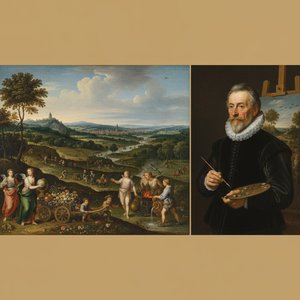
Early Life, Family and Training
Johann Grimm enters the historical record on 15 September 1675 in Bern, Switzerland. He is born into a family of religious standing, the son of the pastor Johann Grimm and Barbara Freudenreich. While his father’s vocation involves the pulpit and the schoolroom, the boy's own path diverges toward the visual arts. His formative years are spent in the Simmental, a landscape that shapes his early environment before he moves toward the urban center of Bern.
The transition from the Simmental to the formal training of the city marks a decisive shift in his development. In Bern, Johann Grimm enters the studio of Joseph Werner. Under Werner’s instruction, he begins to master the technical demands of his craft. This apprenticeship provides the foundation for a career defined by precision and the ability to capture both the likeness of individuals and the architecture of the Swiss landscape.
By 1695, the training moves beyond the borders of Switzerland. Johann Grimm travels to Rome, a move that places him in the heart of the classical tradition. This period of travel expands his perspective, bridging the gap between his local Swiss upbringing and the broader European artistic currents of the era. He returns from Italy not merely as a student, but as a practitioner ready to command his own space in the Bernese art scene.
Workshop and Notable Pupils
The transition of artistic authority in Bern finds its pivot in the succession of Joseph Werner. After his own training under Werner, Grimm eventually takes over the established painting school, maintaining the continuity of the local tradition. The workshop becomes a central hub for the next generation of Swiss painters, moving beyond mere instruction to shape the regional aesthetic.
Johann Ludwig Aberli emerges from this environment as a significant figure. He does not merely study under Grimm but eventually follows him into the leadership of the painting school. This transition ensures that the pedagogical methods of the era persist through the next decade. Other students, such as Johann Sebastian Dür, also pass through the studio, absorbing the technical foundations established within the school's walls.
Key Works and Commissions
Grimm’s brush captures the architectural and social landscape of the Swiss region through a variety of formats. He produced numerous veduten of the cities of Burgdorf and Bern, documenting the urban character of these locations. His topographical focus extends to a large view of Berthoud from the north, a work executed before 1715. In the Burgerbibliothek Bern, his hand is visible in the 1726 Ehrenpforte and an armorial preserved within the same institution.
Portraiture forms another significant pillar of his output. He executed a portrait of Johann Georg Altmann in 1740. His commissions also reached the prominent families of Burgdorf, specifically the Fankhauser and Kupferschmid families, whose likenesses remain part of the historical record. These works reflect a steady demand for his skill in capturing both the likeness of individuals and the specificities of the Swiss landscape.
Kérdések és válaszok
Hol tekinthetném meg Johann Grimm összes művét?
Johann Grimm minden alkotása megtekinthető a ez a weboldal oldalán, az alkotó Összes műalkotás oldalán keresztül.
Mely történelmi korszakban alkotott Johann Grimm?
Johann Grimm a Early Modern korszakban alkotott. Ez az időszak a művész tevékenységét a történelembe helyezi.
Hol tekinthetők meg Johann Grimm műveit egy 3D-s galériában?
Johann Grimm művei megtekinthetők a művész virtuális, 3D-s galériájában, a 3D Galéria oldalon.
Johann Grimm műveit műkorok szerint is böngészhetem?
A Összes művészeti irányzat oldalon Johann Grimm műveletei műkorlátok szerint vannak csoportosítva.