Work
Painting
Abstract Art
1968
Modern
136.0 x 136.0 cm
Kézzel készített olajfestmény reprodukció
Kézzel festett olajvastú vászon, az Ön által választott méretben és keretben, művészeink készítik meglévőre.
Válasszon előre meghatározott méreteink közül, amelyek megfelelnek a műalkotás eredeti arányainak.
Ön megadhat saját méreteket egy adott kerethez vagy térhez igazításhoz. Ha a kiválasztott méret nem egyezik az eredeti kép arányával, akkor a műalkotást levágjuk, vagy további kézzel festett elemekkel meghosszabbítjuk a festményt. A gyártás megkezdése előtt küldünk Önnek egy digitális előnézetet jóváhagyásra.

Kérjük, vegye figyelembe, hogy a képernyőn megjelenő előnézet nem tükrözi a tényleges vágást vagy kiterjesztést. Csak az előnézet fog pontosan mutatni a végső kompozíciót.
Bár egyedi méretek állnak rendelkezésre, javasoljuk, hogy válasszon egy méretet az előre meghatározott listából az eredeti arányok megőrzése érdekében.
A rendelést követően a OriginalUniqueArt.com csapata e-mailt küld az ügyfélnek az instrukciókért, és biztosít egy előnézeti képet (mockup).
Világszerte elérhető szállítás () 3-4 hét alatt a szokásos 5 hét helyett. (24 július). A minőség nem kérdőjelezhető.
Ingyenes globális expressz szállítás
Prémium minőségű len vászon
Teljes szállítási biztosítás
Vámvisszatérítési Garancia
Tökéletes színpontosság garancia
60 napos visszaküldési lehetőség (csak gyártási hibák esetén)
100%-os pénzvisszatérítési garancia
Kedvezmény több termény esetén
Work
Reprodukciós technika
A reprodukció mérete
-
Összesített ár
-
A műalkotás leírása
A Symphony of Geometry and Light
In the vast landscape of twentieth-century abstraction, few works capture the primal energy of form as vibrantly as this 1968 masterpiece by Yoo Youngkuk. At first glance, the viewer is met with a striking interplay of a crimson triangle and a radiant yellow orb, a composition that feels both ancient and avant-garde. The painting presents a dynamic, slightly curved triangular structure that anchors the canvas, its edges bleeding into warm orange hues that suggest the heat of a setting sun or the glow of an emerging dawn. At its heart lies a luminous yellow circle, acting as a celestial focal point that breathes life into the geometric rigor. This is not merely a study of shapes; it is a rhythmic dance of color where the weight of the red pigment meets the ethereal lightness of the yellow center, creating a visual tension that pulls the eye inward toward an infinite, glowing core.
The technique employed in this work reflects Yoo Youngkuk’s profound ability to distill the natural world into its most essential elements. While the subject matter appears purely abstract, there is a palpable sense of texture and depth achieved through the careful layering of pigments on canvas. The way the colors transition from deep reds to soft oranges suggests a painterly touch that softens the hard edges of the geometry, lending the piece an organic, breathing quality. For the discerning collector or interior designer, this work offers a sophisticated balance; its bold, primary-adjacent palette provides a powerful statement piece for modern minimalist settings, yet its soft, rounded contours allow it to integrate seamlessly into more eclectic, warm-toned environments. It serves as a window into a world where geometry is not cold or clinical, but rather a vessel for warmth and vitality.
To understand this painting is to understand the legacy of Yoo Youngkuk, a pioneer who sought to translate the rugged majesty of the Korean landscape into a universal language of abstraction. Born in Uljin, his connection to the mountains and the natural light of his homeland deeply informed his geometric explorations. In this 1968 piece, we see the culmination of a lifetime spent stripping away the superficial to reveal the structural soul of nature. The triangle becomes a mountain; the circle becomes the sun; the red becomes the earth’s heat. For those looking to adorn a space with art that evokes both intellectual depth and emotional resonance, this reproduction offers more than just decoration—it provides an invitation to contemplate the eternal harmony between form, color, and the natural spirit.
A művész életrajza
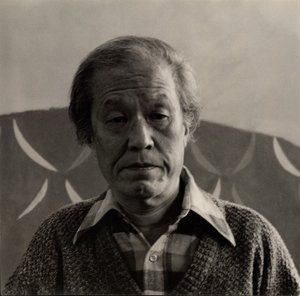
Yoo Youngkuk – Korea’s First Abstract Painter
Yoo Youngkuk (劉永國; denoted as YYK) stands as a monumental figure in Korean modern art history, recognized universally as the pioneer of abstract painting within the nation. His artistic journey unfolded against the backdrop of profound societal transformations—the annexation by Japan, World War II, and the Korean War—yet he steadfastly pursued his vision, cementing his legacy as one of Korea’s most influential artists. Born in 1916 in Uljin-gun, Gyeongsangbuk-do Province, Yoo’s formative years were steeped in the majesty of Taebaek Mountains, an experience that subtly permeated even his most geometrically precise compositions. This connection to nature instilled within him a deep appreciation for its enduring beauty and served as a cornerstone of his artistic philosophy. ### Early Life & Education Yoo’s upbringing fostered a spirit of intellectual curiosity and artistic exploration. He graduated from Bunka Gakuin University in Tokyo in 1938 with a Bachelor of Fine Arts degree, immersing himself in the burgeoning avant-garde movements of Western Europe—particularly Russian Constructivism and Suprematism—influenced by artists like Kazimir Malevich. This exposure profoundly shaped his early stylistic sensibilities, propelling him toward abstraction as a means of conveying complex emotions and ideas. His formative years were marked by engagement with Japanese artistic luminaries such as Murai Masanari and Hasegawa Saburo, who championed geometric abstraction and encouraged experimentation with innovative techniques. ### Sinsasil-pa & The Birth of Korean Abstract Expressionism In 1948 Yoo joined forces with Kim Whanki and Lee Kyusang to establish *Sinsasil-pa* (新寫實派, New Realism Group), a watershed moment for Korean art. This collective boldly rejected traditional representational styles in favor of abstraction—a daring stance that challenged artistic conventions and ignited debate within the Korean art community. Yoo’s early works during this period demonstrated a dynamic interplay between color fields and emerging geometric forms, reflecting his unwavering commitment to exploring new visual languages. The group's manifesto declared that art should mirror the realities of postwar Korea through an abstract lens—a testament to their ambition and intellectual rigor. ### The Mountain Motif & Artistic Evolution Throughout the 1950s and onward Yoo’s artistic style underwent a transformative evolution, characterized by a deepening preoccupation with the mountain motif. Often referred to as “the painter of mountains,” Yoo didn't depict mountains literally; rather, he abstracted their essence—their solidity, grandeur, and spiritual resonance—into powerful compositions of color and form. The mountain became a symbol of Korea itself, representing resilience, endurance, and the enduring spirit of the nation. His exploration of geometric abstraction intensified during this period, influenced by artists like Piet Mondrian and Josef Albers, resulting in works that prioritized clarity, balance, and harmonious relationships between visual elements. ### Recognition & Legacy Yoo Youngkuk’s contributions to Korean modern art were widely acknowledged during his lifetime, culminating in a comprehensive survey by *Monthly Art* magazine which hailed him as the most outstanding artist among over a hundred of his contemporaries. His work has been exhibited extensively both domestically and internationally, securing his position as a leading figure in the global abstract art scene. Yoo’s unwavering dedication to artistic innovation—coupled with his profound connection to Korean culture and landscape—continues to inspire artists today. His ability to distill nature's beauty into pure form and color remains a testament to his enduring artistry and lasting influence.Yoo Youngkuk
1916 - 2002 , Dél-Korea
Rövid tények
- Artistic Movement Or Style: Egyedi geometriás absztrakt művészi stílus
- Artists Or Movements Influenced By This Artist: ['Egyedi geometriás absztrakt művészi stílus']
- Artists Who Influenced This Artist:
- Murai Masanari
- Hasegawa Saburo
- Date Of Birth: 1916
- Full Name: Yoo Youngkuk
- Nationality: Dél-koreai
- Notable Artworks:
- Ébresztő Himalája
- Művészet
- Place Of Birth: Uljin, Dél-Korea

Az üvegkeretes opció csak 110 cm alatti méretben érhető el