Megtekintés
 Küldés
 Megosztás
 Részletek
 Útmutató

 Letöltés
 Hasonló darabok
 X-ray felvétel
 Diavetítés
 Statisztika
White oval
 Olajfestmény vászonon
- Falfeliratok és faldekoráció
- Expressionism
 1919
1919- Modern
 80.0 x 93.0 cm
 Összes részlet megjelenítése
Giclée / Műnyomat
Múzeumi minőségű giclée vagy vászonnyomat, gyors gyártással és rugalmas finomítási lehetőségekkel. ( Kézzel festett másolat rendelése Áttérés digitális képre)




P118B Ft10

P118H Ft10

P118W Ft10

P438Z Ft10

P508JH Ft12

P508YH Ft12

P805H Ft10

P805Z Ft10

P919BZ Ft10

P919G Ft10

P919XJ Ft10

P959ZH Ft10

P968JZ Ft12

W106C Ft8

W218G Ft10

W218JH Ft8

W218Y Ft10

W307PJ Ft10

W316G Ft10

W316PJ Ft8

W316Y Ft10

W398PJ Ft8

W4111J Ft10

W500HY Ft15

W500JH Ft15

W692G Ft12

W849H Ft8

W940BG Ft15

W953PJ Ft8




Válasszon előre meghatározott méreteink közül, amelyek megfelelnek a műalkotás eredeti arányainak.

Írja be a keretének vagy a falának megfelelő szélességet és magasságot. A nyomatot csak le lehet vágni, soha nem tehető nagyobbá, mint az eredeti kép, így egy eltérő alakú méretnél a kép egy része elveszik. Mielőtt bármit kinyatintanánk, küldünk egy digitális próbamodellt jóváhagyásra. Az oldalon látható kép nem tartalmazza a valós levágást — ezt csak a próbamodell mutatja meg.
Világszerte történő kiszállítás területére mindössze 2 hét alatt, a szokásos 4-5 hét helyett. (27 október)

Ingyenes globális expressz szállítás

Prémium minőségű len vászon

Teljes körű szállítási biztosítás

Vámvisszatérítési Garancia

Hiteles színarányosság garancia

100 napos visszaküldési lehetőség (csak hibás termékek esetén)

100% pénzvisszatérítési garancia

Több darab vásárlásakor kedvezmény
 Az üvegkeretes opció csak 110 cm alatti méretben érhető el

White oval
Giclée / Műnyomat
Reprodukció mérete
-


Összesített ár
Ft 25827
The Genesis of Abstraction: Unveiling ‘White Oval’ by Wassily Kandinsky
Wassily Kandinsky, a name synonymous with the birth of modern art, wasn't merely a painter; he was a visionary architect of feeling, translating inner experiences into vibrant visual languages. His journey from law student to revolutionary artist is as compelling as his artwork itself, and few pieces encapsulate this transformation more powerfully than ‘White Oval,’ created in 1919. This deceptively simple composition—a central white oval surrounded by a constellation of circles, lines, and splashes of color—represents a pivotal moment in Kandinsky’s exploration of abstraction, a deliberate rejection of representational art in favor of pure emotional expression. Born in Moscow in 1866, Kandinsky's early life was steeped in the traditions of Russian culture – his family history included connections to Mongolia and China – yet he felt an undeniable pull towards the burgeoning artistic movements of Europe. Witnessing Monet’s “Haystacks” ignited a profound shift within him, moving beyond mere depiction to capture the *essence* of color and its ability to evoke powerful sensations. ‘White Oval’ isn't just a painting; it’s a distillation of this evolving philosophy, a testament to Kandinsky’s belief that art could transcend the limitations of the visible world and tap directly into the realm of the soul.A Symphony of Color and Form
The beauty of ‘White Oval’ lies not in its complexity, but in its carefully orchestrated simplicity. Measuring 80 x 93 cm, the canvas is dominated by a large, luminous white oval – a shape that immediately draws the eye, acting as an anchor within the swirling composition. Around this central element dance a multitude of smaller circles, varying in size and intensity, interspersed with dynamic lines. The palette itself is remarkably restrained yet profoundly expressive: vibrant reds, deep blues, sunny yellows, verdant greens, and fiery oranges coalesce to create an energetic atmosphere. Kandinsky’s use of color wasn't arbitrary; he meticulously studied the psychological effects of hues, believing that each shade possessed its own inherent emotional power. Red, for instance, represented passion and energy, while blue evoked feelings of tranquility and introspection. The painting is executed in oil on canvas, a medium that allowed Kandinsky to build up layers of color and texture, creating a rich, tactile surface. The brushstrokes are visible, adding a sense of immediacy and spontaneity to the work—a deliberate departure from the smooth, polished surfaces favored by many of his contemporaries.The Spiritual Dimension: Influences and Intentions
Kandinsky’s artistic journey was deeply intertwined with spiritual ideas, particularly those influenced by Theosophy. He sought to create art that could awaken inner feelings and connect viewers to a higher consciousness. His seminal work, *Concerning the Spiritual in Art*, articulated this belief, arguing that color and form possessed an inherent spiritual significance. ‘White Oval’ embodies this philosophy perfectly; it's not simply a visual arrangement but a carefully constructed symbolic landscape designed to stimulate emotional response. The white oval itself can be interpreted as representing the “soul,” a blank canvas upon which the artist projects his inner world. The surrounding shapes and colors then act as symbols, each contributing to the overall composition of the painting’s spiritual narrative. Kandinsky's exploration of abstraction was not merely an aesthetic choice but a deeply personal quest for artistic truth—a desire to express what words could not capture.Kandinsky’s Legacy: A Bridge Between Art and Emotion
‘White Oval’ stands as a cornerstone in the development of abstract art, profoundly influencing generations of artists who followed. It's a key example of Kandinsky’s early work during his time with the Expressionist movement, which emphasized subjective experience and emotional intensity. His exploration of color theory and its connection to human emotion paved the way for later movements like Fauvism and Surrealism. The painting’s influence extends beyond the art world; it has been cited as a source of inspiration for designers, architects, and even musicians. Reproductions of ‘White Oval,’ such as those offered by OriginalUniqueArt.com, provide an accessible gateway to this groundbreaking artwork, allowing viewers to experience Kandinsky's vision firsthand. To delve deeper into the life and work of Wassily Kandinsky, explore resources like OriginalUniqueArt.com, which offers detailed information about his artistic development and other notable pieces such as “Small dream in red” or “Red Oval.” His legacy continues to resonate today, reminding us that art can be a powerful tool for self-expression and spiritual exploration.Kérdések és válaszok
A „White oval” Wassily Wassilyevich Kandinsky pályájának mely szakaszát képviseli?
A "White oval" Wassily Wassilyevich Kandinsky alkotói pályájának Early Period szakaszát képviseli.
Van-e útmutató a(z) „White oval”, Wassily Wassilyevich Kandinsky alkotása alkotáshoz?
A "White oval" útmutatója a mű Útmutató oldala – egy kinyomtatható adatlap, amely bemutatja a művet a leírással, a szerzői megjegyzéssel és az azonosító táblázattal (művész, dátumok, technika, eredeti méret, gyűjtemény) együtt.
Hogyan szerezhető be „White oval”, Wassily Wassilyevich Kandinsky alkotása digitális fájlja?
A "White oval" elérhető magas felbontású digitális kép letöltése formátumban, amelyet közvetlenül a Digitális alkotás oldalon vásárolhat meg.
A művész életrajza
A Life Immersed in Color and Spirit
Wassily Wassilyevich Kandinsky, born in Moscow in 1866, was a revolutionary figure who irrevocably altered the course of modern art. His journey wasn’t one of immediate artistic calling; initially destined for a career in law and economics at the University of Moscow, it was a profound encounter with Impressionist painting – specifically Claude Monet's “Haystacks” – and a deeply moving experience witnessing Wagner’s opera "Lohengrin" that ignited within him an irrepressible desire to pursue art. This pivotal moment, occurring around age thirty, marked not merely a career change but a complete transformation of perspective, setting him on a path toward pioneering abstraction. He soon relocated to Munich, enrolling at the prestigious Academy of Fine Arts and studying under Franz von Stuck, though even within formal training, Kandinsky’s spirit yearned for exploration beyond conventional boundaries. Early influences included Russian folk art, gleaned from an ethnographic expedition to the Vologda region in 1889, which instilled a fascination with vibrant color palettes and symbolic imagery. This foundation would prove crucial as he began to develop his unique artistic language. These early explorations weren’t simply about aesthetic preference; they were rooted in a deep cultural connection and a burgeoning understanding of how art could communicate beyond the literal. He was particularly drawn to the rich, earthy tones and intricate patterns found in traditional Russian textiles and icons, which would later inform his use of color and composition.The Dawn of Abstraction: From Expressionism to Inner Necessity
Kandinsky’s early works reveal a strong expressionistic bent, characterized by bold colors and emotional intensity – pieces like “Papeln (Poplars)” from 1902 exemplify this period. These paintings were imbued with a sense of dynamism and movement, reflecting the artist's own inner turmoil and striving for self-expression. However, he wasn’t content with merely representing the external world; he sought to express inner realities, spiritual truths that transcended mere visual depiction. This quest led him gradually away from representational art and toward a revolutionary exploration of color, form, and their emotional resonance. He believed that art should not simply mirror reality but rather serve as a conduit for conveying profound emotions and ideas. He began to believe that colors possessed inherent psychological effects, capable of evoking specific feelings and sensations in the viewer. This conviction was deeply intertwined with his burgeoning interest in Theosophy, a spiritual movement emphasizing esoteric knowledge and universal brotherhood. As he delved deeper into these ideas, Kandinsky’s paintings became increasingly non-objective, shedding recognizable forms in favor of abstract compositions driven by an “inner necessity.” This wasn't simply about abandoning representation; it was about discovering a new visual language capable of expressing the intangible realms of emotion and spirituality. He sought to create a visual equivalent of music, where color and form harmonized to evoke profound emotional responses.Geometric Harmony and Spiritual Resonance
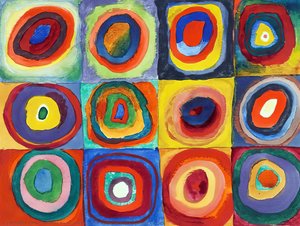
The period following his involvement with the influential artist group Der Blaue Reiter (The Blue Rider), which he co-founded in Munich in 1911, saw a further evolution in Kandinsky’s style. While earlier works often featured fluid, organic shapes, he began to explore geometric abstraction, focusing on the interplay of circles, triangles, and squares. “Several Circles” (140 x 140 cm) stands as a prime example of this phase – a dynamic composition where color and form interact in a harmonious yet energetic dance. He believed that these simple geometric forms held profound symbolic meaning, representing fundamental aspects of the universe and human consciousness. The use of primary colors—red, blue, and yellow—was deliberate, reflecting his belief in their inherent power to evoke specific emotions. This wasn’t cold or sterile geometry; rather, it was imbued with spiritual significance. Kandinsky believed that geometric shapes possessed inherent symbolic meaning, and their arrangement within the canvas could evoke specific emotional responses. His theoretical writings, most notably “Concerning the Spiritual in Art” (1911), articulated these beliefs, laying the groundwork for a new understanding of abstract art as a vehicle for expressing profound spiritual truths. He argued that art should not aim to imitate nature but rather to reveal the artist’s inner world and connect with the viewer on a deeper, more intuitive level.Bauhaus Influence and Lasting Legacy
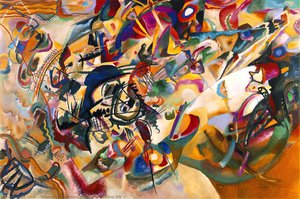
The outbreak of World War I forced Kandinsky's return to Russia in 1914, but following the Russian Revolution, he found himself increasingly at odds with the prevailing artistic climate. In 1920, he accepted a teaching position at the Bauhaus school in Germany, where he profoundly influenced generations of artists with his theories on color, form, and abstraction. The Bauhaus provided an ideal environment for Kandinsky to further develop his ideas and explore new creative avenues. He emphasized the importance of intuitive feeling and non-objective expression, encouraging students to move beyond representational art and embrace the expressive potential of pure color and form. He continued to experiment with geometric forms and vibrant colors, often incorporating layered impasto techniques to create textured surfaces that added depth and complexity to his compositions – as seen in later works like “An Intimate Party” (1942). After the closure of the Bauhaus by the Nazi regime in 1933, Kandinsky moved to France, where he remained for the rest of his life. His impact on modern art is immeasurable; he is widely recognized as a pioneer of abstract expressionism and a key figure in the development of non-representational painting. His works are held in major museums worldwide, including the Tretyakov Gallery in Moscow, which houses his monumental “Composition VII,” a testament to his artistic vision and enduring legacy. Kandinsky’s exploration of color, form, and spirituality continues to inspire artists today, solidifying his place as one of the most important figures in 20th-century art history. He didn't just paint pictures; he painted emotions, ideas, and the very essence of the human spirit.
Wassily Wassilyevich Kandinsky
1866 - 1944 , Oroszország
Rövid információk
- Artistic Movement Or Style: Ábrázatlan művészet, Kifejezőművészet
- Artists Or Movements Influenced By This Artist:
- Ábrázatlan művészet
- Der Blaue Reiter
- Artists Who Influenced This Artist:
- Claude Monet
- Richard Wagner
- Date Of Birth: 1866
- Date Of Death: 1944
- Full Name: Wassily Wassilyevich Kandinsky
- Nationality: Orosz, Francia
- Notable Artworks:
- Múzeum Színes Újra
- Tömbös Elán
- Belső Vendégvárás
- Számos Kör
- Place Of Birth: Moszkva, Oroszország
Kapcsolódó cikkek

Kandinsky Mesterművei: 25 Lenyűgöző Festmény a Modern Művészet Gyöngyszemeiből | OriginalUniqueArt
Fedezze fel Wassily Kandinsky 25 legikonikusabb művét! Merüljön el az absztrakt művészet világában, ismerje meg a színek és formák lenyűgöző történetét. Prémium minőségű reprodukciók és inspiráló dekorötletek a OriginalUniqueArt.com-on.

Absztrakt Expresszionizmus Mesterei: 10 alkotás, ami meghatározta a művészetet | OriginalUniqueArt.com
Fedezze fel a 10 legikonikusabb absztrakt expresszionista alkotást! Ismerje meg Jackson Pollock, Mark Rothko és más mesterek történetét. Művészeti reprodukciók prémium minőségben – OriginalUniqueArt.com.

Neo-Abstract Art: The High-Impact Evolution of Modern Visual Energy and Geometric Sophistication
Discover the power of Neo-Abstract art. Explore how bold geometric forms and high-impact visual energy are redefining modern design. Learn to curate sophisticated, high-energy spaces with the latest trends in contemporary abstraction and structural color.

A Fehér Szín Mesterei: 10 Híres Festmény, Amelyek Elvarázsolnak – OriginalUniqueArt.com
Fedezze fel a 10 legikonikusabb fehér tónusú festményt! Monet, Van Gogh és más mesterek alkotásainak története. Vászonképek, reprodukciók – inspiráció otthonába. OriginalUniqueArt.com: minőségi művészet online.

Geometrikus Absztrakció Mesterei: 10 Alapvető Műalkotás a Lakberendezéshez
Fedezze fel a geometrikus absztrakció 10 legikonikusabb műalkotását! Kandinsky, Mondrian és más mesterek festményeinek története inspirálja otthona dekorációját. Múzeumi minőségű reprodukciók a OriginalUniqueArt.com-on – fedezze fel online!