Cubism
Interior (Stuart Davis)
Stuart Davis (1892–1964) megalkotta: Interior. A Cubism irányzathoz tartozik.

 Megtekintés

 Kézzel festett olajfestmény
 Küldés
 Megosztás
 Útmutató


 Letöltés
 Hasonló darabok
 X-ray felvétel
 Diavetítés
 Kérdések és válaszok

 Statisztika
Interior: alapvető információk
- Cím
- Interior
- Művész
- Stuart Davis (1892–1964)
- A művész születési helye
- Philadelphia, Amerikai Egyesült Államok
- Mozgalom
- Cubism
- Téma
- abstract, geometric, modernism, composition, lines, forms
Mit ábrázol a Interior?
A Dynamic Vision of Modernity: Exploring Stuart Davis’s “Interior”
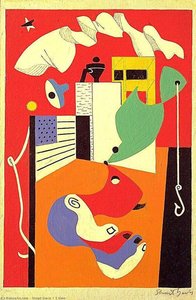
Stuart Davis's “Interior” is a captivating example of American Modernism, pulsating with energy and reflecting the artist’s unique response to the burgeoning urban landscape and the rhythms of jazz. Created sometime during his prolific career (1892-1964), this work embodies Davis’s commitment to developing a distinctly American visual language, moving beyond European influences towards a bold, independent style.
Deconstructing Space: Style & Technique
- The artwork is immediately striking for its geometric abstraction. Davis employs fragmented forms and flattened perspectives – hallmarks of both Cubism and Constructivism – but infuses them with a uniquely American sensibility.
- A vibrant palette dominates, anchored by the stark contrast between the white background, bold reds, blues, and greys, and punctuated by energetic black lines. The orange border further intensifies this visual impact.
- Davis’s technique is evident in the visible brushstrokes and layering of paint, creating a subtle texture that adds depth despite the overall flattened composition. This suggests an active process of building up form and color on the canvas, likely using oil paints as his primary medium.
- The arrangement isn't simply random; it’s carefully orchestrated into distinct zones – a tower-like structure in blue-grey, a dynamic red section with a vertical ‘sail’ or flag element, and a central area of interwoven geometric shapes. This zoning creates a sense of controlled chaos.
Echoes of Jazz & the Machine Age: Context & Symbolism
Davis was deeply influenced by jazz music, which he saw as embodying the spirit of modern America – improvisational, energetic, and uniquely its own. While “Interior” isn’t a direct representation of musical notes, the dynamic interplay of shapes and colors evokes the same sense of rhythm and syncopation found in jazz compositions.
- The architectural elements, particularly the stylized tower, could be interpreted as representing aspiration or the burgeoning skyscrapers of American cities. Davis frequently engaged with urban themes throughout his career.
- The ‘sail’ or flag-like form introduces a sense of movement and direction, perhaps symbolizing progress or the forward momentum of modern life.
- His early exposure to the Armory Show in 1913 was pivotal. While his initial works reflected the Ashcan School style, he quickly absorbed and transformed European avant-garde ideas into something distinctly American.
Emotional Resonance & Lasting Impact
“Interior” is not a tranquil scene; it’s charged with energy and tension. The fragmented forms and bold colors create a sense of dynamism, while the lack of traditional perspective can be slightly unsettling. This emotional complexity reflects the anxieties and excitements of a rapidly changing world.
- The artwork invites viewers to actively engage with its abstract language, prompting individual interpretations and fostering a personal connection.
- As a pioneering figure in American Modernism, Stuart Davis paved the way for subsequent generations of artists. His work continues to inspire those seeking to break free from convention and explore new forms of visual expression.
Interior nagy felbontásban
Szerzői jogi védelem alatt áll: a kép csak illusztrációképpen látható.
További méretek, kivágások és idézetforrás →Stuart Davis, Interior.
Interior kapcsán felmerülő kérdések
Mely paletta és domináns szín határozza meg a "Interior" alkotást?
A „Interior”, Stuart Davis alkotása egy Metallics színpalettát használ, melynek domináns színe a Steel Blue (#5c7ba9).
Megtekinthető a "Interior" teljes képernyős diaporámaként is?
Mi magyarázza a „Interior”, Stuart Davis alkotása szerzői jogi helyzetét?
A „Interior”, Stuart Davis alkotása még szerzői jog védi állapotban van. A szerzői jogi védelem időtartama a művész halálától számítódik, amely 1964 évben történt.
Milyen színek jellemzik a "Interior" alkotást?
A „Interior”, Stuart Davis alkotása egy Metallics színpalettát használ, amely összefoglalja a mű egészében megnyilvánuló színes karakterét.
Vannak a „Interior” alkotáshoz hasonló művek?
A "Interior" alkotással hasonló művek a festmény Hasonló alkotások oldalán találhatók.
Milyen szín vezeti a „Interior”, Stuart Davis alkotása kompozícióját?
A(z) Steel Blue (#5c7ba9) a(z) „Interior”, Stuart Davis alkotása domináns színe.
Ki a "Interior" mögött álló művész?
A „Interior” műtémét Stuart Davis alkotójának tulajdonítják.
Mely művészeti irányba tartozik a „Interior”, Stuart Davis alkotása?
A „Interior”, Stuart Davis alkotása művészeti irányata a Cubism. Ez a klasszifikáció a művet a kapcsolódó alkotók és alkotások közé sorolja.
Hogyan épül fel a „Interior”, Stuart Davis alkotása színes kompozíciója?
A "Interior" alkotásban egy Statement kontraszt párosul egy Strong Color Unity harmóniával.
A művészről: Stuart Davis

1892–1964, Amerikai Egyesült Államok
Stuart Davis
Stuart Davis: Az amerikai modernizmus úttörője Korai élet és képzés Stuart Davis, aki 1892. december 7-én született Philadelphiában, már gyermecsapáiban is a művészet lenyűgöző környezetébe áltkozott. Apja, Edward Wyatt Davis a Philadelphia Press művészeti szerkesztőjeként dolgozott, édesanyja, Helen Stuart Davis pedig szobrászművész volt. Ez a családi háttér kétségtelenül alapot teremtett korai vizuális érdeklődésének, amely később egész életművévé vált.
Stuart Davis további művei
 Odol
 Lucky Strike1924
 T View1951
 Blue Café1928
Esszék a Interior körül
 Stuart Davis: Modernist Abstraction & the Vibrant Spirit of the Jazz AgeExplore the vibrant world of Stuart Davis, a pioneer of American Modernism. Discover his jazz-inspired paintings, signature style & investm…
 The Geometry of Elegance: Elevating Modern Villa Interiors with Cubist-Inspired ArtDiscover how Cubist-inspired art elevates modern villa interiors. Explore the intersection of geometric precision and luxury design through…
 Steel & Soul: The Rhythmic Geometry and Industrial Resonance of the Machine AgeExplore the rhythmic geometry of Fernand Leger and the Machine Age. Discover the power of industrial art today.