

 Megtekintés
 Küldés
 Megosztás
 Részletek

 Letöltés
 Hasonló darabok
 X-ray felvétel
 Diavetítés
October Sunlight


 Összes részlet megjelenítése
Giclée / Műnyomat
Múzeumi minőségű giclée vagy vászonnyomat, gyors gyártással és rugalmas finomítási lehetőségekkel. ( Kézzel festett másolat rendelése Kép letöltése)




P118B $10

P118H $10

P118W $10

P438Z $10

P508JH $12

P508YH $12

P805H $10

P805Z $10

P919BZ $10

P919G $10

P919XJ $10

P959ZH $10

P968JZ $12

W106C $8

W218G $10

W218JH $8

W218Y $10

W307PJ $10

W316G $10

W316PJ $8

W316Y $10

W398PJ $8

W4111J $10

W500HY $15

W500JH $15

W692G $12

W849H $8

W940BG $15

W953PJ $8




Válasszon előre meghatározott méreteink közül, amelyek megfelelnek a műalkotás eredeti arányainak.

Megadhat saját méreteket is egy konkrét kerethez vagy helyszínhez igazítva. Amennyiben a kiválasztott méret nem egyezik az eredeti kép arányokkal, a műalkotást le fogjuk vágni, vagy kiegészítjük a képet tükrözött vagy egyszínű szélekkel. A gyártás megkezdése előtt egy digitális tervezetet küldünk jóváhagyásra.
Kérjük, vegye figyelembe, hogy a képernyőn látható előnézet nem tükrözi a tényleges levágást vagy kiegészítést. Csak a tervezet mutatja pontosan a végső kompozíciót.
Bár az egyedi méretek is elérhetőek, az eredeti arányok megőrzése érdekében azt javasoljuk, hogy válasszon a előre meghatározott listából származó méretet.
Világszerte történő kiszállítás területére mindössze 2 hét alatt, a szokásos 4-5 hét helyett. (28 augusztus)

Ingyenes globális expressz szállítás

Prémium minőségű len vászon

Teljes körű szállítási biztosítás

Vámvisszatérítési Garancia

Hiteles színpontosság garancia

60 napos visszaküldési lehetőség (csak hibás termékek esetén)

100% pénzvisszatérítési garancia

Több darab vásárlása esetén kedvezmény
 Az üvegkeretes opció csak 110 cm alatti méretben érhető el

October Sunlight
Giclée / Műnyomat
Reprodukció mérete
-


Összesített ár
$ 80
A Moment of Golden Light: Exploring “October Sunlight”
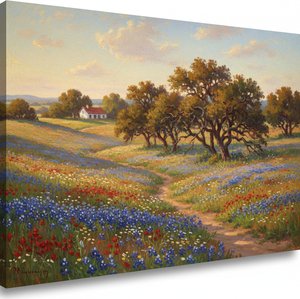
Robert Julian Onderdonk’s “October Sunlight,” painted in 1911, isn't merely a depiction of a Texas autumn; it’s a profound distillation of the state’s spirit – its rugged beauty, its enduring light, and a poignant sense of melancholy. This oil on canvas captures a specific moment, a fleeting intersection between the fading warmth of summer and the approaching chill of winter, rendered with an Impressionistic fervor that speaks volumes about Onderdonk's artistic vision.
The scene unfolds within a landscape dominated by towering trees, their branches reaching skyward like supplicating arms. The foliage is ablaze with color – vibrant reds, deep oranges, and touches of golden yellow—a testament to the season’s final, glorious burst before yielding to dormancy. Yet, there's an underlying sense of quietude, a stillness that suggests both beauty and a certain sadness. The artist masterfully employs broken brushstrokes and dappled light to create an atmosphere thick with atmospheric perspective; the distant trees recede into a hazy blue, while the foreground is sharply defined, drawing the viewer’s eye into the heart of the composition.
The Texas Painter's Palette: Technique and Style
Onderdonk was deeply rooted in the Impressionist tradition, yet he infused it with his distinctly Texan sensibility. He favored a palette rich in earth tones – ochres, siennas, and umbers—that perfectly capture the colors of the Texas landscape. His brushwork is loose and expressive, prioritizing capturing the *impression* of light and color over meticulous detail. Notice how he uses short, broken strokes to build up layers of paint, creating a shimmering effect that mimics the play of sunlight through the leaves. The painting’s luminosity isn't achieved through heavy glazing but rather through careful layering and manipulation of color—a technique that lends the work an almost palpable warmth.
The composition itself is carefully balanced, with the trees acting as a vertical anchor and the light source – a brilliant shaft of sunlight piercing through the branches – creating a dynamic diagonal line. This interplay of form and light draws the eye across the canvas, inviting the viewer to lose themselves in the scene’s tranquil beauty.
A Portrait of Texas: Historical Context
Robert Julian Onderdonk is often hailed as “the father of Texas painting,” a title earned through his tireless dedication to capturing the essence of the Lone Star State. Born in San Antonio in 1882, he spent much of his life documenting the landscapes and people of Texas, becoming particularly renowned for his depictions of bluebonnets and other wildflowers. “October Sunlight” was painted during a period when Onderdonk was establishing himself as one of Texas’s leading artists, and it reflects his growing confidence in his ability to translate the state's visual richness onto canvas.
The painting also speaks to the broader cultural context of early 20th-century Texas. The era witnessed a burgeoning interest in regional art and identity, as Texans sought to define their own artistic voice distinct from that of the East Coast. Onderdonk’s work embodies this spirit of regionalism, celebrating the beauty and character of his native land.
Evoking Emotion: Symbolism and Resonance
Beyond its technical merits, “October Sunlight” resonates with a profound emotional depth. The painting evokes a sense of nostalgia—a longing for simpler times, for the fading warmth of summer, and for the beauty of the natural world. The solitary trees, bathed in golden light, seem to stand as silent witnesses to the passage of time. There’s also an undercurrent of melancholy, perhaps reflecting Onderdonk's own struggles with illness and financial hardship during his lifetime.
Ultimately, “October Sunlight” is a testament to the power of art to capture not just what we see but also what we feel—a poignant reminder of the beauty and fragility of life in the heart of Texas. It’s a piece that invites contemplation, offering a moment of quiet reflection amidst the hustle and bustle of modern life.
A művész életrajza
The Texas Landscape Illuminated: A Life in Light and Color
Robert Julian Onderdonk, affectionately remembered as “the father of Texas painting,” wasn’t merely a recorder of the Lone Star State's beauty; he was its poetic interpreter. Born in San Antonio on July 30, 1882, into an artistic lineage—his father, Robert Jenkins Onderdonk, being a respected painter himself—Julian’s life unfolded as a passionate exploration of light, color, and the captivating essence of his native land. His early years were steeped in creativity and observation, nurtured by a family that valued both intellectual pursuits and artistic expression. This foundation proved crucial, shaping a career dedicated to capturing the soul of Texas on canvas. The Onderdonk heritage also extended to education through his grandfather, Henry Onderdonk, who served as headmaster of Saint James School in Maryland, instilling a sense of refinement alongside artistic fervor. From these roots blossomed a talent that would come to define a distinctly Texan voice within the American Impressionist movement.From New York Studies to a Texan Vision
Onderdonk’s formal artistic journey began at West Texas Military Academy, where he simultaneously honed his skills and supported his education by teaching art. A pivotal moment arrived in 1901 when, through the generosity of a neighbor, he traveled to New York City. There, he immersed himself in the teachings of William Merritt Chase at Shinnecock Hills Summer School of Art on Long Island. This experience proved transformative, instilling a deep appreciation for *en plein air* painting—the practice of creating art directly from nature—and an emphasis on capturing fleeting moments of light and atmosphere. He continued his studies with Chase for several years, absorbing the techniques and philosophies that would become hallmarks of his own style. Despite initial attempts to establish himself in New York’s bustling art scene, where he married Gertrude Shipman and started a family, Onderdonk found an undeniable pull back towards the landscapes of his youth. The vibrant hues and expansive vistas of Texas called to him, promising a unique artistic inspiration that the urban environment couldn't match.A Homecoming and the Bloom of Inspiration
The year 1909 marked a significant turning point as Onderdonk returned with his family to San Antonio. This relocation ushered in the most productive and celebrated period of his career. He wholeheartedly dedicated himself to portraying the beauty of the Texan countryside, quickly becoming renowned for his vibrant depictions of bluebonnet fields—scenes that would become synonymous with his artistic identity. Onderdonk’s paintings are characterized by their loose brushstrokes, a rich palette of colors, and an unwavering focus on capturing the ephemeral qualities of light and atmosphere. Works like “Blue Bonnet Field, Early Morning, San Antonio Texas” (1914), “Road to the Hills” (1918), "Early Spring—Bluebonnets and Mesquite" (1919), “Coreopsis, near San Antonio, Texas” (1919), and “Dawn in the Hills” (1922) exemplify his mastery of Impressionistic techniques and his deep connection to the land. He wasn’t merely painting landscapes; he was conveying a feeling, an experience—the very soul of Texas. He sought not just to represent what he saw, but how it *felt* to be immersed in that landscape, bathed in its light and air.Influences and Artistic Style
Onderdonk’s artistic development was profoundly shaped by several key influences. The teachings of William Merritt Chase at Shinnecock Hills instilled within him a deep appreciation for *en plein air* painting—the practice of working directly from nature, capturing the fleeting effects of light and atmosphere. This approach became central to his style, allowing him to translate the vibrant colors and shifting moods of the Texan landscape onto canvas with remarkable immediacy. His father, Robert Jenkins Onderdonk, a respected painter in his own right, also provided an early foundation in artistic principles and techniques. Furthermore, he was influenced by the realism of Robert Henri, whose emphasis on portraying everyday life and social issues resonated with Onderdonk’s desire to capture the essence of Texas culture. His paintings are characterized by their loose brushstrokes, a rich palette of colors—often dominated by blues, greens, and yellows—and an evocative portrayal of the landscape. He skillfully blended Impressionistic techniques with a uniquely Texan sensibility, creating works that are both visually stunning and emotionally resonant.Legacy and Enduring Influence
Robert Julian Onderdonk’s untimely death in 1922 at the age of forty robbed the art world of a promising talent, yet his legacy continues to resonate deeply within Texan artistic circles and beyond. His unwavering dedication to portraying the unique beauty of the Texas landscape earned him the well-deserved title of “the father of Texas painting.” His influence extended far beyond his own creations, inspiring generations of artists to embrace regional subjects and develop a distinct style rooted in the spirit of the Southwest. Recognition of his importance grew over time, culminating in national acclaim—three of his paintings even graced the Oval Office during President George W. Bush’s administration. The Dallas Museum of Art houses an extensive collection of his work, dedicating several rooms to showcase his artistic achievements. Furthermore, the preservation of his former art studio on the grounds of the Witte Museum in San Antonio serves as a tangible testament to his enduring legacy. The publication of *Julian Onderdonk: A Catalogue Raisonne* by Harry A. Halff and Elizabeth Halff solidified his place in art history, providing a comprehensive record of his oeuvre and ensuring that his contributions would be recognized for years to come.A Lasting Impression
- Key Influences: William Merritt Chase’s emphasis on *en plein air* painting and capturing fleeting light effects profoundly shaped Onderdonk's style.
- Artistic Style: Onderdonk masterfully blended Impressionistic techniques with a uniquely Texan sensibility, characterized by loose brushstrokes, vibrant colors, and an evocative portrayal of the landscape.
- Major Themes: The Texas landscape, particularly bluebonnet fields, served as his primary inspiration, symbolizing the beauty and spirit of the region.
- Historical Significance: Onderdonk is credited with establishing a distinctly Texan voice within American Impressionism, inspiring generations of artists to celebrate their regional heritage.

Robert Julian Onderdonk
1880 - 1922 , Egyesült Államok
A művészről röviden
- Artistic Movement Or Style: Impressionista
- Artists Or Movements Influenced By This Artist: ['Texani festők']
- Artists Who Influenced This Artist: ['William Merritt Chase']
- Date Of Birth: 1882. 7. 30.
- Date Of Death: 1922. 10. 27.
- Full Name: Robert Julian Onderdonk
- Nationality: Amerikai
- Notable Artworks:
- Bluebonnet mező
- Hajdaló út
- Régi tavasz
- Place Of Birth: San Antonio, USA
Kapcsolódó cikkek
Robert Julian Onderdonk: Pioneering Texas Impressionism & Capturing Regional Light
Explore the life & art of Robert Julian Onderdonk, 'the Father of Texas Painting.' Discover his vibrant Impressionist landscapes, iconic bluebonnets, and lasting legacy. Learn about collecting Onderdonk's work today.

Evocations of Place: A Historical Journey Through Landscape Art
Explore the rich history of landscape art with OriginalUniqueArt. Discover renowned artists, movements like Impressionism & Romanticism, and expert guidance for collecting timeless pieces. Find your perfect serene escape today!

A Romantikus Tájképfestészet 10 Legikonikusabb Műalkotása – OriginalUniqueArt.com
Fedezze fel a romantikus tájképfestészet 10 legikonikusabb műalkotását! Caspar David Friedrich, J.M.W. Turner és más mesterek festményeinek története – inspiráló olajfestmények otthonába. OriginalUniqueArt.com: múzeumi minőségű reprodukciók és egyedi dekorációk online.

Evocations of Place: A Historical Journey Through Landscape Art
Explore the rich history of landscape art with OriginalUniqueArt. Discover renowned artists, movements like Impressionism & tonalism, and expert guidance for collecting timeless pieces. Find your perfect serene escape today!

Paul Cézanne 25 Mesterműve: A Modern Művészet Úttörői | OriginalUniqueArt
Fedezze fel Paul Cézanne 25 legikonikusabb művét! Ismerje meg a posztimpresszionizmus úttörőjének festményeit, technikáját és inspirációit. Vászonképek, portrék, tájképfestmények – minden otthonba. Böngéssze gyűjteményünket a OriginalUniqueArt-on!

