

 Előnézet
 Megosztás
 Megosztás
 Részletek
 Útmutató

 Letöltés
 Hasonló darabok
 X-ray felvétel
 Diavetítés
 Statisztika
Idilio campero


 Tovább olvasom
Giclée / Műnyomat
Múzeumi minőségű giclée vagy vászonnyomat, gyors gyártással és rugalmas finomítási lehetőségekkel. ( Kézzel festett másolat vásárlása Áttérés digitális képre)




P118B $10

P118H $10

P118W $10

P438Z $10

P508JH $12

P508YH $12

P805H $10

P805Z $10

P919BZ $10

P919G $10

P919XJ $10

P959ZH $10

P968JZ $12

W106C $8

W218G $10

W218JH $8

W218Y $10

W307PJ $10

W316G $10

W316PJ $8

W316Y $10

W398PJ $8

W4111J $10

W500HY $15

W500JH $15

W692G $12

W849H $8

W940BG $15

W953PJ $8




Válasszon előre meghatározott méreteink közül, amelyek megfelelnek a műalkotás eredeti arányainak.

Megadhat saját méreteket is egy konkrét kerethez vagy helyszínhez igazítva. Amennyiben a kiválasztott méret nem egyezik az eredeti kép arányokkal, a műalkotást le fogjuk vágni, vagy kiegészítjük a képet tükrözött vagy egyszínű szélekkel. A gyártás megkezdése előtt egy digitális tervezetet küldünk jóváhagyásra.
Kérjük, vegye figyelembe, hogy a képernyőn látható előnézet nem tükrözi a tényleges levágást vagy kiegészítést. Csak a tervezet mutatja pontosan a végső kompozíciót.
Bár az egyedi méretek is elérhetőek, az eredeti arányok megőrzése érdekében azt javasoljuk, hogy válasszon a előre meghatározott listából származó méretet.
Világszerte történő kiszállítás területére mindössze 2 hét alatt, a szokásos 4-5 hét helyett. (26 szeptember)

Ingyenes globális expressz szállítás

Prémium minőségű len vászon

Teljes körű szállítási biztosítás

Vámvisszatérítési Garancia

Tökéletes színarányosság garancia

100 napos visszaküldési garancia (csak gyártási hibás termékek esetén)

100% pénzvisszatérítési garancia

Több darab vásárlásakor kedvezmény
 Az üvegkeretes opció csak 110 cm alatti méretben érhető el

Idilio campero
Giclée / Műnyomat
Reprodukció méretei
-


Összesített ár
$ 80
A Pastoral Symphony in Brushstrokes
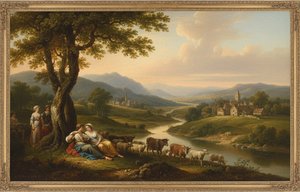
In the evocative masterpiece Idilio campero, painted in 1935, the Uruguayan master Pedro Figari invites us into a nostalgic realm where time seems to slow to the rhythm of the countryside. The painting presents a breathtaking tableau of rural life, centered around a majestic, sprawling tree that serves as both a physical and emotional anchor for the composition. Beneath its protective canopy, two figures share a quiet moment of intimacy, their presence framed by the soft, atmospheric light that characterizes Figari’s late period. This central vignette is not merely a depiction of a landscape, but a profound meditation on connection and the enduring peace found within the natural world.
As the eye wanders from the central figures, it discovers a lively, breathing ecosystem of movement and life. In the middle ground, horses graze peacefully, adding a sense of depth and pastoral authenticity to the scene. The presence of other figures—scattered subtly across the canvas—imbues the landscape with a gentle vitality, suggesting a community that exists in perfect harmony with the land. Each person, positioned with deliberate care, contributes to a narrative of shared existence, turning a simple landscape into a rich tapestry of social and natural interaction.
The Soul of Uruguayan Modernism
To understand Idilio campero, one must understand the unique spirit of Pedro Figari. A polymath who transitioned from law and politics to the canvas in his sixties, Figari brought a deep, intellectual empathy to his work. His style is a captivating blend of post-impressionist influence and a deeply personal, almost dreamlike memory. He did not merely paint what he saw; he painted the essence of what he remembered about the gaucho culture and the traditional customs of Uruguay. This technique creates a soft, blurred edge to reality, where forms emerge from a hazy, luminous atmosphere, making the painting feel less like a photograph and more like a cherished, fading memory.
The technique employed in this work relies on a masterful use of light and texture to evoke emotion. The brushwork is fluid and expressive, eschewing rigid lines in favor of organic shapes that mimic the undulating terrain of the pampas. For collectors and interior designers, this piece offers an unparalleled emotional depth; it possesses a warmth that can transform a room, providing a focal point that is both sophisticated and deeply comforting. It is a work that does not demand attention through aggression, but rather captures it through a quiet, irresistible charm.
A Timeless Addition to the Modern Collection
For those seeking to curate a space filled with character and historical resonance, Idilio campero stands as an exquisite choice. The painting’s palette—earthy, warm, and harmonious—complements a wide variety of interior aesthetics, from classic traditionalism to contemporary minimalist settings. It serves as a window into a lost era, offering a sense of tranquility and a connection to the roots of Latin American modernism.
Owning a high-quality reproduction of this work allows for the preservation of Figari's legacy within a private collection or a curated design project. The piece functions not just as decoration, but as a conversation starter—a soulful tribute to the beauty of simplicity and the enduring magic of the pastoral idyll. It is an invitation to pause, to breathe, and to reconnect with the serene rhythms of life that Figari so lovingly immortalized on canvas.
A művész életrajza
A Life Imbued with Uruguayan Essence
Pedro Figari, a name inextricably linked to the vibrant heart of Uruguay, was far more than simply a painter; he was a profound cultural observer and a pivotal figure in the blossoming of Latin American modernism. Born in Montevideo in 1861, his life unfolded as a rich tapestry woven with threads of law, politics, literature, and ultimately, an unparalleled artistic vision. Initially pursuing a career in law – a profession that instilled within him a keen understanding of social dynamics and justice – Figari’s path took an unexpected turn when he began to channel the raw realities he witnessed into his art. His early legal work defending the marginalized exposed him to the struggles of everyday people, experiences that would later fuel the emotional core of his paintings. A marriage in 1886 brought him to France, a pivotal moment where he encountered the revolutionary currents of post-impressionism – an encounter that subtly shaped his artistic sensibilities without fundamentally altering his unique perspective. However, it was in 1921, at the remarkable age of sixty, that Figari truly embraced painting as his primary vocation, unleashing a torrent of creativity that would forever alter the landscape of Latin American art.From Legal Chambers to Artistic Visions
For decades prior to this transformative shift, Figari had maintained a remarkably diverse and intellectually stimulating life. He was deeply involved in Uruguayan public affairs, serving as a respected member of Parliament, directing the Escuela Nacional de Artes y Oficios (National School of Arts and Crafts), and contributing significantly to intellectual discourse through his writings on law, education, aesthetics, and even utopian ideals. This multifaceted engagement wasn’t a distraction from his artistic aspirations; rather, it profoundly enriched them. His legal training cultivated an acute observational skill and a sensitivity to the complexities of human relationships, while his literary pursuits honed his ability to articulate complex ideas with remarkable clarity and nuance. The move to Buenos Aires in 1921 proved to be a catalyst for this final transformation. It was there that he shed the constraints imposed by earlier, more academically-influenced styles and began to forge a truly distinctive artistic voice – one rooted firmly in the memory of his homeland. He deliberately abandoned meticulous realism, opting instead for a more intuitive approach, prioritizing feeling and essence over strict adherence to photographic accuracy. This deliberate shift reflected a desire to capture not just *what* he saw, but *how* he remembered—a process that imbued his work with an intensely personal and nostalgic quality.A Pioneer’s Palette: Style and Subject Matter
Figari's artistic style is immediately recognizable for its bold color palettes, dynamic brushstrokes, and seemingly naïve simplicity. He wasn’t interested in creating illusions of depth or photographic realism; instead, he treated his canvases as vibrant studies in color and form, reconstructing scenes from the fragmented recollections of his past. His subjects were drawn almost exclusively from the world he knew intimately – the gauchos (cowboys) roaming the vast pampas grasslands, lively carnival celebrations brimming with energy and color, the solemn rituals and daily life of Montevideo’s black community, and the quiet intimacy of colonial patios bathed in golden light. These weren't merely picturesque depictions; they were poignant reflections on Uruguayan identity, social customs, and a disappearing way of life – a subject he felt compelled to document before it was lost forever. He captured fleeting moments—a dance in progress, a gathering of friends sharing stories, a street scene teeming with activity—with an immediacy that felt both timeless and deeply rooted in place. His technique, often employing *impasto* (thickly applied paint) with visible brushstrokes, further emphasized the expressive power of color and texture, creating paintings that pulsated with energy and emotion. The deliberate roughness of his application was a key element of his style, conveying a sense of immediacy and unfiltered experience.Breaking with Tradition: A Latin American Voice
Pedro Figari emerged during a crucial period in Latin American art history – the early 20th century – a time when artists were actively seeking to break free from the dominance of European artistic traditions and forge their own unique aesthetic identities. Traditional academic painting, often focused on historical or religious subjects and prioritizing technical skill over genuine emotional expression, was increasingly being challenged. Figari boldly defied this convention by embracing a more direct, unpretentious style that allowed him to subtly critique social norms and celebrate the vibrant diversity of Uruguayan culture. He believed in the power of art to connect with the everyday experiences of ordinary people, rejecting elitism in favor of authenticity. His work resonated deeply with a growing sense of national pride and a desire to reclaim indigenous roots – a sentiment particularly relevant in a period marked by social and political upheaval. He wasn’t alone in this endeavor; artists like Diego Rivera and Tarsila do Amaral were also pioneering new paths, but Figari's unique blend of memory, color, and social commentary established him as a truly distinctive and influential figure in the development of Latin American modernism. He anticipated later modernist developments with his expressive brushwork and rejection of mechanistic representation, prioritizing feeling over strict adherence to photographic realism.Legacy and Enduring Influence
Pedro Figari’s legacy extends far beyond his individual artistic achievements. He is remembered as one of the first Latin American painters to successfully forge a distinctly regional style, prioritizing feeling and essence over strict realism. His work continues to inspire artists and art lovers alike with its vibrant energy, emotional depth, and unwavering commitment to capturing the spirit of Uruguay. He demonstrated that true modernity wasn’t about imitating European trends but about finding one's own voice – a lesson that resonated throughout Latin America and beyond. Figari died in 1938, leaving behind a remarkable body of work—a testament to his artistic vision, intellectual curiosity, and enduring love for his homeland. His paintings are not merely representations of Uruguayan life; they *are* Uruguay—its colors, its rhythms, its soul—preserved on canvas for generations to come.
Pedro Figari
1861 - 1939 , Uruguay
Gyors információk
- Artistic Movement Or Style: Latin Amer Modern
- Artists Or Movements Influenced By This Artist: ['Post-Impressionism']
- Artists Who Influenced This Artist: ['Godofredo Sommavilla']
- Date Of Birth: 1861
- Date Of Death: 1938
- Full Name: Pedro Figari
- Nationality: Uruguayi
- Notable Artworks:
- Rincón De Negros
- El Requiebro
- Place Of Birth: Montevideo, Uruguay
Kapcsolódó cikkek

Evocations of Place: A Historical Journey Through Landscape Art
Explore the rich history of landscape art with OriginalUniqueArt. Discover renowned artists, movements like Impressionism & Romanticism, and expert guidance for collecting timeless pieces. Find your perfect serene escape today!

Idyllic Visions: Exploring the Pastoral Scene in Art History – From Arcadia to Modern Interpretations
Explore the captivating history of pastoral art from classical Arcadia to modern masterpieces. Discover key artists like Millet & Cole at OriginalUniqueArt. Find serene landscape paintings for your home.
Idyllic Visions: Exploring the Pastoral Tradition in Western Art – Themes, Techniques & Enduring Appeal
Explore the rich history of pastoral art from classical Arcadia to contemporary interpretations. Discover key artists, themes & collecting tips at OriginalUniqueArt.

A Romantikus Tájképfestészet 10 Legikonikusabb Műalkotása – OriginalUniqueArt.com
Fedezze fel a romantikus tájképfestészet 10 legikonikusabb műalkotását! Caspar David Friedrich, J.M.W. Turner és más mesterek festményeinek története – inspiráló olajfestmények otthonába. OriginalUniqueArt.com: múzeumi minőségű reprodukciók és egyedi dekorációk online.

John Constable 25 Mesterműve: A Természet Lényege Vászonon – OriginalUniqueArt.com
Fedezze fel John Constable 25 legszebb művészeti alkotását! Ismerje meg a romantika ikonikus tájképeit, Dedham Vale szépségét és a természet lenyűgöző ábrázolásait. Vászonkép reprodukcióinkkal eleganciát csempészhet otthonába – OriginalUniqueArt.com
