Olajfestmény vásárlása
 Minden, ami a Untitled kapcsán







































 A bármely oldalsó méretét túlszálaló 105 cm (kb. 41 hüvelyk) meghaladó műalkotások vagy reprodukciók esetében a keret összeszerelhető készletként, szétszerelve kerül szállításra. Ez a módszer biztosítja a biztonságos szállítást, és megakadályozza a szállítás során fellépő sérüléseket.


Identification of the Artwork and Artist
Untitled is a work by Mark Rothko, executed about 1950. The artist, born in 1903 in Daugavpils, Latvia, moved to the United States in 1913, eventually settling in Portland, Oregon, before his career centered in New York. His practice underwent a significant transition from figurative realism toward the abstraction that defined his mature period.
Rothko’s life and artistic development were shaped by the political instability of the Russian Empire and the subsequent immigrant experience. He died in 1970, leaving behind a body of work that prioritized the expressive capacity of color over representational imagery. This specific canvas reflects his commitment to exploring the human condition through the medium of light and pigment.
Visual Composition and Color Palette
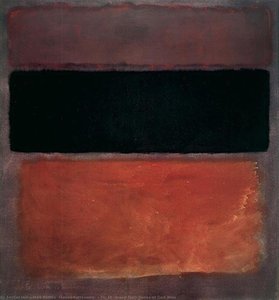
The composition is structured around a square format, measuring approximately 110 x 126 cm. A yellow background provides the foundation for the work, upon which a brown stripe runs horizontally through the center. This central band of muted brown and yellow hues is contained within a bold crimson stripe that borders the inner area. A red border surrounds the entire perimeter of the canvas, framing the internal color fields.
The palette relies on the interaction between these primary and earthy tones. The yellow and brown elements create a sense of depth through their tonal shifts, while the red border provides a sharp visual anchor. The arrangement of these blocks emphasizes the isolation of the central colors from the outer edge.
Technique and Artistic Method
This work exemplifies the Color Field technique, prioritizing the expressive power of color over representational imagery. The canvas is treated with a meticulous layering of thin washes of oil paint. These pigments, primarily yellow and brown, are applied in translucent layers that build a sense of depth. Through this slow process, the colors bleed into one another, creating an ethereal haze that softens the boundaries of the composition.
The edges of the colored shapes are blurred and soft, avoiding any sharp or defined outlines. This method allows the luminous rectangles to appear as if they are hovering within a shallow, breathing space. The interplay of these bleeding hues creates a velvety texture, where light seems to emanate from within the pigment itself rather than reflecting off the surface.
Related Works by Mark Rothko
The artist's evolution includes earlier explorations such as Mother and Child (1934) and The Pugilist. During his transition toward more abstract forms, he produced The High Priest in 1945. These works represent different stages of his engagement with subject matter before his mature period of color field painting.
Rothko's large-scale commissions often addressed specific environments. He created a series of paintings known as the Seagram murals. Additionally, he left fourteen paintings for the Rothko Chapel in Houston, Texas. These specific works in the chapel consist of varying shades of black.
Kérdések és válaszok
Untitled képe kézzel festett vagy nyomtatott?
Kézzel festve: egy képzett festő az Untitled című műet alkotást olajfestékkel vászonra másolja.
Mekkora méretet válasszak a Untitled című műhöz?
Az eredeti mű mérete 110 x 126 cm. A méretek 29.6 x 33.8 cm (Ft64564)-től 214.5 x 245.6 cm (Ft618201)-ig terjednek; az oldalon található táblázat tartalmazza a különböző átméretű lehetőségeket és azok árait.
Mennyi ideig tart a szállítás?
A szállítás 4-5 hetet vesz igénybe, ingyenes világszinten történő expressz szállítással; ezen az oldalon sürgősségi gyártási lehetőség is rendelkezésre áll. A termék 100 napon belül, bármely feltétel nélkül visszaküldhető a teljes összeg visszatérítéséért.
Milyen technikát/anyagot használt Mark Rothko a(z) Untitled című műhöz?
Oil On Canvas
Több információ erről a festményről
 Megtekintés

 Küldés
 Megosztás
 Részletek
 Információs lap


 Letöltés
 Hasonló darabok
 X-ray felvétel
 Diavetítés
 Kérdések és válaszok

 Statisztika