

 Előnézet
 Megosztás
 Megosztás
 Részletek
 Útmutató

 Letöltés
 Hasonló darabok
 X-ray felvétel
 Diavetítés
 Statisztika
New Planet


 Tovább olvasom
Giclée / Műnyomat
Múzeumi minőségű giclée vagy vászonnyomat, gyors gyártással és rugalmas finomítási lehetőségekkel. ( Kézzel festett másolat vásárlása Áttérés digitális képre)




P118B Ft10

P118H Ft10

P118W Ft10

P438Z Ft10

P508JH Ft12

P508YH Ft12

P805H Ft10

P805Z Ft10

P919BZ Ft10

P919G Ft10

P919XJ Ft10

P959ZH Ft10

P968JZ Ft12

W106C Ft8

W218G Ft10

W218JH Ft8

W218Y Ft10

W307PJ Ft10

W316G Ft10

W316PJ Ft8

W316Y Ft10

W398PJ Ft8

W4111J Ft10

W500HY Ft15

W500JH Ft15

W692G Ft12

W849H Ft8

W940BG Ft15

W953PJ Ft8




Válasszon előre meghatározott méreteink közül, amelyek megfelelnek a műalkotás eredeti arányainak.

Megadhat saját méreteket is egy konkrét kerethez vagy helyszínhez igazítva. Amennyiben a kiválasztott méret nem egyezik az eredeti kép arányokkal, a műalkotást le fogjuk vágni, vagy kiegészítjük a képet tükrözött vagy egyszínű szélekkel. A gyártás megkezdése előtt egy digitális tervezetet küldünk jóváhagyásra.
Kérjük, vegye figyelembe, hogy a képernyőn látható előnézet nem tükrözi a tényleges levágást vagy kiegészítést. Csak a tervezet mutatja pontosan a végső kompozíciót.
Bár az egyedi méretek is elérhetőek, az eredeti arányok megőrzése érdekében azt javasoljuk, hogy válasszon a előre meghatározott listából származó méretet.
Világszerte történő kiszállítás területére mindössze 2 hét alatt, a szokásos 4-5 hét helyett. (4 október)

Ingyenes globális expressz szállítás

Prémium minőségű len vászon

Teljes körű szállítási biztosítás

Vámvisszatérítési Garancia

Tökéletes színarányosság garancia

100 napos visszaküldési garancia (csak gyártási hibás termékek esetén)

100% pénzvisszatérítési garancia

Több darab vásárlásakor kedvezmény
 Az üvegkeretes opció csak 110 cm alatti méretben érhető el

New Planet
Giclée / Műnyomat
Reprodukció méretei
-


Összesített ár
Ft 24966
A Celestial Revolution: The Visionary World of Konstantin Yuon
In the wake of the profound political tremors that reshaped Russia in the early twentieth century, few artists captured the psychological landscape of a nation in flux as poignantly as Konstantin Yuon. His 1921 masterpiece, New Planet, stands as a breathtaking testament to this era of transformation. Originally conceived for the grand stage of the Bolshoi Theatre, this work transcends mere theatrical design to become a profound piece of Symbolist storytelling. The painting presents us with a cosmic event that is simultaneously celestial and deeply terrestrial, capturing the precise moment when an old world dissolves to make way for the unknown.
The composition is dominated by a colossal, radiant orb—a scarlet planet that pulses with intense heat and light. This celestial body, rendered in brilliant shades of yellow, orange, and deep crimson, serves as the painting's emotional heartbeat. As it emerges against a stark, dark blue void, it evokes a complex tapestry of human emotion: the awe of witnessing a miracle, the anxiety of facing an unpredictable future, and the fiery fervor of a revolution. To gaze upon this piece is to feel the heat of that rising sun, making it an arresting focal point for any collection dedicated to art that stirs the soul.
Symbolism and the Texture of Change
Beyond its visual splendor, New Planet is a dense thicket of symbolism. The scarlet planet is not merely an astronomical phenomenon; it is a metaphor for the revolutionary spirit that swept through Russia following the October Revolution of 1917. Yuon utilizes the language of Symbolism to represent the birth of a new era—a "new country" emerging from the shadows of the past. The vibrant, almost aggressive colors reflect the heat of political upheaval, suggesting a world being forged in fire.
Below this cosmic spectacle, the human element provides a grounded, poignant contrast. A group of figures is scattered across the lower canvas, their forms rendered in more subdued tones that allow the celestial light to take center stage. Some individuals appear to be gathered in collective anticipation, while others are fallen or retreating, mirroring the diverse and often conflicting reactions of a populace undergoing radical change. This interplay between the monumental heavens and the vulnerable human figures creates a dynamic tension that keeps the viewer's eye moving, searching for meaning within the glow.
A Masterclass in Color and Technique
Technically, Yuon demonstrates his mastery of both Impressionist light and Symbolist depth. Using tempera on canvas, he achieves a luminous quality that allows the oranges and yellows to appear as if they are truly radiating from within the work. His background in Impressionist landscape painting is evident in the way he handles light and atmosphere, yet he pushes these techniques toward something more spiritual and psychological. The contrast between the deep, nocturnal blues of the background and the incandescent warmth of the planet creates a dramatic chiaroscuro effect that is both visually striking and emotionally resonant.
For the discerning collector or interior designer, a high-quality reproduction of New Planet offers more than just decoration; it offers a window into a pivotal moment in art history. The painting’s scale and vibrant palette make it an ideal centerpiece for spaces that demand a sense of drama, intellect, and historical weight. Whether placed in a contemporary gallery setting or a classic study, Yuon's work continues to radiate the same energy and uncertainty that defined his era, inviting every viewer to contemplate their own place within the ever-changing cosmos of human history.
Gyakran Ismételt Kérdések
„New Planet”, Yuon Konstantin alkotása színei tel愈tek vagy fakók?
A „New Planet”, Yuon Konstantin alkotása színei Vivid Color telítettségűek. A telítettség azt mutatja meg, hogy a színek mennyire élénkek vagy fakók.
Milyen érzelmi hangulatot áraszt a „New Planet”, Yuon Konstantin alkotása?
A "New Planet" egy Dramatic érzetet kelt. Az érzelmi hangulat azt az impressziót írja le, amelyet a mű közvetít.
Használhatom az augmented reality technológiát, hogy megtekintsem a „New Planet”, Yuon Konstantin alkotása művet a saját szobámban?
A „New Planet”, Yuon Konstantin alkotása mű kedvező esetben megtekinthető a saját falán is a mű AR előnézet oldalán keresztül, az argementált valóság technológiájának alkalmazásával egy kompatibilis eszközön.
Hogyan találkoznak a korszak és a mű stílusa „New Planet”, Yuon Konstantin alkotása alkotásban?
A „New Planet” a Symbolism irányzat alkotása, készítője pedig a Modern kor korszakban tevékenykedett.
Mikor készült a "New Planet"?
A „New Planet”, Yuon Konstantin alkotása alkotásának éve 1921.
Mennyi volt Yuon Konstantin életkora, amikor a "New Planet" készült?
Yuon Konstantin 46 éves volt, amikor 1921 évben megalkotta a "New Planet" alkotást. A korúsítás az alkotó születési évéből, 1875 fel основании került kiszámítva.
Mely művészhez köthető a "New Planet"?
A "New Planet" alkotását Yuon Konstantin készítette. Az ezen az oldalon található információk Yuon Konstantin eredeti művészetét mutatják be.
A művész életrajza
Early Life and Artistic Foundations
Konstantin Fyodorovich Yuon, a name synonymous with the vibrant heart of Russian art, was born in Moscow on October 24, 1875. His lineage intertwined threads of Swiss-Russian heritage, a unique blend that subtly shaped his artistic perspective. His brother, Paul Juon, would later become a celebrated composer, suggesting an early exposure to creative currents within the family – a fertile ground for Konstantin’s own burgeoning talents. From a remarkably young age, Konstantin demonstrated a keen sensitivity to visual expression; his mother, recognizing this innate gift, nurtured it through dedicated artistic pursuits within their home. This formative environment laid the crucial groundwork for his formal education at the Moscow School of Painting, Sculpture and Architecture from 1892 to 1898. It was here, under the tutelage of distinguished masters such as Konstantin Savitsky and Konstantin Korovin, that he truly began to hone his craft, absorbing their techniques and philosophical approaches – a process that would profoundly influence the trajectory of his early work. These formative years weren’t confined solely to Moscow; Yuon embarked on extensive travels throughout Europe, particularly immersing himself in the burgeoning Impressionist movement in Paris. While undeniably captivated by artists like Camille Pissarro, he didn't simply mimic their style; instead, he skillfully synthesized these influences with a distinctly Russian sensibility, forging a unique artistic voice that resonated with both European innovation and national identity.From Symbolism to Socialist Realism
Yuon’s early artistic output is characterized by an evocative interplay of Impressionistic landscapes imbued with the subtle, haunting qualities of Symbolism. Paintings such as *To the Trinity* (1903) and *Tverskoy Boulevard* (1909) exemplify this period, capturing fleeting moments of light and atmosphere – not merely depicting scenes but conveying deeper emotional resonances. He wasn’t content to remain solely within the confines of Impressionism; Yuon began experimenting with lyrical landscapes that incorporated elements drawn from traditional Russian art forms—the delicate precision reminiscent of Palekh miniature painting and the spiritual depth echoing the iconography of ancient icons. This masterful fusion created a visual language entirely his own, deeply rooted in Russian national identity yet simultaneously open to embracing innovation and experimentation. However, the tumultuous political landscape of the early 20th century dramatically altered the course of Yuon’s artistic journey. As the Soviet era dawned, he found himself navigating the shifting demands of a new ideological framework. His style gradually evolved, reflecting this change—a deliberate shift towards a more academic approach that aligned with the tenets of Socialist Realism – a style prioritizing accessibility and serving as a powerful tool for disseminating revolutionary ideals. This transformation is powerfully illustrated in his monumental work *Parade on the Red Square on November 7, 1941*, a stirring patriotic depiction of Soviet strength during wartime—a testament to his ability to adapt while retaining his artistic integrity.Key Influences and Artistic Techniques
Yuon’s artistic development was profoundly shaped by a diverse range of influences. The teachings of Konstantin Savitsky and Konstantin Korovin at the Moscow School of Painting instilled in him a rigorous understanding of technique and composition, while his time spent in Paris exposed him to the revolutionary ideas of Impressionism. He particularly admired Camille Pissarro’s ability to capture fleeting moments of light and atmosphere, incorporating this skill into his own landscapes. Beyond these Western influences, Yuon drew inspiration from traditional Russian art forms—the intricate detail of Palekh miniature painting and the spiritual depth of icon artistry—weaving these elements into his own unique style. His brushwork was characterized by a remarkable sensitivity to color and light, often employing broken colors and subtle gradations to create a sense of atmosphere and movement. He possessed an exceptional ability to capture the essence of Russian landscapes – from the rolling hills of the countryside to the majestic beauty of the Ural Mountains—transforming them into evocative works of art that resonated with both local pride and universal appeal.Major Achievements and Institutional Roles
Konstantin Yuon’s contributions extended far beyond his artistic creations; he was a significant figure in the organization and administration of the Russian art world. He co-founded both the Union of Russian Artists and, later, the Association of Artists of Revolutionary Russia – actively shaping the direction of artistic expression during periods of profound social change. His administrative talents were further recognized through his leadership roles: he served as director of the Research Institute of the Academy of Arts (1948–1950) and, culminating in a distinguished career, became the First Secretary of the Union of Soviet Artists (1956–1958). These positions afforded him considerable influence over artistic policy and education, allowing him to champion his vision for Russian art. His dedication was acknowledged with prestigious accolades, including the Stalin Prize in 1943 and the Order of Lenin – solidifying his status as a national treasure.Legacy and Enduring Influence
Konstantin Yuon’s legacy is complex and profoundly significant—a testament to an artist who navigated turbulent times while remaining steadfastly committed to his craft. He stands as a pivotal figure in Russian art history, bridging the gap between the aesthetic sensibilities of the late 19th century and the ideological demands of the Soviet era. His early Symbolist landscapes possess a haunting beauty that continues to captivate viewers, while his later Socialist Realist works offer valuable insights into the artistic strategies employed by the Soviet regime. Today, Yuon’s paintings are held in prominent museum collections across Russia, including the Tretyakov Gallery and the Taganrog Art Museum—ensuring their accessibility for generations to come. His work remains a subject of study and celebration, a lasting tribute to a remarkable artist who indelibly shaped the cultural landscape of Russia.- Notable Works: New Planet, Bean Vine, Parade on the Red Square on November 7, 1941.
- Key Influences: Konstantin Savitsky, Konstantin Korovin, Valentin Serov, Camille Pissarro.
- Artistic Movements: Impressionism, Symbolism, Socialist Realism.

Yuon Konstantin
1875 - 1958 , Oroszország
Gyors információk
- Artistic Movement Or Style: Impressionista, Szimbolista, Szocialista
- Artists Or Movements Influenced By This Artist: ['Szimbolista']
- Artists Who Influenced This Artist:
- Savicseny Korovin
- Valentin Serov
- Camille Pissarro
- Date Of Birth: 1875. 10. 24.
- Date Of Death: 1958. 04. 11.
- Full Name: Konstantin Fyodorovich Yuon
- Nationality: Orosz
- Notable Artworks:
- Új bolygó
- Babérfa
- Vörös tér felvonulása
- Place Of Birth: Moszkva, Oroszország
Kapcsolódó cikkek

Mikhail Nesterov: Spiritual Quests & Symbolic Landscapes of Russian Symbolism
Explore the captivating world of Mikhail Nesterov, a pioneer of Russian Symbolism. Discover his spiritual themes, iconic paintings like 'The Hermit,' and lasting influence on Russian art history. Learn more at OriginalUniqueArt.
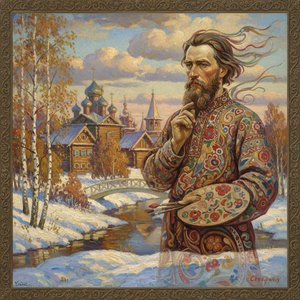
Igor Grabar: Bridging Impressionism & National Identity in Russian Modern Art
Explore the life & art of Igor Grabar, a pivotal figure in Russian Modernism. Discover his Impressionist landscapes, crucial role in art history, and legacy at the Tretyakov Gallery. A deep dive into a master painter & scholar.

Victor Vasnetsov: Myth, Nationalism & the Revival of Russian Fairy Tale Painting
Explore the captivating world of Victor Vasnetsov, a co-founder of Russian folklorist painting. Discover his iconic works, influence on national identity, and lasting legacy in this expert guide.

Vladimir Makovsky: Realism, Social Commentary & Russian Life in Late 19th-Century Painting
Explore the captivating world of Vladimir Makovsky, a leading Russian realist painter. Discover his insightful depictions of 19th-century life, social commentary & legacy with OriginalUniqueArt.

Ivan Bilibin: A Synthesis of Folklore, Modernism & National Identity in Russian Illustration
Explore the enchanting world of Ivan Bilibin, a master Russian illustrator who synthesized folklore, Art Nouveau & national identity. Discover his iconic fairy tale illustrations and legacy with OriginalUniqueArt.