
 Megtekintés
 Küldés
 Megosztás
 Részletek

 Letöltés
 Hasonló darabok
 X-ray felvétel
 Diavetítés
Allegory
 Oil On Canvas
- WallArt
- Dutch Golden Age
 1663
1663 116.0 x 97.0 cm
 Statens Museum for Kunst
 Összes részlet megjelenítése
Giclée / Műnyomat
Múzeumi minőségű giclée vagy vászonnyomat, gyors gyártással és rugalmas finomítási lehetőségekkel. ( Kézzel festett másolat rendelése Kép letöltése)




P118B $10

P118H $10

P118W $10

P438Z $10

P508JH $12

P508YH $12

P805H $10

P805Z $10

P919BZ $10

P919G $10

P919XJ $10

P959ZH $10

P968JZ $12

W106C $8

W218G $10

W218JH $8

W218Y $10

W307PJ $10

W316G $10

W316PJ $8

W316Y $10

W398PJ $8

W4111J $10

W500HY $15

W500JH $15

W692G $12

W849H $8

W940BG $15

W953PJ $8




Válasszon előre meghatározott méreteink közül, amelyek megfelelnek a műalkotás eredeti arányainak.

Megadhat saját méreteket is egy konkrét kerethez vagy helyszínhez igazítva. Amennyiben a kiválasztott méret nem egyezik az eredeti kép arányokkal, a műalkotást le fogjuk vágni, vagy kiegészítjük a képet tükrözött vagy egyszínű szélekkel. A gyártás megkezdése előtt egy digitális tervezetet küldünk jóváhagyásra.
Kérjük, vegye figyelembe, hogy a képernyőn látható előnézet nem tükrözi a tényleges levágást vagy kiegészítést. Csak a tervezet mutatja pontosan a végső kompozíciót.
Bár az egyedi méretek is elérhetőek, az eredeti arányok megőrzése érdekében azt javasoljuk, hogy válasszon a előre meghatározott listából származó méretet.
Világszerte történő kiszállítás területére mindössze 2 hét alatt, a szokásos 4-5 hét helyett. (13 augusztus)

Ingyenes globális expressz szállítás

Prémium minőségű len vászon

Teljes körű szállítási biztosítás

Vámvisszatérítési Garancia

Hiteles színpontosság garancia

60 napos visszaküldési lehetőség (csak hibás termékek esetén)

100% pénzvisszatérítési garancia

Több darab vásárlása esetén kedvezmény
 Az üvegkeretes opció csak 110 cm alatti méretben érhető el

Allegory
Giclée / Műnyomat
Reprodukció mérete
-


Összesített ár
$ 80
Gyűjthető leírása
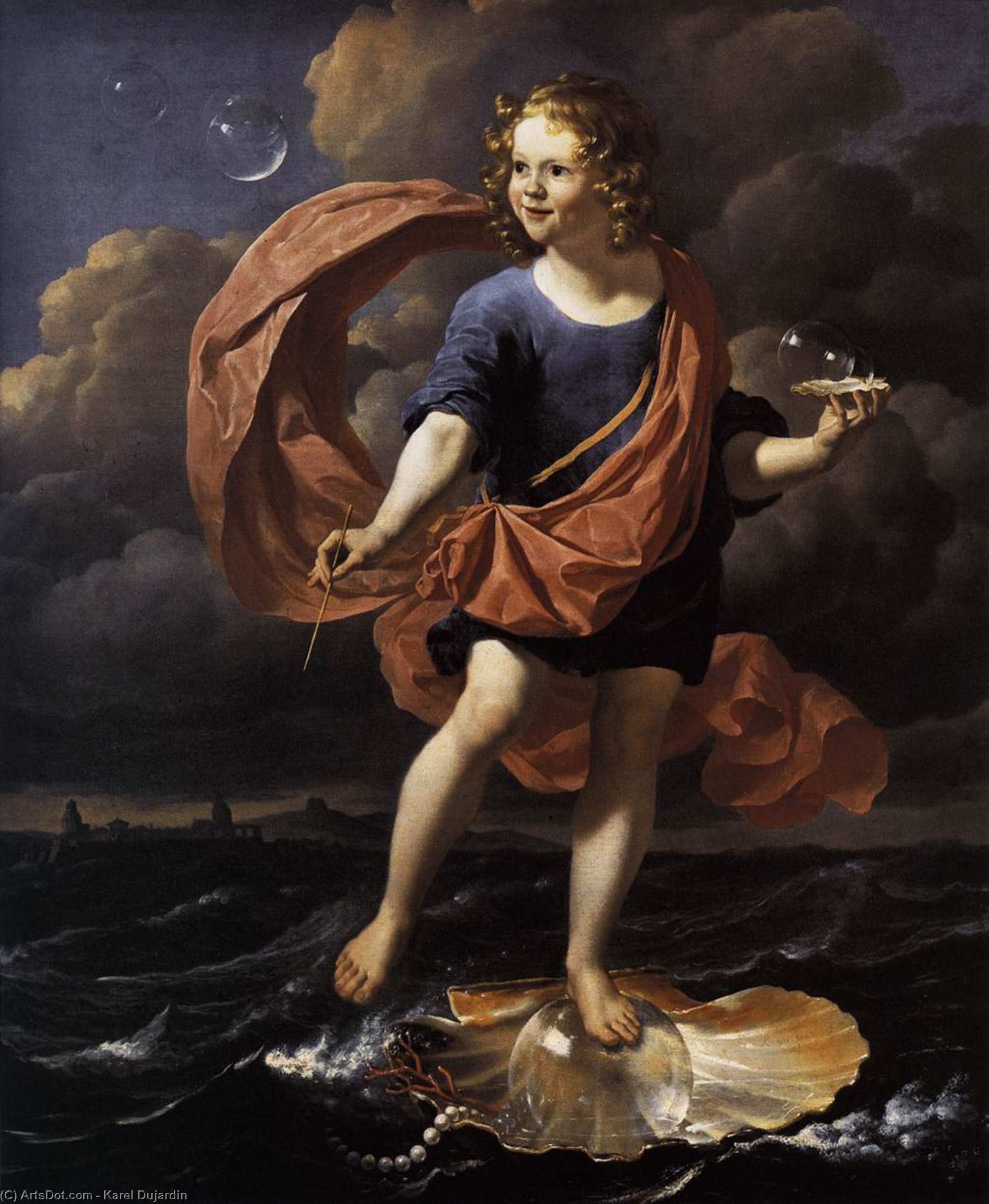
Karel Dujardin’s “Allegory”: A Fleeting Beauty Captured in Light
Karel Dujardin's "Allegory," painted in 1663, is more than just a picturesque scene; it’s a poignant meditation on the ephemeral nature of life and beauty. Born in Amsterdam during the height of the Dutch Golden Age, Dujardin was a master of capturing fleeting moments – particularly those involving light, animals, and idyllic landscapes. This particular work, housed within the National Gallery in London, exemplifies his signature style: a delicate balance between realism and idealized vision, imbued with a subtle melancholy that speaks to the transience of all things.
The painting depicts a young boy, dressed in a vibrant blue tunic and a flowing pink cloak, standing on the back of what appears to be a large sea creature – perhaps a whale or dolphin. He holds a small wand aloft, releasing a flurry of iridescent bubbles into the air. The backdrop is a hazy, cloudy sky, lending an atmospheric quality that enhances the sense of dreamlike serenity. Scattered throughout the scene are other figures, engaged in various activities—a woman tending to flowers, a man sailing a boat, and others enjoying the leisurely pace of life by the water’s edge. The inclusion of these secondary figures subtly underscores the central theme: a shared appreciation for beauty amidst the inevitable passage of time.
A Symbol of Transience: The Bubbles as Metaphor
At first glance, “Allegory” might seem simply a charming depiction of childhood play and a beautiful landscape. However, Dujardin deliberately employs symbolism to elevate the scene beyond mere representation. The bubbles themselves are the key to unlocking the painting’s deeper meaning. In 17th-century Dutch art, blowing bubbles was a well-established motif, representing the fleeting nature of life – much like the delicate spheres themselves. Each bubble rises briefly into the air before bursting, mirroring the transient beauty and joy that characterize human existence.
The boy’s posture—relaxed, almost carefree—suggests an acceptance of this ephemeral quality. He isn't striving to hold onto the bubbles; he simply enjoys their brief appearance. This mirrors a philosophical stance: embracing the present moment rather than clinging to illusions of permanence. The artist masterfully uses light and shadow to further emphasize this theme. The soft, diffused sunlight bathes the scene in a gentle glow, creating an atmosphere of tranquility while simultaneously reminding us that all beauty is ultimately subject to decay.
Dujardin’s Technique: Light, Color, and Detail
Dujardin's skill lies not only in his ability to capture a fleeting moment but also in his meticulous technique. He was known for his incredibly detailed renderings of animals and landscapes, often employing a technique called “grisaille,” where he would build up layers of thin paint to create subtle gradations of tone and texture. This is evident in the rendering of the sea creature’s skin, the delicate folds of the boy's clothing, and the shimmering surface of the bubbles themselves.
The color palette is restrained yet luminous—primarily blues, greens, and browns—creating a sense of harmony and balance. Dujardin expertly utilizes light to model forms and create depth, drawing the viewer’s eye into the scene. The subtle variations in tone suggest a mastery of chiaroscuro, a technique that employs strong contrasts between light and dark to heighten drama and create a sense of realism.
A Window into 17th-Century Dutch Life
"Allegory" offers a fascinating glimpse into 17th-century Dutch life. The scene is populated with figures engaged in typical activities—fishing, sailing, gardening—reflecting the prosperity and leisure enjoyed by many during this period. The inclusion of these everyday details grounds the allegorical theme in a tangible reality, making it all the more poignant. Dujardin’s work also reflects the influence of Italianate art, particularly the idealized landscapes favored by artists working in Rome at the time.
Today, “Allegory” remains a captivating masterpiece—a testament to Dujardin's artistic skill and his profound understanding of human nature. It serves as a beautiful reminder that even the most fleeting moments of beauty are worth cherishing, and that embracing the transience of life is an essential part of finding joy and fulfillment.
A művész életrajza
A Life Immersed in Light and Landscape
Karel Dujardin, a name resonating softly within the pantheon of Dutch Golden Age masters, was born in Amsterdam in 1626 – though some records suggest 1622. His life unfolded during a period of unprecedented artistic flourishing in the Netherlands, yet his path wasn’t one of immediate acclaim but rather a gradual unfolding of talent nurtured by careful study and extensive travel. Details surrounding his early years remain somewhat elusive, shrouded in the mists of time, however it is widely accepted that he received foundational training under Nicolaes Berchem, a painter celebrated for his idyllic landscapes populated with animals. This mentorship proved pivotal, instilling in Dujardin a deep appreciation for naturalism and a keen eye for capturing the subtle nuances of light and atmosphere. But Dujardin’s artistic journey wasn't confined to the studios of Amsterdam; he possessed an adventurous spirit that led him to Rome, where he became a member of the *Bentvueghels*, a society of predominantly Dutch and Flemish painters who embraced a bohemian lifestyle and often adopted satirical nicknames. In Rome, he was known as “Barba di Becco” or "Goat-Beard," a moniker likely referencing his distinctive facial hair, and it was here that his artistic voice truly began to mature.Early Training and Influences
Dujardin’s formative years were marked by an immersion in the artistic traditions of Amsterdam. He benefited from the tutelage of Nicolaes Berchem, whose landscapes—characterized by luminous skies and serene depictions of animals—served as a cornerstone for Dujardin's own stylistic development. This connection to Berchem instilled within him not only a profound understanding of compositional principles but also an unwavering commitment to capturing the ethereal beauty of natural light. Paulus Potter, another influential mentor, further honed Dujardin’s observational skills and fostered his fascination with animal studies—a preoccupation that would permeate much of his subsequent oeuvre. These early influences shaped Dujardin's artistic sensibility, establishing him firmly within the broader context of Dutch landscape painting and preparing him for the challenges and opportunities presented by his travels abroad.The Roman Period: Embracing Satire and Experimentation
Around 1646, Dujardin embarked on a transformative journey to Italy—a pivotal moment that irrevocably altered the trajectory of his artistic career. This expedition wasn’t merely a quest for inspiration; it was an active engagement with the intellectual and cultural currents of the Renaissance, fostering a spirit of experimentation and prompting him to broaden his artistic horizons. Joining the *Bentvueghels*, Dujardin immersed himself in the vibrant social milieu of Rome—a society populated by artists who championed unconventional ideas and often adopted whimsical nicknames as expressions of their personalities. It was here that he adopted “Barba di Becco,” a moniker reflecting his prominent beard, symbolizing both eccentricity and intellectual curiosity. This Roman experience fueled his artistic creativity and allowed him to synthesize Italianate aesthetics with Dutch genre painting traditions—resulting in works imbued with a distinctive blend of observation and imagination.Stylistic Characteristics: Light, Detail, and Everyday Life
Dujardin’s paintings are instantly recognizable for their meticulous attention to detail and their masterful manipulation of light—qualities that elevate them beyond mere representation into evocative explorations of mood and atmosphere. Like Berchem before him, Dujardin prioritized capturing the subtle interplay of sunlight and shadow, imbuing his canvases with a palpable warmth and realism. However, unlike many of his contemporaries who focused on grand historical narratives or mythological subjects, Dujardin turned his gaze inward—towards scenes of everyday life populated by ordinary people engaged in commonplace activities. His depictions of rural landscapes—featuring animals grazing peacefully under expansive skies—are particularly noteworthy for their serene beauty and harmonious portrayal of the human-animal relationship. Furthermore, he excelled at portraying interiors—often depicting domestic scenes bathed in soft light—demonstrating his versatility as an artist and solidifying his reputation as a master of genre painting.Notable Works and Legacy
Among Dujardin’s most celebrated paintings are *Woman Milking a Red Cow*, *Farm Animals in the Shade of a Tree*, *Rest at an Italian Inn*, *Self-Portrait (1662)*, and *The Regents of the Spinhuis and Nieuwe Werkhuis, Amsterdam*. Each piece exemplifies his artistic prowess—his ability to capture both technical precision and emotional resonance. These works stand as enduring monuments to Dutch Golden Age artistry, captivating audiences with their luminous landscapes and intimate portraits alike. Dujardin’s influence extended beyond his own lifetime, inspiring subsequent generations of painters who sought to emulate his stylistic innovations and embrace his humanist vision. He remains a testament to the transformative power of artistic exploration—a figure whose legacy continues to illuminate the rich tapestry of Dutch art history. His paintings are held in prestigious collections across Europe, ensuring that his remarkable talent and artistic sensibility will be remembered for centuries to come.
Karel Dujardin
1626 - 1678 , Holland
A művészről röviden
- Artistic Movement Or Style: Holland Aranykora
- Artists Who Influenced This Artist:
- Nicolaes Berchem
- Rembrandt van Rijn
- Date Of Birth: Szeptember 27, 1626
- Date Of Death: 1678
- Full Name: Karel Dujardin
- Nationality: Hollandi
- Notable Artworks:
- Nő tejjel önti egy vörös ököröt
- Állatok tájékában egy fa árnyékában
- Pihenés egy olasz vidéken
- Önismereti portré (1662)
- A Spinhuis és Új Épület kormányzói
- Place Of Birth: Amsterdam, Hollandia
Kapcsolódó cikkek

Golden Light & Dutch Skies: The Timeless Magic of Dutch Golden Age Landscapes
Discover the breathtaking beauty of Dutch Golden Age landscapes. Explore the mastery of light, chiaroscuro, and 17th-century realism through an expert art history lens, celebrating the enduring legacy of the Dutch Masters for discerning collectors and art lovers.

A Hollandi Aranykor 10 Mesterműve: Festmények, Amelyek Megváltoztatták a Világot | OriginalUniqueArt.com
Fedezze fel a Hollandi Aranykor 10 legikonikusabb műalkotását! Rembrandt, Vermeer és más mesterek festményeinek történeteit olvassa el. Barokk stílus, klasszikus művészet – inspirálódjon otthon dekorációjához a OriginalUniqueArt.com-on! Fedezze fel a teljes gyűjteményt online.

Golden Light & Dutch Skies: Bringing the Magic of Dutch Golden Age Landscapes into Your Home
Transform your home with the breathtaking light of Dutch Golden Age landscapes. Discover how hand-painted oil reproductions of masterworks like Ruisdael and Vermeer bring timeless elegance, atmosphere, and soulful texture to modern interiors. Elevate your space with museum-quality art.
Nicolaes Berchem: Dutch Golden Age Pastoralism & the Evolution of Landscape Painting
Explore the captivating world of Nicolaes Berchem, a leading Dutch Golden Age painter. Discover his idyllic landscapes, masterful technique & lasting influence on art history. Learn more at OriginalUniqueArt.
Charles Leickert: Capturing the Dutch Golden Age Light – A Comprehensive Study of Technique, Context, and Legacy
Explore the captivating winter landscapes of Charles Leickert, a master of Dutch Golden Age light & atmosphere. Discover his techniques, symbolism, and lasting legacy – a comprehensive study for art enthusiasts and collectors.


