Váltás nyomtatványra
 Összes részlet megjelenítése







































 A bármely oldalsó méretét túlszálaló 105 cm (kb. 41 hüvelyk) meghaladó műalkotások vagy reprodukciók esetében a keret összeszerelhető készletként, szétszerelve kerül szállításra. Ez a módszer biztosítja a biztonságos szállítást, és megakadályozza a szállítás során fellépő sérüléseket.


A Symphony of Fragments: Reimagining Reality in Juan Gris’s The Dice
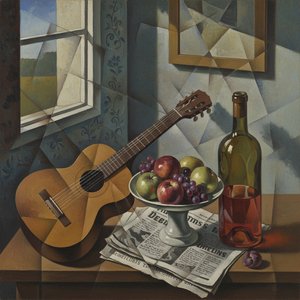
In the quiet, intellectual atmosphere of 1922, Juan Gris orchestrated a visual revolution that would forever alter our perception of the mundane. His masterpiece, The Dice, is far more than a mere arrangement of tabletop objects; it is a profound meditation on the architecture of sight. At first glance, the viewer encounters a familiar collection of elements—a book, dice, a glass, and an apple—yet these items are stripped of their traditional, naturalistic weight. Instead, they are reborn through the lens of Synthetic Cubism, where the boundaries between object and space begin to dissolve. Gris invites us into a world where reality is not something to be merely observed, but something to be reconstructed from the very essence of form and geometry.
The brilliance of this composition lies in its masterful deconstruction. Eschewing the soft, fleeting light of the Impressionists, Gris employs a rigorous, analytical approach inspired by the structural legacies of Cézanne. The artwork is a complex tapestry of overlapping planes, where sharp, angular lines and intersecting rectangles create a rhythmic, almost musical, tension. Each shape—be it a circle, triangle, or cube—is presented from multiple viewpoints simultaneously, challenging the eye to navigate a flattened yet deeply layered perspective. This technique does not merely depict objects; it captures their structural soul, presenting a multidimensional experience on a two-dimensional canvas.
The Poetics of Geometry and Symbolism
Beyond its technical prowess, The Dice breathes with a hidden symbolic life that resonates deeply with the contemplative viewer. The inclusion of dice introduces an element of chance and fate, suggesting the unpredictable nature of existence, while the apple serves as a timeless emblem of knowledge or temptation. These elements are woven into a muted, sophisticated color palette that emphasizes intellectual clarity over emotional excess. The interplay of light and shadow is used not to create realistic volume, but to define the edges of these geometric fragments, casting strong, directional shadows that anchor the composition within its own constructed reality.
For the discerning collector or interior designer, this piece offers an unparalleled sense of structural elegance and modern sophistication. The artwork’s restrained palette and disciplined form allow it to serve as a powerful focal point in any contemporary setting, providing a sense of historical depth and avant-garde prestige. To possess a high-quality reproduction of The Dice is to bring a piece of the Parisian avant-garde into one's personal sanctuary—a constant reminder of the beauty found in fragmentation and the enduring power of the analytical mind. It is an invitation to look closer, to find order within chaos, and to appreciate the profound artistry hidden within the simplest of arrangements.
Kérdések és válaszok
Milyen érzéssel párosítható a "The Dice"?
A "The Dice" egy Reflective érzetet kelt. Az érzelmi hangulat azt az impressziót írja le, amelyet a mű közvetít.
Hol tudok nyomtatványt vásárolni a(z) „The Dice”, Juan Gris alkotása alkotásból?
A "The Dice" minőségi giclée nyomat pamutvászonon vagy archiváló vászonpapíron formátumban is elérhető. A rendelést a Művészeti nyomtatvány oldalon lehet megtenni, a kívánt méretben.
Hol vásárolható „The Dice”, Juan Gris alkotása kézzel festett másolata?
A „The Dice”, Juan Gris alkotása kézzel festett másolataival a ez a weboldal oldalon találkozhat, kézzel festett olajfesték reprodukció lino vászonon formában, melyet a(z) Kézzel festett másolat oldalon lehet megrendelni.
Több információ erről a festményről
 Megtekintés
 Küldés
 Megosztás
 Részletek
 Útmutató

 Letöltés
 Hasonló darabok
 X-ray felvétel
 Diavetítés
 Kérdések és válaszok
 Statisztika