Váltás nyomtatványra
 Összes részlet megjelenítése







































 A bármely oldalsó méretét túlszálaló 105 cm (kb. 41 hüvelyk) meghaladó műalkotások vagy reprodukciók esetében a keret összeszerelhető készletként, szétszerelve kerül szállításra. Ez a módszer biztosítja a biztonságos szállítást, és megakadályozza a szállítás során fellépő sérüléseket.


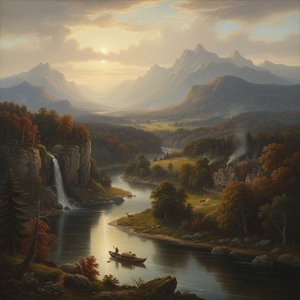
A Serene Vision of the Hudson Valley: John Frederick Kensett’s “Hudson River Scene”
John Frederick Kensett's "Hudson River Scene," painted in 1857, isn’t merely a landscape; it’s a carefully constructed meditation on light, tranquility, and the sublime beauty of the American wilderness. Belonging to the illustrious Hudson River School, a movement that profoundly shaped the course of American art, this painting embodies the core tenets of Luminism – an approach prioritizing atmospheric effects and subtle tonal variations over dramatic detail. Kensett, deeply influenced by the Romantic ideals of his time, sought not to represent nature as it *is*, but rather as it *feels*—a source of profound spiritual resonance.
The scene unfolds along the banks of the Hudson River, a quintessential vista of the New York countryside. Rolling hills, draped in a soft, hazy blue, recede into the distance, their contours softened by atmospheric perspective. A meandering river reflects the muted light of the sky, creating an illusion of infinite depth and mirroring the serenity above. Two figures, rendered with remarkable delicacy, are positioned near the center of the composition, suggesting a quiet moment of contemplation amidst this idyllic setting. Their presence isn’t intrusive; rather, they serve to anchor the viewer in the scene, inviting us to share their peaceful observation.
The Language of Light and Color
Kensett's mastery lies not just in his depiction of the landscape but also in his innovative use of color. He eschewed the bold, vibrant hues favored by some of his contemporaries, opting instead for a palette dominated by cool blues, greens, and grays. This restrained approach creates a sense of stillness and quietude, emphasizing the subtle shifts in light and shadow. The artist’s brushwork is remarkably delicate—almost invisible—allowing the colors to blend seamlessly into one another, mimicking the hazy atmosphere of a summer afternoon. He employed a technique known as “broken color,” applying thin layers of paint that refract light and create shimmering effects, particularly noticeable in the water and sky.
The painting’s luminosity – its ability to seem to glow from within – is a hallmark of Luminism. Kensett meticulously studied the way light interacts with different surfaces, capturing the ephemeral quality of sunlight filtering through trees or reflecting off the river's surface. This pursuit of atmospheric effects was deeply influenced by his travels in Europe, particularly his admiration for the Dutch Masters who excelled at depicting light and shadow.
A Reflection of Transcendentalist Ideals
"Hudson River Scene" is inextricably linked to the broader philosophical currents of the mid-19th century. The Hudson River School artists, including Kensett, were deeply influenced by the Transcendentalist movement, which emphasized the inherent goodness of humanity and the importance of connecting with nature. For these artists, the landscape wasn’t simply a picturesque backdrop; it was a conduit to spiritual truth. Kensett's paintings, like this one, aim to evoke a sense of awe and wonder, prompting viewers to contemplate their place within the vastness of the natural world.
The inclusion of the two figures adds another layer of meaning. They represent humanity’s ability to find solace and connection in nature—a theme central to Transcendentalist thought. Their quiet contemplation suggests a harmonious relationship between humans and the environment, reflecting an ideal of balance and serenity.
Collecting a Legacy: Reproduction and Beyond
Reproductions of “Hudson River Scene” offer a remarkable opportunity to bring this timeless masterpiece into your home or office. OriginalUniqueArt’s hand-painted reproductions meticulously recreate Kensett's delicate brushwork and nuanced color palette, capturing the essence of his original vision. Whether you seek an authentic work of art or a high-quality reproduction that evokes the spirit of the Hudson River School, this painting remains a powerful symbol of American landscape artistry and its enduring appeal.
Consider how this serene scene can complement your interior design—bringing a touch of tranquility and natural beauty to any space. The subtle colors and atmospheric effects create a calming atmosphere, perfect for relaxation or contemplation. “Hudson River Scene” is more than just a painting; it’s an invitation to connect with the timeless allure of the American wilderness.
Kérdések és válaszok
Mennyire intenzívek a „Hudson River Scene”, John Frederick Kensett alkotása színei?
A „Hudson River Scene”, John Frederick Kensett alkotása Balanced szín intenzitással rendelkezik.
Szabadon reprodukálható-e a/az „Hudson River Scene”, John Frederick Kensett alkotása képe?
A „Hudson River Scene”, John Frederick Kensett alkotása szerzői jogi státusza: a mű közösségi tulajdon – a szerzői jog lejártt. Ez határozza meg, hogy a kép másolatai szabadon készíthetők-e.
Hol találhatók statisztikák a(z) „Hudson River Scene”, John Frederick Kensett alkotása kapcsán?
A „Hudson River Scene”, John Frederick Kensett alkotása statisztikái a mű Statisztikák oldalán érhetőek el: a mű havi látogatottsága, a művész alkotásainak megtekintése, valamint a legutóbbi látogatók országos és nyelvi lebontása.
 Megtekintés
 Küldés
 Megosztás
 Részletek
 Útmutató

 Letöltés
 Hasonló darabok
 X-ray felvétel
 Diavetítés
 Q&A
Q&A Statisztika